
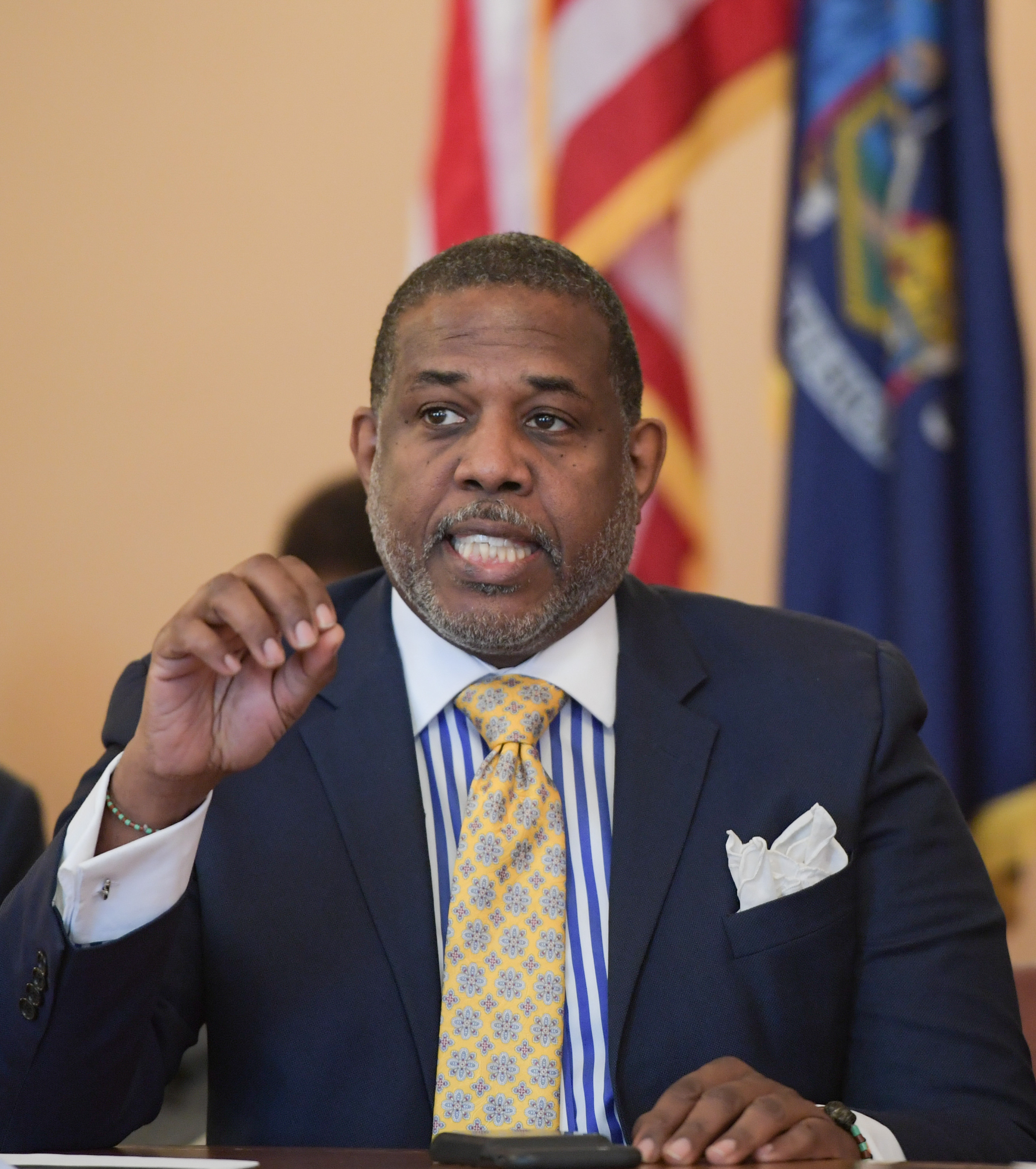
Serving · State Senate · New York
Kevin Parker
State Senator · New York · District 21 · Democratic/Working Families
Kevin Parker serves as a State Senator in the New York State Senate, representing District 21 for the Democratic/Working Families party. The page below collects sourced biographical facts, the seat and district served, and provenance for Parker.
Key facts
- Full name
- Kevin Parker
- Office
- State Senator
- Chamber
- New York State Senate
- State
- New York
- District
- District 21
- Party
- Democratic/Working Families
- Status
- Currently serving
- Born
- 1967
- OpenStates ID
- ocd-person/dbf73f29-d4ce-4192-b8fe-42b3ac538dda
- Dataset version
- 1.20260609
Biographical narrative
855 words · sourced from the Wikipedia REST extract
Kevin Parker is an American politician currently serving as a member of the New York State Senate, representing the 21st district. A member of the Democratic Party and the Working Families Party, Parker has held this office since his election in 2002. His district encompasses various neighborhoods in Brooklyn, including Flatbush, East Flatbush, Kensington, Ditmas Park, Midwood, Flatlands, Canarsie, Georgetown, Old Mill Basin, Mill Basin, Bergen Beach, and Marine Park. Over the years, Parker has been involved in several legislative initiatives and has faced challenges during his tenure.
Early life and career
Kevin Parker was born on March 6, 1967, to Sonie and Georgie Parker. He grew up in Brooklyn, where he attended several local schools, including P.S. 193, Andries Hudde I.S. 240, and Midwood High School. Following his secondary education, Parker pursued higher education, earning a Bachelor of Science degree in Public Service from Penn State University. He furthered his studies by obtaining a Master of Science degree in Urban Policy and Management from the New School for Social Research.
Before entering elected office, Parker gained experience in public service through various roles. He worked as a special assistant to New York State Comptroller H. Carl McCall, where he was involved in financial oversight and policy development. Additionally, Parker served as a New York City Urban Fellow under Manhattan Borough President Ruth Messinger, where he contributed to urban policy initiatives and community engagement efforts.
In 2001, Parker sought to enter the political arena by running in the Democratic primary for New York City Council District 45. Despite his efforts, he did not secure a nomination, finishing fifth in the primary with a notable percentage of the vote. This experience, however, laid the groundwork for his future political endeavors.
Legislative service
Parker's political career took a significant turn in 2002 when he successfully ran for the New York State Senate. In a competitive Democratic primary, he defeated former City Councilman Noach Dear for a newly drawn Senate seat. Following his primary victory, Parker won the general election, marking the beginning of his long tenure in the state legislature.
Throughout his time in the Senate, Parker has faced various electoral challenges. In 2008, he defended his seat against strong competition from fellow Democrats, including New York City Councilmembers Simcha Felder and Kendall Stewart. Despite not receiving an outright majority, Parker emerged victorious in the primary. More recently, in 2022, he faced a primary challenge from David Alexis, a candidate affiliated with the Democratic Socialists of America. Parker won this contest, securing his position for another term.
Parker's tenure has not been without controversy. In April 2010, during a confirmation hearing for a nominee to the New York State Power Authority, Parker became embroiled in a heated exchange with Republican Senator John DeFrancisco. His remarks during this incident drew significant media attention and criticism, leading to discussions about his conduct in the Senate.
In June 2011, Parker voted in favor of the Marriage Equality Act, a landmark piece of legislation that legalized same-sex marriage in New York. However, he expressed frustration during the proceedings, feeling that he was not given an opportunity to speak on the bill. This incident further highlighted the complexities of his legislative approach.
After the Democratic Party regained control of the Senate in 2018, Parker was appointed Chair of the Committee on Energy and Telecommunications. This role allowed him to influence energy policy and telecommunications regulations in New York State.
Parker's interactions on social media have also attracted attention. In December 2018, he faced backlash for a tweet responding to a Republican staffer about an illegally parked vehicle associated with him. His response was widely criticized, prompting an apology, although no formal disciplinary action was taken against him.
Policy focus and district
Parker's legislative priorities have included a range of social and public policy issues. He has been an advocate for reproductive rights, voting in favor of the Reproductive Health Act, which expanded access to reproductive health services in New York. His commitment to public health is further evidenced by his sponsorship of a bill that recognized racism as a public health crisis, reflecting his focus on addressing systemic inequalities.
In response to public safety concerns, Parker sponsored legislation aimed at banning undetectable firearms, which was signed into law in July 2019. He also played a role in protecting utility customers during emergencies by sponsoring a bill that prohibited service shut-offs during the COVID-19 pandemic and other states of emergency.
Parker's efforts to recognize significant historical events include sponsoring a bill that established Juneteenth as an official state holiday in New York. This legislation commemorates the emancipation of enslaved individuals in the United States and reflects Parker's commitment to acknowledging and addressing historical injustices.
As of March 2026, Parker serves as the Senate's senior assistant majority leader, a position that underscores his influence within the legislative body. His district, Senate District 21, is characterized by its diverse neighborhoods, each with unique needs and challenges. Parker's legislative work continues to focus on issues pertinent to his constituents, as he navigates the complexities of state governance and public policy in New York.
Notable legislation
Sponsored and co-sponsored legislation for Kevin Parker is pending operator curation. The biographical narrative above carries the same provenance trail until per-bill rows are written.
Sources
- [1]https://en.wikipedia.org/wiki/Kevin_Parker_(New_York_politician)Wikipedia · retrieved 2026-06-09
Notable quotes
Sourced quotes for Kevin Parker are pending operator curation. Narrative-scope provenance remains attached below.
Sources
- [1]https://en.wikipedia.org/wiki/Kevin_Parker_(New_York_politician)Wikipedia · retrieved 2026-06-09
Key positions
Curated policy positions for Kevin Parker are pending operator review. The biographical narrative above carries the same provenance trail until per-topic positions are written.
Sources
- [1]https://en.wikipedia.org/wiki/Kevin_Parker_(New_York_politician)Wikipedia · retrieved 2026-06-09
Legislative service
- New York State SenateDistrict 21 · Democratic/Working Families
Sources & provenance
Every attributable claim above carries a per-section [N] marker that resolves to the corresponding URL below. Each entry records the upstream provider, the canonical URL, and the timestamp at which the source was retrieved by the ingest pipeline.
Key facts
- https://openstates.org/person/kevin-parker-6h4JK6eKW57oIftFOHUIDC/openstates · retrieved 2026-06-09
- https://ballotpedia.org/Kevin_Parker_(New_York)ballotpedia · retrieved 2026-06-09
- https://www.nysenate.gov/senators-committeesofficial · retrieved 2026-06-09
Biographical narrative
- https://en.wikipedia.org/wiki/Kevin_Parker_(New_York_politician)wikipedia · retrieved 2026-06-09
Explore the State Senate
Browse New York’s District 21 seat, the full New York State Senate roster, or New York’s federal candidates.
Related on The Candidate
- New York District 21Every member representing District 21 in the New York State Senate.Open
- New York State SenateThe full roster of the New York State Senate, by district.Open
- New York legislatureBoth chambers of the New York state legislature.Open
- New York federal candidatesEvery 2026 federal House and Senate candidate in New York.Open