
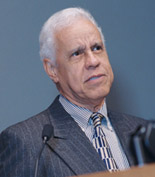
Former · State Senate · Virginia
Douglas Wilder
Former State Senator · Virginia · District 9 · Independent
Douglas Wilder served as a State Senator in the Virginia State Senate, representing District 9 for the Independent party. The page below collects sourced biographical facts, the seat and district served, and provenance for Wilder.
Key facts
- Full name
- Douglas Wilder
- Office
- State Senator
- Chamber
- Virginia State Senate
- State
- Virginia
- District
- District 9
- Party
- Independent
- Status
- Left office
- Born
- 1931
- OpenStates ID
- —
- Dataset version
- 1.20260610
Biographical narrative
863 words · sourced from the Wikipedia REST extract
Lawrence Douglas Wilder is a prominent American lawyer and politician who served as a member of the Virginia State Senate for District 9 from 1970 to 1986. An influential figure in Virginia's political landscape, he is known for his historic role as the first African American governor of Virginia and the first African American elected as governor of any U.S. state since the Reconstruction era. Wilder's political career is marked by his transition from a state legislator to a statewide elected official, culminating in his tenure as governor from 1990 to 1994. In addition to his political endeavors, he has also contributed to academia as a professor at the Wilder School at Virginia Commonwealth University.
Early life and career
Douglas Wilder was born on January 17, 1931, in the Church Hill neighborhood of Richmond, Virginia, a region characterized by its segregation during his formative years. He was the son of Beulah Olive Richards and Robert Judson Wilder, and he is a descendant of enslaved individuals, with his paternal grandparents having been enslaved in Goochland County. As the seventh of eight siblings, Wilder's upbringing was shaped by the experiences of his family, who navigated the challenges of life during the Great Depression. Although they were never entirely impoverished, Wilder described his childhood as one of "gentle poverty."
Wilder completed his secondary education at Armstrong High School in 1947, where he shared the classroom with notable individuals, including dancer and choreographer Nat Horne. He then pursued higher education at Virginia Union University, a historically black institution, where he worked various jobs, including waiting tables and shining shoes, to finance his studies. He graduated in 1951 with a degree in chemistry.
Following his graduation, Wilder was drafted into the United States Army during the Korean War. He volunteered for combat duty and participated in significant battles, including the Battle of Pork Chop Hill, where he and his comrades managed to capture enemy soldiers, an act for which he was awarded the Bronze Star Medal. After his discharge in 1953, he briefly worked in the state medical examiner's office while pursuing a master's degree in chemistry. However, in 1956, he shifted his career trajectory and enrolled at Howard University Law School, graduating in 1959.
After establishing a law practice in Richmond, Wilder married Eunice Montgomery in 1958. The couple had three children—Lynn Diana, Lawrence Douglas Jr., and Loren Deane—before their divorce in 1978.
Legislative service
Wilder's political career began in earnest when he joined the Democratic Party and won a special election in 1969 to represent a Richmond-area district in the Virginia State Senate. His election marked a significant milestone, as he became the first African American to serve in the Virginia Senate since the Reconstruction era. Following a redistricting in 1970, Wilder found himself representing a predominantly African American constituency, which positioned him as a liberal voice within a largely conservative and white-majority legislative body.
During his time in the Senate, Wilder became known for his advocacy on various issues, navigating the complexities of a political landscape that often resisted progressive change. He briefly considered an independent run for the United States Senate in 1982, motivated by a disagreement with a fellow Democratic candidate's homage to a political organization that had historically opposed racial integration. This moment highlighted Wilder's commitment to addressing racial issues within the political arena.
In 1985, Wilder was elected as the 35th Lieutenant Governor of Virginia, serving alongside the Democratic gubernatorial candidate Gerald L. Baliles. This election was historic as Wilder became the first African American to win a statewide office in Virginia. His campaign strategy included extensive outreach to Virginia's predominantly rural areas, which helped him gain recognition and support from a broader electorate.
Policy focus and district
Throughout his legislative career, Wilder focused on a range of policy issues that reflected the needs and interests of his constituents. His tenure in the Virginia Senate was characterized by efforts to promote civil rights, education, and social justice, aligning with the broader goals of the Democratic Party during that era. Wilder's ability to navigate the complexities of a conservative legislature while advocating for progressive policies demonstrated his political acumen and commitment to his constituents.
Wilder's district, which became predominantly African American after the 1970 redistricting, provided him with a unique platform to address the concerns of his community. He worked to ensure that the voices of African American constituents were heard in the legislative process, advocating for policies that aimed to improve their social and economic conditions. His experiences as a member of a historically marginalized group informed his approach to governance and policy-making.
After leaving the Virginia Senate in 1986, Wilder continued to engage in public service and politics, ultimately leading to his election as governor in 1989. His governorship further solidified his legacy as a trailblazer in Virginia's political history. Wilder's journey from a state legislator to the highest office in Virginia exemplifies his dedication to public service and his impact on the state's political landscape. Following his tenure as governor, he remained active in various capacities, including academia and community service, further contributing to the discourse on civil rights and social justice in the United States.
Notable legislation
Sponsored and co-sponsored legislation for Douglas Wilder is pending operator curation. The biographical narrative above carries the same provenance trail until per-bill rows are written.
Sources
- [1]https://en.wikipedia.org/wiki/Douglas_WilderWikipedia · retrieved 2026-06-10
Notable quotes
Sourced quotes for Douglas Wilder are pending operator curation. Narrative-scope provenance remains attached below.
Sources
- [1]https://en.wikipedia.org/wiki/Douglas_WilderWikipedia · retrieved 2026-06-10
Key positions
Curated policy positions for Douglas Wilder are pending operator review. The biographical narrative above carries the same provenance trail until per-topic positions are written.
Sources
- [1]https://en.wikipedia.org/wiki/Douglas_WilderWikipedia · retrieved 2026-06-10
Legislative service
- Virginia State Senate1970–1986District 9 · Independent
Sources & provenance
Every attributable claim above carries a per-section [N] marker that resolves to the corresponding URL below. Each entry records the upstream provider, the canonical URL, and the timestamp at which the source was retrieved by the ingest pipeline.
Key facts
- https://www.wikidata.org/wiki/Q881154wikidata · retrieved 2026-06-10
- https://ballotpedia.org/Douglas_Wilderballotpedia · retrieved 2026-06-10
Biographical narrative
- https://en.wikipedia.org/wiki/Douglas_Wilderwikipedia · retrieved 2026-06-10
Explore the State Senate
Browse Virginia’s District 9 seat, the full Virginia State Senate roster, or Virginia’s federal candidates.
Related on The Candidate
- Virginia District 9Every member representing District 9 in the Virginia State Senate.Open
- Virginia State SenateThe full roster of the Virginia State Senate, by district.Open
- Virginia legislatureBoth chambers of the Virginia state legislature.Open
- Virginia federal candidatesEvery 2026 federal House and Senate candidate in Virginia.Open