
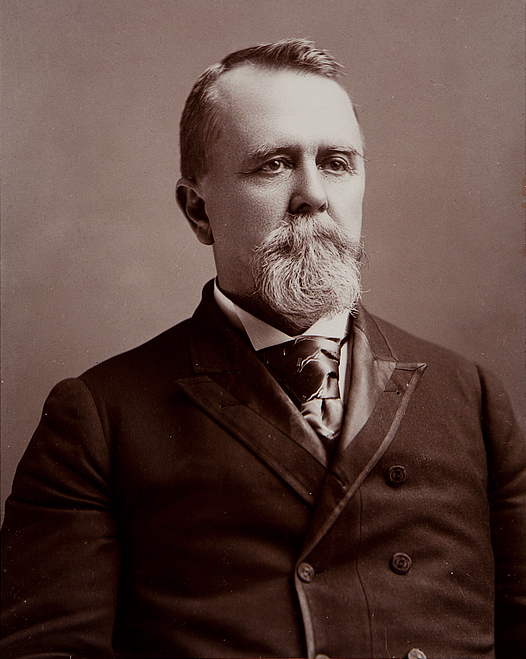
Historical · U.S. House · Alabama · District 2
Hilary Herbert
Former U.S. Representative · Alabama District 2 · 1877–1893 · Democratic
Hilary Herbert represented Alabama's District 2 in the United States House of Representatives (1877–1893) for the Democratic party. The page below collects sourced biographical facts, term history, committee roles, and provenance for Herbert.
Bioguide ID: H000524
Key facts
- Full name
- Hilary Herbert
- State
- Alabama
- District
- District 2
- Party
- Democratic
- House service
- 1877–1893
- First House term
- 1877
- Status
- Left office
- Current term ends
- —
- Born
- 1834
- Bioguide ID
- H000524
- Committee assignments
- —
- Dataset version
- 1.20260606
Biographical narrative
910 words · sourced from the Wikipedia REST extract
Hilary Abner Herbert was a prominent American politician and lawyer who served as a U.S. Representative from Alabama and later as Secretary of the Navy under President Grover Cleveland. Born on March 12, 1834, in Laurensville, South Carolina, Herbert's career spanned significant periods in American history, including the Civil War and the post-war Reconstruction era. His legislative contributions, particularly in naval affairs, and his controversial views on race and suffrage marked his time in public office. Herbert's tenure in the U.S. House of Representatives lasted from 1877 until 1893, during which he was known for his leadership in naval appropriations and his opposition to the Reconstruction Acts.
Early life and career
Hilary Abner Herbert was born in Laurensville, South Carolina, and moved with his family to Greenville, Alabama, in 1846. His education took place at the University of Alabama and the University of Virginia, where he became a member of the Delta Kappa Epsilon fraternity. After completing his studies, Herbert began practicing law in Greenville, establishing a legal career that would be interrupted by the Civil War.
With the onset of the Civil War, Herbert joined the Confederate Army, initially serving as a second lieutenant. He quickly rose through the ranks, becoming captain of the Greenville Guards and later attaining the rank of colonel in the Eighth Regiment, Alabama Infantry. Herbert's military service included participation in significant battles, and he was wounded at the Battle of the Wilderness on May 6, 1864. Following the war, he returned to his law practice in Greenville, where he resumed his legal career and began to engage more actively in politics.
House tenure
Herbert's political career began in earnest when he was elected to the United States House of Representatives in 1877, representing Alabama's 2nd congressional district as a member of the Democratic Party. Over the course of his eight terms in office, he became a notable figure in Congress, particularly in matters related to naval affairs. His role as chairman of the Committee on Naval Affairs was pivotal, as he advocated for increased appropriations that contributed to the revival of the United States Navy during a time when naval power was becoming increasingly important.
Despite his leadership in naval appropriations, Herbert held a more conservative view compared to some of his contemporaries. He opposed the expansive naval program proposed by Secretary of the Navy Benjamin F. Tracy in 1890, which called for the construction of a large fleet, including 40 battleships. Instead, Herbert supported a more limited naval expansion, resulting in the authorization of only four battleships during his tenure. His views were influenced by the naval strategies of Captain Alfred Thayer Mahan, who advocated for a strong navy capable of offensive operations.
In addition to his work on naval affairs, Herbert was involved in various legislative initiatives and was known for his contentious relationship with certain scientific communities. He led efforts to reduce funding for the United States Geological Survey, which resulted in a public dispute with paleontologist Othniel Charles Marsh. This conflict highlighted the tensions between scientific advancement and political priorities during Herbert's time in Congress.
Herbert's congressional career was also marked by his outspoken opposition to the Reconstruction Acts, which aimed to provide civil rights and suffrage to African Americans following the Civil War. He publicly articulated his belief that African Americans were unfit for such rights, a stance that reflected the prevailing racial attitudes of the time. His views on race and suffrage were controversial and have been a point of discussion among historians examining his legacy.
Legislative focus and committees
During his time in the House of Representatives, Herbert's primary focus was on naval affairs, where he played a crucial role in shaping the direction of U.S. naval policy. As chairman of the Committee on Naval Affairs, he was instrumental in advocating for the modernization and expansion of the Navy, which was seen as essential for national security and international standing. His efforts contributed to a revival of naval strength in the late 19th century, a period marked by increasing competition among global powers.
Herbert's legislative agenda was not limited to naval issues; he was also involved in broader discussions about government funding and scientific research. His push to cut funding for the United States Geological Survey illustrated his willingness to engage in contentious debates over federal spending priorities. This particular conflict with Marsh brought attention to the intersection of science and politics, as well as the challenges faced by scientific institutions in securing government support.
In 1893, Herbert's political career transitioned when he was appointed Secretary of the Navy by President Grover Cleveland. In this role, he was able to further influence naval policy and appropriations, aligning more closely with the ideas of Mahan regarding naval strategy. His tenure as Secretary of the Navy was characterized by efforts to prepare the fleet for potential conflicts, notably the Spanish-American War, which occurred shortly after he left office.
After leaving the Cabinet in 1897, Herbert returned to his legal practice in Washington, D.C., where he continued to work until his death on March 6, 1919, just days before his 85th birthday. His legacy includes his contributions to naval policy and the complexities of his political views, particularly regarding race and civil rights. Herbert's life and career reflect the broader historical currents of his time, including the challenges of Reconstruction, the evolution of American naval power, and the contentious debates surrounding civil rights in the United States.
Notable legislation
Sponsored and co-sponsored legislation for Hilary Herbert is pending operator curation. The biographical narrative above carries the same provenance trail until per-bill rows are written.
Sources
- [1]https://en.wikipedia.org/wiki/Hilary_A._HerbertWikipedia · retrieved 2026-06-06
Notable quotes
Sourced quotes for Hilary Herbert are pending operator curation. Narrative-scope provenance remains attached below.
Sources
- [1]https://en.wikipedia.org/wiki/Hilary_A._HerbertWikipedia · retrieved 2026-06-06
Key positions
Curated policy positions for Hilary Herbert are pending operator review. The biographical narrative above carries the same provenance trail until per-topic positions are written.
Sources
- [1]https://en.wikipedia.org/wiki/Hilary_A._HerbertWikipedia · retrieved 2026-06-06
Terms served
- 1877–1879U.S. House · Term 1 · Democratic
- 1879–1881U.S. House · Term 2 · Democratic
- 1881–1883U.S. House · Term 3 · Democratic
- 1883–1885U.S. House · Term 4 · Democratic
- 1885–1887U.S. House · Term 5 · Democratic
- 1887–1889U.S. House · Term 6 · Democratic
- 1889–1891U.S. House · Term 7 · Democratic
- 1891–1893U.S. House · Term 8 · Democratic
Sources & provenance
Every attributable claim above carries a per-section [N] marker that resolves to the corresponding URL below. Each entry records the upstream provider, the canonical URL, and the timestamp at which the source was retrieved by the ingest pipeline.
Key facts
- https://bioguide.congress.gov/search/bio/H000524bioguide · retrieved 2026-06-06
- https://www.govtrack.us/congress/members/405387govtrack · retrieved 2026-06-06
Biographical narrative
- https://en.wikipedia.org/wiki/Hilary_A._Herbertwikipedia · retrieved 2026-06-06
Find your representative
Every U.S. state elects representatives by district. Browse Alabama’s delegation, the full former-representative roster, or explore the role and term length.
Related on The Candidate
- Preceded by James RapierEarlier holder of the Alabama District 2 House seat · Republican.Open
- Succeeded by Jesse StallingsLater holder of the Alabama District 2 House seat · Democratic.Open
- Alfred BuckFormer U.S. Representative · Alabama District 1 · RepublicanOpen
- Benjamin TurnerFormer U.S. Representative · Alabama District 1 · RepublicanOpen
- Bradley ByrneFormer U.S. Representative · Alabama District 1 · RepublicanOpen
- Edmund DarganFormer U.S. Representative · Alabama District 1 · DemocraticOpen