
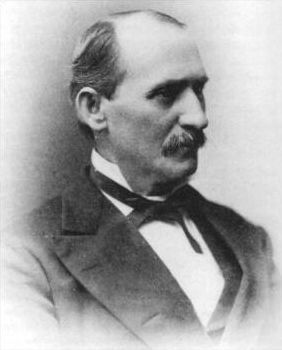
Historical · U.S. House · Alabama · District 4
Charles Shelley
Former U.S. Representative · Alabama District 4 · 1877–1885 · Democratic
Charles Shelley represented Alabama's District 4 in the United States House of Representatives (1877–1885) for the Democratic party. The page below collects sourced biographical facts, term history, committee roles, and provenance for Shelley.
Bioguide ID: S000326
Key facts
- Full name
- Charles Shelley
- State
- Alabama
- District
- District 4
- Party
- Democratic
- House service
- 1877–1885
- First House term
- 1877
- Status
- Left office
- Current term ends
- —
- Born
- 1833
- Bioguide ID
- S000326
- Committee assignments
- —
- Dataset version
- 1.20260606
Biographical narrative
938 words · sourced from the Wikipedia REST extract
Charles Shelley was a U.S. Representative from Alabama's 4th congressional district, serving during the late Reconstruction era. A member of the Democratic Party, he held office for a total of four terms in the House of Representatives from 1877 until 1885. Prior to his political career, Shelley was a brigadier general in the Confederate States Army during the American Civil War. His life spanned significant periods in American history, including the Civil War and the Reconstruction era, and his political career was marked by the complexities of post-war governance in the South.
Early life and career
Charles Shelley was born on December 28, 1833, in Sullivan County, Tennessee. His family relocated to Selma, Alabama, in 1836, where he spent his formative years. Despite receiving limited formal education, Shelley demonstrated a strong aptitude for architecture, which led him to pursue a career as an architect and builder during the 1850s. This early professional background would later influence his perspectives on infrastructure and development during his time in public office.
With the onset of the American Civil War in 1861, Shelley enlisted in the Confederate Army, beginning his military service as a first lieutenant. He was initially stationed at Fort Morgan before being assigned to the 5th Alabama Infantry. Throughout the war, he rose through the ranks, ultimately achieving the rank of brigadier general. His leadership was particularly noted during the Battle of Franklin, where he commanded Cantey's Brigade. The brigade faced significant casualties, with a substantial number of soldiers left on the battlefield. Shelley's military strategies were recognized by his contemporaries, including General Hood, who credited him with saving a critical corps from capture during the conflict.
Shelley's military service was not without personal loss; his brother, James Shelley, served as a lieutenant colonel in the 10th Alabama Infantry and was killed at the Battle of Petersburg. This familial connection to the war underscored the personal sacrifices made by many families during this tumultuous period in American history.
House tenure
Following the Civil War, Shelley transitioned into a political career, entering the U.S. House of Representatives after being elected on November 7, 1876. He represented Alabama's 4th congressional district, securing his initial election with a plurality of the votes. The political landscape at the time was complex, as the Republican vote was divided among multiple candidates, which ultimately facilitated Shelley's victory despite receiving just under 38% of the total votes cast.
In the subsequent election of 1878, Shelley faced a significantly altered political environment. The end of Reconstruction brought about a resurgence of Democratic control in the South, accompanied by increased intimidation and violence directed at African American voters. This shift made Shelley's reelection campaign less contentious, as he garnered over 55% of the vote. However, this election also reflected a contraction in the electorate, as the number of votes he received was lower than in his previous campaign, indicating the impact of Democratic strategies aimed at suppressing black Republican participation.
Shelley's congressional career was not without challenges. He faced a contested election in which his credentials as a Member-elect to the Forty-seventh Congress were challenged by James Q. Smith. This dispute resulted in the declaration of his seat as vacant on July 20, 1882. However, Shelley was subsequently elected to fill the vacancy and served from November 7, 1882, until March 3, 1883. He then presented his credentials for the Forty-eighth Congress and served from March 4, 1883, until January 9, 1885. His tenure concluded when he was succeeded by George H. Craig, who contested the election results.
After leaving Congress, Shelley was appointed as the fourth auditor of the United States Department of the Treasury in May 1885. This position allowed him to continue his public service in a different capacity, contributing to the financial administration of the federal government.
Legislative focus and committees
During his time in the House of Representatives, Charles Shelley was involved in various legislative activities that reflected the interests and needs of his constituents in Alabama. His background as an architect likely informed his perspectives on infrastructure and development, which were critical issues during the Reconstruction era as the South sought to rebuild after the devastation of the Civil War.
Shelley's legislative focus included addressing the economic challenges faced by the South, particularly in the context of industrial development. His post-congressional career involved promoting the industrial interests of Birmingham, Alabama, a city that was experiencing significant growth and transformation during this period. This focus on industrialization was emblematic of the broader economic trends occurring in the South as it transitioned from an agrarian economy to one that embraced manufacturing and industry.
While specific details regarding the committees on which Shelley served are not provided, it is reasonable to infer that his military background and experience in architecture may have influenced his committee assignments and legislative priorities. His work in Congress would have involved navigating the complexities of post-war governance, including issues related to civil rights, economic recovery, and the reintegration of Southern states into the political framework of the United States.
After concluding his congressional service, Shelley returned to Birmingham, where he continued to engage in activities that supported the region's industrial growth until his death on January 20, 1907. He was interred in Oak Hill Cemetery in Talladega, Alabama, leaving behind a legacy intertwined with the historical developments of his time, both as a military leader and a public servant. His life and career reflect the challenges and transformations that characterized the United States during the late 19th century, particularly in the context of the South's recovery from the Civil War and the complexities of the Reconstruction era.
Notable legislation
Sponsored and co-sponsored legislation for Charles Shelley is pending operator curation. The biographical narrative above carries the same provenance trail until per-bill rows are written.
Sources
- [1]https://en.wikipedia.org/wiki/Charles_M._ShelleyWikipedia · retrieved 2026-06-06
Notable quotes
Sourced quotes for Charles Shelley are pending operator curation. Narrative-scope provenance remains attached below.
Sources
- [1]https://en.wikipedia.org/wiki/Charles_M._ShelleyWikipedia · retrieved 2026-06-06
Key positions
Curated policy positions for Charles Shelley are pending operator review. The biographical narrative above carries the same provenance trail until per-topic positions are written.
Sources
- [1]https://en.wikipedia.org/wiki/Charles_M._ShelleyWikipedia · retrieved 2026-06-06
Terms served
- 1877–1879U.S. House · Term 1 · Democratic
- 1879–1881U.S. House · Term 2 · Democratic
- 1881–1883U.S. House · Term 3 · Democratic
- 1883–1885U.S. House · Term 4 · Democratic
Sources & provenance
Every attributable claim above carries a per-section [N] marker that resolves to the corresponding URL below. Each entry records the upstream provider, the canonical URL, and the timestamp at which the source was retrieved by the ingest pipeline.
Key facts
- https://bioguide.congress.gov/search/bio/S000326bioguide · retrieved 2026-06-06
- https://www.govtrack.us/congress/members/409823govtrack · retrieved 2026-06-06
Biographical narrative
- https://en.wikipedia.org/wiki/Charles_M._Shelleywikipedia · retrieved 2026-06-06
Find your representative
Every U.S. state elects representatives by district. Browse Alabama’s delegation, the full former-representative roster, or explore the role and term length.
Related on The Candidate
- Preceded by Charles HaysEarlier holder of the Alabama District 4 House seat · Republican.Open
- Succeeded by Alexander DavidsonLater holder of the Alabama District 4 House seat · Democratic.Open
- Alfred BuckFormer U.S. Representative · Alabama District 1 · RepublicanOpen
- Benjamin TurnerFormer U.S. Representative · Alabama District 1 · RepublicanOpen
- Bradley ByrneFormer U.S. Representative · Alabama District 1 · RepublicanOpen
- Edmund DarganFormer U.S. Representative · Alabama District 1 · DemocraticOpen