
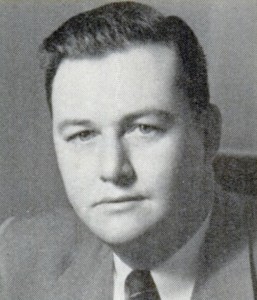
Historical · U.S. House · Alabama · District 5
Armistead Selden Jr.
Former U.S. Representative · Alabama District 5 · 1953–1969 · Democratic
Armistead Selden Jr. represented Alabama's District 5 in the United States House of Representatives (1953–1969) for the Democratic party. The page below collects sourced biographical facts, term history, committee roles, and provenance for Jr..
Bioguide ID: S000232
Key facts
- Full name
- Armistead Selden Jr.
- State
- Alabama
- District
- District 5
- Party
- Democratic
- House service
- 1953–1969
- First House term
- 1953
- Status
- Left office
- Current term ends
- —
- Born
- 1921
- Bioguide ID
- S000232
- Committee assignments
- —
- Dataset version
- 1.20260605
Biographical narrative
894 words · sourced from the Wikipedia REST extract
Armistead Selden Jr. was a U.S. Representative from Alabama who served in the House of Representatives for eight terms from 1953 until 1969. A member of the Democratic Party during his congressional career, Selden was known for his opposition to civil rights legislation and his involvement in foreign affairs. After leaving Congress, he transitioned to a diplomatic role and later switched his party affiliation to the Republican Party. He was born on February 20, 1921, in Greensboro, Alabama, and passed away on November 14, 1985.
Early life and career
Armistead Selden Jr. was born in Greensboro, Alabama, where he attended local public schools. He graduated from Greensboro High School in 1938 and went on to pursue higher education at the University of the South in Sewanee, Tennessee, graduating in 1942. Following his graduation, Selden enlisted in the United States Navy during World War II. He served from August 1942 until March 1946, spending a significant portion of his service aboard ships in the North Atlantic. He achieved the rank of lieutenant and later held the title of lieutenant commander in the United States Naval Reserve.
After his military service, Selden returned to academia, enrolling at the University of Alabama School of Law. He completed his law degree in 1948 and was subsequently admitted to the bar that same year. He began practicing law in Greensboro, Alabama, where he also entered politics. Selden served in the Alabama House of Representatives for two years, in 1951 and 1952, before making the leap to national politics.
House tenure
Selden was elected to the United States House of Representatives as a Democrat in 1952, beginning his first term in the Eighty-third Congress in January 1953. He was re-elected to seven consecutive terms, serving until January 3, 1969. Throughout his time in Congress, Selden was recognized for his strong opposition to civil rights initiatives. He was a signatory of the Southern Manifesto in 1956, which condemned the Supreme Court's decision in Brown v. Board of Education that mandated the desegregation of public schools. His voting record included opposition to several key pieces of civil rights legislation, including the Civil Rights Acts of 1957, 1960, 1964, and 1968, as well as the Voting Rights Act of 1965 and the 24th Amendment to the U.S. Constitution.
In addition to his stance on civil rights, Selden was active in foreign affairs during his congressional tenure. He served on the United States House Committee on Foreign Affairs and was the head of the now-defunct House Inter-American Affairs Committee. His involvement in international issues became particularly notable following the Cuban Revolution in 1958, which led to significant changes in U.S.-Cuba relations. Selden played a role in the passage of the embargo against Cuba in October 1960, and he was influential in the expulsion of Cuba from the Organization of American States in January 1962.
Selden's congressional career concluded in 1969 when he chose not to seek re-election. Instead, he ran for a seat in the United States Senate but was unsuccessful, losing the Democratic primary to former Lieutenant Governor James Allen. After leaving Congress, Selden returned to his law practice until October 1970.
Legislative focus and committees
During his time in the House of Representatives, Selden's legislative focus was primarily on foreign affairs and issues related to national security. His role on the House Committee on Foreign Affairs allowed him to influence U.S. policy in Latin America and other regions. He was particularly involved in matters concerning Cuba, reflecting the broader geopolitical tensions of the Cold War era. His support for the embargo against Cuba and his participation in the expulsion of Cuba from the Organization of American States underscored his commitment to U.S. foreign policy objectives during this period.
In addition to his work on foreign affairs, Selden's voting record on domestic issues, particularly civil rights, has been a significant aspect of his legacy. His opposition to various civil rights measures positioned him within a faction of Southern Democrats who resisted the changing social landscape of the 1960s. This resistance was emblematic of the broader struggle over civil rights in the United States, which would eventually lead to a realignment of political parties in the South.
After leaving Congress, Selden continued his public service by taking on roles in the executive branch. He served as the Principal Deputy Assistant Secretary of Defense for International Security Affairs from October 1970 to February 1973. Following this position, he was appointed as the U.S. Ambassador to New Zealand, Fiji, the Kingdom of Tonga, and Western Samoa, serving from 1974 until 1979. His diplomatic career further emphasized his interest in international relations and security matters.
In the years following his ambassadorship, Selden attempted to return to the political arena as a Republican candidate for the United States Senate in 1980, though he was not successful in securing the nomination. He later took on a leadership role as president of the American League for Exports and Security Assistance from 1980 until his death in 1985.
Armistead Selden Jr. passed away on November 14, 1985, in Birmingham, Alabama, after a battle with cancer. He was interred in Greensboro City Cemetery in his hometown. His legacy includes the A.I. Selden Dam, constructed in 1958 on Alabama's Black Warrior River, which bears his name and serves as a reminder of his contributions to both local and national affairs.
Notable legislation
Sponsored and co-sponsored legislation for Armistead Selden Jr. is pending operator curation. The biographical narrative above carries the same provenance trail until per-bill rows are written.
Sources
- [1]https://en.wikipedia.org/wiki/Armistead_I._Selden_Jr.Wikipedia · retrieved 2026-06-05
Notable quotes
Sourced quotes for Armistead Selden Jr. are pending operator curation. Narrative-scope provenance remains attached below.
Sources
- [1]https://en.wikipedia.org/wiki/Armistead_I._Selden_Jr.Wikipedia · retrieved 2026-06-05
Key positions
Curated policy positions for Armistead Selden Jr. are pending operator review. The biographical narrative above carries the same provenance trail until per-topic positions are written.
Sources
- [1]https://en.wikipedia.org/wiki/Armistead_I._Selden_Jr.Wikipedia · retrieved 2026-06-05
Terms served
- 1953–1955U.S. House · Term 1 · Democratic
- 1955–1957U.S. House · Term 2 · Democratic
- 1957–1959U.S. House · Term 3 · Democratic
- 1959–1961U.S. House · Term 4 · Democratic
- 1961–1963U.S. House · Term 5 · Democratic
- 1963–1965U.S. House · Term 6 · Democratic
- 1965–1967U.S. House · Term 7 · Democratic
- 1967–1969U.S. House · Term 8 · Democratic
Sources & provenance
Every attributable claim above carries a per-section [N] marker that resolves to the corresponding URL below. Each entry records the upstream provider, the canonical URL, and the timestamp at which the source was retrieved by the ingest pipeline.
Key facts
- https://bioguide.congress.gov/search/bio/S000232bioguide · retrieved 2026-06-05
- https://www.govtrack.us/congress/members/409737govtrack · retrieved 2026-06-05
Biographical narrative
- https://en.wikipedia.org/wiki/Armistead_I._Selden_Jr.wikipedia · retrieved 2026-06-05
Find your representative
Every U.S. state elects representatives by district. Browse Alabama’s delegation, the full former-representative roster, or explore the role and term length.
Related on The Candidate
- Preceded by Joe StarnesEarlier holder of the Alabama District 5 House seat · Democratic.Open
- Succeeded by Ronnie FlippoLater holder of the Alabama District 5 House seat · Democratic.Open
- Alfred BuckFormer U.S. Representative · Alabama District 1 · RepublicanOpen
- Benjamin TurnerFormer U.S. Representative · Alabama District 1 · RepublicanOpen
- Bradley ByrneFormer U.S. Representative · Alabama District 1 · RepublicanOpen
- Edmund DarganFormer U.S. Representative · Alabama District 1 · DemocraticOpen