
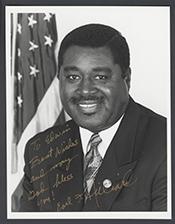
Historical · U.S. House · Alabama · District 7
Earl Hilliard
Former U.S. Representative · Alabama District 7 · 1993–2003 · Democratic
Earl Hilliard represented Alabama's District 7 in the United States House of Representatives (1993–2003) for the Democratic party. The page below collects sourced biographical facts, term history, committee roles, and provenance for Hilliard.
Bioguide ID: H000621
Key facts
- Full name
- Earl Hilliard
- State
- Alabama
- District
- District 7
- Party
- Democratic
- House service
- 1993–2003
- First House term
- 1993
- Status
- Left office
- Current term ends
- —
- Born
- 1942
- Bioguide ID
- H000621
- Committee assignments
- —
- Dataset version
- 1.20260605
Biographical narrative
820 words · sourced from the Wikipedia REST extract
Earl F. Hilliard is a former American politician who served as a U.S. Representative for Alabama's 7th congressional district from 1993 until 2003. A member of the Democratic Party, Hilliard's political career spans several decades, during which he held various positions in both state and federal government. Notably, he was the first African American to represent Alabama in Congress since the Reconstruction era, marking a significant milestone in the state's political history.
Early life and career
Earl Frederick Hilliard was born on April 9, 1942, in Birmingham, Alabama. He completed his secondary education at Western-Olin High School in Birmingham, graduating in 1960. Hilliard pursued higher education at Morehouse College, where he earned a Bachelor of Arts degree in 1964. He continued his academic journey by obtaining a Juris Doctor from Howard University in 1967, followed by a Master of Business Administration from Atlanta University in 1970.
Hilliard's professional career began in public service, where he first entered politics by being elected to the Alabama House of Representatives in 1974. He served in this capacity until 1980, when he transitioned to the Alabama Senate, where he continued to represent his constituents until he was elected to the U.S. Congress. His tenure in the Alabama legislature laid the groundwork for his future political endeavors and established him as a prominent figure in Alabama politics.
In 1992, Hilliard was elected to the United States House of Representatives, representing Alabama's 7th district. This district is notable for its significant African American population, comprising approximately 65 percent of the district's demographic. Hilliard's election was historically significant, as he became the first African American to represent Alabama in Congress since Jeramiah Haralson, who served in 1877. His election also marked the return of a Democrat to represent a substantial portion of the state capital, Montgomery, since 1965.
House tenure
Hilliard's first term in the House of Representatives began in 1993, and he was re-elected multiple times during his congressional career, serving a total of five terms. Throughout his tenure, he was involved in various legislative initiatives and represented the interests of his constituents in Alabama. Hilliard's political career was characterized by his commitment to addressing the needs of his district, which included urban areas with diverse populations and significant socio-economic challenges.
During his time in Congress, Hilliard faced a notable challenge in the 2000 Democratic primary election from Artur Davis, who emerged as a serious contender in what was considered the real contest in this heavily Democratic district. Hilliard successfully won this primary, reinforcing his position within the party and among his constituents.
However, the political landscape shifted in the following years due to redistricting, which altered the demographics of the 7th district. In 2002, Hilliard faced Davis again in a rematch during the Democratic primary. This election was marked by intense scrutiny of Hilliard's record in office, as well as discussions surrounding ethical concerns and various political issues, including race relations and international conflicts. Despite finishing with the most votes in the initial primary, Hilliard did not secure a majority, leading to a runoff election where Davis ultimately won with a majority of the votes.
Legislative focus and committees
Throughout his congressional career, Hilliard was involved in a range of legislative matters, reflecting the interests and concerns of his constituents. His legislative focus often included issues pertinent to the African American community, civil rights, and social justice. Hilliard was known for his advocacy on matters related to economic development, education, and healthcare, which were critical to the well-being of his district.
Hilliard's positions on foreign policy were also notable, particularly regarding the Israeli-Palestinian conflict. In 2001, he voted against legislation that aimed to increase military support to Israel, which highlighted his willingness to take a stance that diverged from mainstream party lines on foreign policy issues. This decision was part of a broader narrative during his tenure, where he faced criticism and challenges related to his views on international relations and domestic policies.
In addition to his legislative work, Hilliard was a member of the Congressional Black Caucus Institute, which focuses on promoting the interests of African Americans and addressing issues of social and economic inequality. His involvement in this organization underscored his commitment to advocating for the rights and needs of marginalized communities.
Earl Hilliard's political legacy is further reflected in his family's continued involvement in politics. His son, Earl Hilliard Jr., has also served in the Alabama House of Representatives and made an unsuccessful bid for Congress in 2010, indicating a familial commitment to public service and political engagement.
Hilliard's career in the U.S. House of Representatives concluded on January 3, 2003, marking the end of a significant chapter in Alabama's political history. His tenure as a congressman not only represented a breakthrough for African Americans in Alabama but also contributed to the ongoing dialogue about race, representation, and the role of government in addressing the needs of diverse communities.
Notable legislation
Sponsored and co-sponsored legislation for Earl Hilliard is pending operator curation. The biographical narrative above carries the same provenance trail until per-bill rows are written.
Sources
- [1]https://en.wikipedia.org/wiki/Earl_Hilliard_Sr.Wikipedia · retrieved 2026-06-05
Notable quotes
Sourced quotes for Earl Hilliard are pending operator curation. Narrative-scope provenance remains attached below.
Sources
- [1]https://en.wikipedia.org/wiki/Earl_Hilliard_Sr.Wikipedia · retrieved 2026-06-05
Key positions
Curated policy positions for Earl Hilliard are pending operator review. The biographical narrative above carries the same provenance trail until per-topic positions are written.
Sources
- [1]https://en.wikipedia.org/wiki/Earl_Hilliard_Sr.Wikipedia · retrieved 2026-06-05
Terms served
- 1993–1995U.S. House · Term 1 · Democratic
- 1995–1997U.S. House · Term 2 · Democratic
- 1997–1999U.S. House · Term 3 · Democratic
- 1999–2001U.S. House · Term 4 · Democratic
- 2001–2003U.S. House · Term 5 · Democratic
Sources & provenance
Every attributable claim above carries a per-section [N] marker that resolves to the corresponding URL below. Each entry records the upstream provider, the canonical URL, and the timestamp at which the source was retrieved by the ingest pipeline.
Key facts
- https://bioguide.congress.gov/search/bio/H000621bioguide · retrieved 2026-06-05
- https://www.govtrack.us/congress/members/400502govtrack · retrieved 2026-06-05
Biographical narrative
- https://en.wikipedia.org/wiki/Earl_Hilliard_Sr.wikipedia · retrieved 2026-06-05
Find your representative
Every U.S. state elects representatives by district. Browse Alabama’s delegation, the full former-representative roster, or explore the role and term length.
Related on The Candidate
- Preceded by Claude Harris Jr.Earlier holder of the Alabama District 7 House seat · Democratic.Open
- Succeeded by Artur DavisLater holder of the Alabama District 7 House seat · Democratic.Open
- Alfred BuckFormer U.S. Representative · Alabama District 1 · RepublicanOpen
- Benjamin TurnerFormer U.S. Representative · Alabama District 1 · RepublicanOpen
- Bradley ByrneFormer U.S. Representative · Alabama District 1 · RepublicanOpen
- Edmund DarganFormer U.S. Representative · Alabama District 1 · DemocraticOpen