
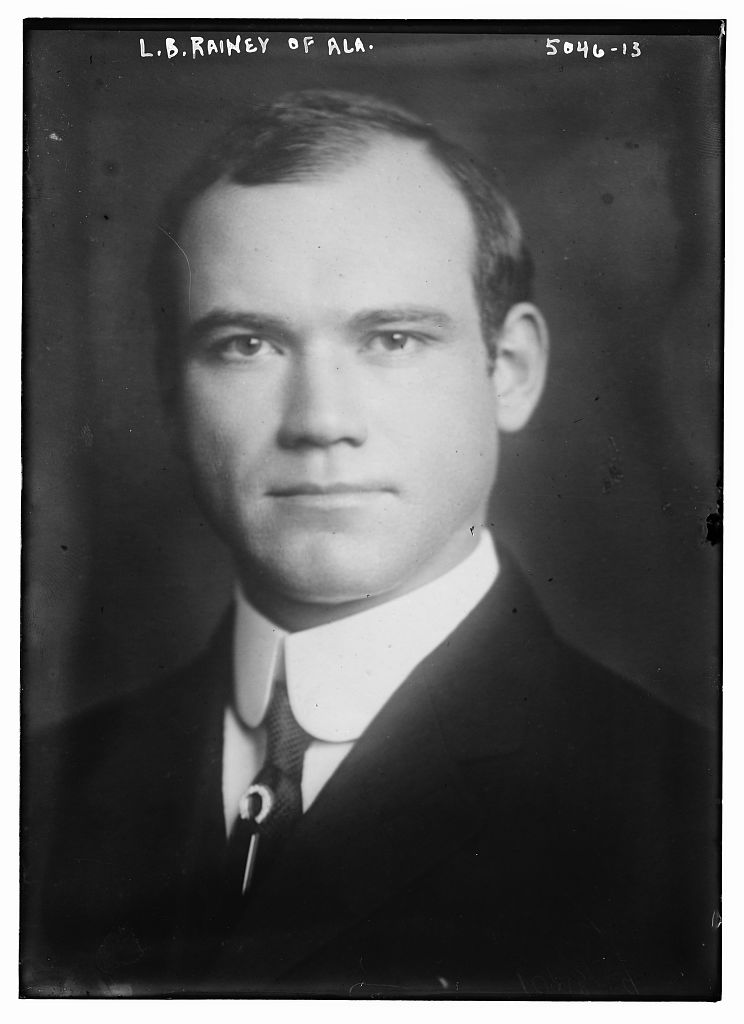
Historical · U.S. House · Alabama · District 7
Lilius Rainey
Former U.S. Representative · Alabama District 7 · 1919–1923 · Democratic
Lilius Rainey represented Alabama's District 7 in the United States House of Representatives (1919–1923) for the Democratic party. The page below collects sourced biographical facts, term history, committee roles, and provenance for Rainey.
Bioguide ID: R000017
Key facts
- Full name
- Lilius Rainey
- State
- Alabama
- District
- District 7
- Party
- Democratic
- House service
- 1919–1923
- First House term
- 1919
- Status
- Left office
- Current term ends
- —
- Born
- 1876
- Bioguide ID
- R000017
- Committee assignments
- —
- Dataset version
- 1.20260606
Biographical narrative
858 words · sourced from the Wikipedia REST extract
Lilius Rainey was an American lawyer and politician who served as a U.S. Representative for Alabama's 7th congressional district from 1919 to 1923. A member of the Democratic Party, Rainey was elected to Congress during a time of significant political and social change in the United States. His legislative contributions included introducing a commemorative coin to mark Alabama's centennial as a state. After completing his congressional service, he returned to his legal practice in Gadsden, Alabama, where he continued to influence his community until his death in 1959.
Early life and career
Lilius Bratton Rainey was born on July 27, 1876, in Dadeville, Alabama. His early education took place in local common schools, which laid the foundation for his future academic pursuits. Following his primary education, Rainey moved to Fort Payne, Alabama, where he continued his studies. He graduated from the Alabama Polytechnic Institute, now known as Auburn University, in 1899. This institution provided him with a solid educational background that would later support his career in law and politics.
After completing his undergraduate education, Rainey pursued a legal education at the University of Alabama in Tuscaloosa, graduating from its law department in 1902. Upon earning his law degree, he was admitted to the bar the same year and began practicing law in Gadsden, Alabama. His legal career in Gadsden marked the beginning of his professional life, where he developed a reputation as a competent attorney.
In addition to his legal work, Rainey was active in military service. He joined the Alabama National Guard and was elected as a captain in 1903. His leadership abilities were recognized, and he was reelected and commissioned again in 1906. However, he resigned from his command in 1907, indicating a shift in focus from military to civic and legal responsibilities. Rainey also served as the city solicitor of Gadsden from 1911 to 1917, a role that allowed him to engage more directly with local governance and community issues.
House tenure
Lilius Rainey's political career took a significant turn when he was elected to the U.S. House of Representatives. He was chosen as a Democrat to fill a vacancy in the Sixty-sixth Congress, which had been created by the death of incumbent John L. Burnett. Rainey officially took office on September 30, 1919. His election came at a time when the nation was grappling with the aftermath of World War I and the social changes that followed.
Rainey served in the House until March 3, 1923, completing two full terms in Congress. During his tenure, he was involved in various legislative activities and discussions pertinent to his constituents in Alabama. His time in office coincided with a period of significant legislative activity, including debates on issues related to veterans, economic recovery, and civil rights. Rainey was reelected to the Sixty-seventh Congress, demonstrating his ability to connect with voters and address their concerns.
Despite his success in Congress, Rainey chose not to seek renomination in 1922, marking the end of his congressional career. His decision to step away from national politics allowed him to return to his legal practice in Gadsden, where he continued to contribute to his community in a different capacity.
Legislative focus and committees
During his time in the U.S. House of Representatives, Lilius Rainey focused on various legislative initiatives that reflected the needs and interests of his constituents. One notable achievement was his introduction of legislation to coin a commemorative half dollar celebrating the 100th anniversary of Alabama's admission to the Union as the 22nd state. This initiative highlighted Rainey's commitment to honoring Alabama's history and promoting state pride.
In addition to this specific legislative effort, Rainey's work in Congress involved participation in broader discussions on national policies affecting his district and the country. While specific committee assignments during his tenure are not detailed in the available records, it is typical for members of Congress to serve on committees that align with their interests and the needs of their constituents. These committees play a crucial role in shaping legislation and overseeing government functions.
Rainey's legislative contributions occurred during a transformative era in American history, characterized by significant social and economic changes. The post-World War I period saw increased demands for social reform, economic stability, and civil rights advancements. As a representative from Alabama, Rainey was positioned to engage in discussions that addressed these pressing issues, although the specific outcomes of his legislative efforts are not detailed in the available records.
After concluding his congressional service, Rainey returned to Gadsden, where he resumed his legal practice. His decision to return to law suggests a continued commitment to public service and community engagement. Rainey remained active in his profession until his death on September 27, 1959, in Gadsden, Alabama. His contributions to both the legal field and public service left a lasting impact on his community.
Lilius Rainey was interred in Glenwood Cemetery in Fort Payne, Alabama, where he is remembered as a significant figure in the political and legal history of the region. His life and career reflect the complexities of early 20th-century American politics, as well as the enduring importance of local representation in the U.S. Congress.
Notable legislation
Sponsored and co-sponsored legislation for Lilius Rainey is pending operator curation. The biographical narrative above carries the same provenance trail until per-bill rows are written.
Sources
- [1]https://en.wikipedia.org/wiki/Lilius_B._RaineyWikipedia · retrieved 2026-06-06
Notable quotes
Sourced quotes for Lilius Rainey are pending operator curation. Narrative-scope provenance remains attached below.
Sources
- [1]https://en.wikipedia.org/wiki/Lilius_B._RaineyWikipedia · retrieved 2026-06-06
Key positions
Curated policy positions for Lilius Rainey are pending operator review. The biographical narrative above carries the same provenance trail until per-topic positions are written.
Sources
- [1]https://en.wikipedia.org/wiki/Lilius_B._RaineyWikipedia · retrieved 2026-06-06
Terms served
- 1919–1921U.S. House · Term 1 · Democratic
- 1921–1923U.S. House · Term 2 · Democratic
Sources & provenance
Every attributable claim above carries a per-section [N] marker that resolves to the corresponding URL below. Each entry records the upstream provider, the canonical URL, and the timestamp at which the source was retrieved by the ingest pipeline.
Key facts
- https://bioguide.congress.gov/search/bio/R000017bioguide · retrieved 2026-06-06
- https://www.govtrack.us/congress/members/408999govtrack · retrieved 2026-06-06
Biographical narrative
- https://en.wikipedia.org/wiki/Lilius_B._Raineywikipedia · retrieved 2026-06-06
Find your representative
Every U.S. state elects representatives by district. Browse Alabama’s delegation, the full former-representative roster, or explore the role and term length.
Related on The Candidate
- Preceded by Milford HowardEarlier holder of the Alabama District 7 House seat · Populist.Open
- Succeeded by Zadoc WeatherfordLater holder of the Alabama District 7 House seat · Democratic.Open
- Alfred BuckFormer U.S. Representative · Alabama District 1 · RepublicanOpen
- Benjamin TurnerFormer U.S. Representative · Alabama District 1 · RepublicanOpen
- Bradley ByrneFormer U.S. Representative · Alabama District 1 · RepublicanOpen
- Edmund DarganFormer U.S. Representative · Alabama District 1 · DemocraticOpen