
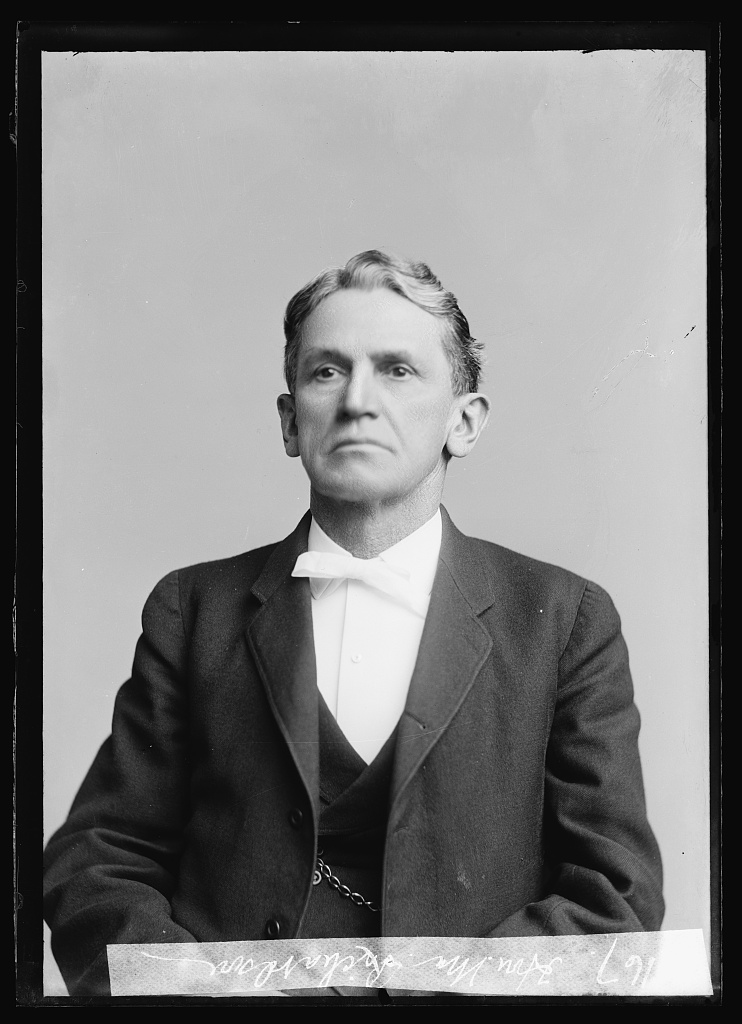
Historical · U.S. House · Alabama · District 8
William Richardson
Former U.S. Representative · Alabama District 8 · 1899–1915 · Democratic
William Richardson represented Alabama's District 8 in the United States House of Representatives (1899–1915) for the Democratic party. The page below collects sourced biographical facts, term history, committee roles, and provenance for Richardson.
Bioguide ID: R000227
Key facts
- Full name
- William Richardson
- State
- Alabama
- District
- District 8
- Party
- Democratic
- House service
- 1899–1915
- First House term
- 1899
- Status
- Left office
- Current term ends
- —
- Born
- 1839
- Bioguide ID
- R000227
- Committee assignments
- —
- Dataset version
- 1.20260606
Biographical narrative
970 words · sourced from the Wikipedia REST extract
William Richardson was an American politician and lawyer who served as a U.S. Representative for Alabama's 8th congressional district. A member of the Democratic Party, Richardson's congressional career spanned from 1899 until his death in 1914, during which he was elected to a total of eight terms in the House of Representatives. His life and career were marked by significant events, including his service in the Civil War and his subsequent political endeavors in Alabama.
Early life and career
William Richardson was born on May 8, 1839, in Athens, Alabama, to William Richardson and Anne Davis. Growing up in the South during a tumultuous period in American history, Richardson's early life was shaped by the cultural and political environment of the antebellum South. As tensions escalated leading up to the Civil War, Richardson enlisted in the Confederate Army. He joined Company K of the 50th Regiment Alabama Infantry, where he participated in several key battles.
Richardson's military service was marked by significant hardships. He was wounded during the battle of Shiloh, one of the early major engagements of the Civil War, and subsequently taken prisoner. His experiences in captivity were harrowing; he managed to escape but was recaptured and faced execution as a suspected spy in Murfreesboro. His life was spared when General Nathan Bedford Forrest and his troops intervened, allowing Richardson to rejoin the fight. Later in the war, he was again wounded at the battle of Chickamauga, a significant conflict in Georgia. Following the war, he was paroled in April 1865 in Marietta, Georgia, marking the end of his military service.
After returning to civilian life, Richardson transitioned into politics. He served in the Alabama House of Representatives from 1865 to 1867, representing his district in the immediate post-war period. This role allowed him to engage in the reconstruction of Alabama's political landscape. He pursued a legal education, studying law and gaining admission to the bar in Huntsville in 1867. His legal career began to flourish, and he became a prominent figure in local legal circles.
From 1875 to 1886, Richardson served as the judge of the probate and county courts of Madison County. His judicial experience contributed to his reputation as a capable leader and public servant. During this time, he played a significant role in the political landscape of Alabama, notably contributing to the election of George Smith Houston as governor in 1886. In 1904, Richardson was a delegate to the Democratic National Convention, further solidifying his involvement in national politics.
House tenure
William Richardson's congressional career began when he was elected as a Democrat to the Fifty-sixth Congress to fill a vacancy caused by the resignation of Joseph Wheeler. His election marked the beginning of a long tenure in the U.S. House of Representatives, where he would serve until his death in 1914. Richardson was reelected to the Fifty-seventh Congress and subsequently to six additional Congresses, demonstrating his sustained popularity and support within his district.
During his time in office, Richardson participated in various legislative activities and contributed to the discussions and decisions that shaped national policies. His commitment to his constituents and his party was evident throughout his congressional service. He was involved in the legislative process during a period of significant change in the United States, including the Progressive Era, which sought to address issues such as economic inequality, labor rights, and government reform.
Richardson's ability to secure multiple terms in Congress reflected his effectiveness as a legislator and his alignment with the interests of his constituents. His long tenure allowed him to build relationships with fellow lawmakers and gain influence within the Democratic Party. As a member of the House, he was part of a larger legislative body that was tasked with addressing the challenges facing the nation during the early 20th century.
Legislative focus and committees
While specific details regarding the bills Richardson sponsored or the committees he served on are not provided, it can be inferred that his legislative focus would have aligned with the priorities of the Democratic Party during his time in office. Given the historical context, Richardson likely engaged with issues pertinent to his constituents in Alabama, including economic development, infrastructure, and social issues relevant to the post-Civil War South.
As a member of Congress, Richardson would have participated in discussions surrounding key national policies, including those related to agriculture, industry, and civil rights. The early 1900s were a time of significant transformation in the United States, and Richardson's role as a legislator would have involved navigating these changes while advocating for the interests of his district.
Richardson's experience as a judge and his legal background likely informed his approach to legislation and governance. His understanding of the law and judicial processes would have been beneficial in crafting legislation and engaging in debates on the House floor. Additionally, his long tenure in the House would have provided him with insights into the legislative process and the workings of Congress, allowing him to effectively represent his constituents' needs.
Throughout his eight terms in the House, Richardson's contributions would have been part of the broader narrative of American politics during a time of significant change. His service in Congress coincided with shifts in public policy and governance that aimed to address the evolving needs of the nation.
William Richardson passed away on March 31, 1914, in Atlantic City, New Jersey, where he had traveled for health reasons. His death marked the end of a notable political career that spanned several decades. He was buried in Maple Hill Cemetery in Huntsville, Alabama, leaving behind a legacy as a public servant who navigated the complexities of American politics in a transformative era. His life and career reflect the challenges and opportunities faced by Southern politicians in the aftermath of the Civil War and during the early 20th century.
Notable legislation
Sponsored and co-sponsored legislation for William Richardson is pending operator curation. The biographical narrative above carries the same provenance trail until per-bill rows are written.
Sources
- [1]https://en.wikipedia.org/wiki/William_Richardson_(Alabama_politician)Wikipedia · retrieved 2026-06-06
Notable quotes
Sourced quotes for William Richardson are pending operator curation. Narrative-scope provenance remains attached below.
Sources
- [1]https://en.wikipedia.org/wiki/William_Richardson_(Alabama_politician)Wikipedia · retrieved 2026-06-06
Key positions
Curated policy positions for William Richardson are pending operator review. The biographical narrative above carries the same provenance trail until per-topic positions are written.
Sources
- [1]https://en.wikipedia.org/wiki/William_Richardson_(Alabama_politician)Wikipedia · retrieved 2026-06-06
Terms served
- 1899–1901U.S. House · Term 1 · Democratic
- 1901–1903U.S. House · Term 2 · Democratic
- 1903–1905U.S. House · Term 3 · Democratic
- 1905–1907U.S. House · Term 4 · Democratic
- 1907–1909U.S. House · Term 5 · Democratic
- 1909–1911U.S. House · Term 6 · Democratic
- 1911–1913U.S. House · Term 7 · Democratic
- 1913–1915U.S. House · Term 8 · Democratic
Sources & provenance
Every attributable claim above carries a per-section [N] marker that resolves to the corresponding URL below. Each entry records the upstream provider, the canonical URL, and the timestamp at which the source was retrieved by the ingest pipeline.
Key facts
- https://bioguide.congress.gov/search/bio/R000227bioguide · retrieved 2026-06-06
- https://www.govtrack.us/congress/members/409203govtrack · retrieved 2026-06-06
Biographical narrative
- https://en.wikipedia.org/wiki/William_Richardson_(Alabama_politician)wikipedia · retrieved 2026-06-06
Find your representative
Every U.S. state elects representatives by district. Browse Alabama’s delegation, the full former-representative roster, or explore the role and term length.
Related on The Candidate
- Preceded by William LoweEarlier holder of the Alabama District 8 House seat · National Greenbacker.Open
- Succeeded by Edward AlmonLater holder of the Alabama District 8 House seat · Democratic.Open
- Alfred BuckFormer U.S. Representative · Alabama District 1 · RepublicanOpen
- Benjamin TurnerFormer U.S. Representative · Alabama District 1 · RepublicanOpen
- Bradley ByrneFormer U.S. Representative · Alabama District 1 · RepublicanOpen
- Edmund DarganFormer U.S. Representative · Alabama District 1 · DemocraticOpen