
Historical · U.S. House · Arkansas · District 3
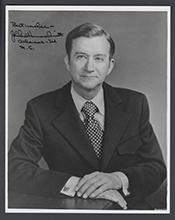
John Hammerschmidt
Former U.S. Representative · Arkansas District 3 · 1967–1993 · Republican
John Hammerschmidt represented Arkansas's District 3 in the United States House of Representatives (1967–1993) for the Republican party. The page below collects sourced biographical facts, term history, committee roles, and provenance for Hammerschmidt.
Bioguide ID: H000124
Key facts
- Full name
- John Hammerschmidt
- State
- Arkansas
- District
- District 3
- Party
- Republican
- House service
- 1967–1993
- First House term
- 1967
- Status
- Left office
- Current term ends
- —
- Born
- 1922
- Bioguide ID
- H000124
- Committee assignments
- —
- Dataset version
- 1.20260605
Biographical narrative
979 words · sourced from the Wikipedia REST extract
John P. Hammerschmidt was an American politician who served as a U.S. Representative for Arkansas's 3rd congressional district from 1967 until 1993. A member of the Republican Party, he was notable for being the first Republican elected to Congress from Arkansas since the Reconstruction era. Throughout his 13 terms in office, Hammerschmidt became a prominent figure in Arkansas politics, navigating a landscape that was predominantly Democratic during much of his tenure. His political career was marked by significant electoral victories, including a notable race against future President Bill Clinton in 1974.
Early life and career
John Paul Hammerschmidt was born on May 4, 1922, in Harrison, Arkansas, where he was the fourth of five children in the family of Arthur Paul Hammerschmidt and Junie Mildred Taylor. His family had deep roots in Boone County, with both sets of grandparents having migrated to the area in the early 20th century, and they were of German descent. Hammerschmidt completed his secondary education at Harrison High School, graduating in 1938.
Following high school, he attended The Citadel in Charleston, South Carolina, for a year before transferring to the University of Arkansas in Fayetteville, where he studied from 1940 to 1941. His education was interrupted by World War II, during which he served in the United States Army Air Corps. He joined the 3rd Combat Cargo Group and was deployed to the China-Burma-India theater, where he served until the end of the war in 1945. For his military service, he was awarded the Distinguished Flying Cross with three oak leaf clusters.
After returning to civilian life, Hammerschmidt continued his education at Oklahoma A&M College (now Oklahoma State University) from 1945 to 1946, earning a Bachelor of Science degree. He then entered the lumber industry, taking over leadership of the Hammerschmidt Lumber Company, a business founded by his grandfather. Under his stewardship, he became president of the company and also held leadership roles in other organizations, including the Construction Products Company and the Arkansas Lumber Dealers Association. Additionally, Hammerschmidt was active in the United States Air Force Reserves from 1945 until 1960 and later served in the District of Columbia Army Reserves from 1977 to 1981.
House tenure
Hammerschmidt's political career began to take shape in the 1960s when he became involved in the Republican Party. He was a delegate to several Republican National Conventions throughout the 1960s and 1970s and served as the state chairman of the Republican Party of Arkansas during two separate terms, first from 1964 to 1966 and again from 2002 to 2004. His political ascent culminated in the 1966 election when he won the Republican nomination for the 3rd congressional district. In a significant victory, he defeated the incumbent Democrat James William Trimble, marking a historic moment as he became the first Republican to represent Arkansas in Congress since Reconstruction.
Hammerschmidt's tenure in the House of Representatives began on January 3, 1967, and he served for a total of 13 terms, concluding his service on January 3, 1993. During his time in office, he became a well-known figure in Arkansas politics, particularly in the 3rd district, which began to shift away from its traditional Democratic roots during his tenure. Despite the district's historical leanings, Hammerschmidt maintained a strong electoral presence, facing only one particularly close contest during his career.
In the 1974 election, Hammerschmidt faced a formidable opponent in Bill Clinton, who was then a law professor at the University of Arkansas. The race was closely contested, with Hammerschmidt winning by a narrow margin. This election was notable not only for its closeness but also because Clinton criticized Hammerschmidt for his support of President Richard Nixon during the Watergate scandal. Following this election, Hammerschmidt's popularity remained strong, and he was reelected unopposed in 1976. He continued to serve in the House, winning subsequent elections with varying degrees of opposition, often focusing on local issues and maintaining a conservative stance on many national matters.
Legislative focus and committees
Throughout his congressional career, Hammerschmidt was known for his conservative voting record, particularly on foreign policy and social issues. However, he exhibited a slightly more moderate approach to economic issues. He was a member of the President's Commission on Aviation Security and Terrorism, which was established in response to the bombing of Pan Am Flight 103 in 1988. This role underscored his involvement in national security matters and his commitment to addressing pressing issues of the time.
Hammerschmidt's legislative priorities included support for a constitutional amendment aimed at enacting flag desecration laws, reflecting his conservative values. His voting record also indicated a focus on issues relevant to his constituents in Arkansas, although he did not vote on certain pieces of legislation, such as the Abandoned Shipwrecks Act of 1987.
In addition to his legislative work, Hammerschmidt was actively involved in various civic organizations and community activities. He was a member of the American Legion, Veterans of Foreign Wars, Freemasons, Shriners, Elks, and Rotary International. His commitment to public service extended beyond his congressional duties, as he served as a trustee for Arkansas State University at Jonesboro from 1999 to 2004.
Hammerschmidt's legacy includes the establishment of a fellowship at the University of Arkansas at Fort Smith, designed to provide students with opportunities to work in the 3rd congressional district office. The John Paul Hammerschmidt Federal Building, located near the Fayetteville Historic Square, serves as a reminder of his contributions to the region and houses the Fayetteville office of the United States District Court for the Western District of Arkansas.
John P. Hammerschmidt passed away on April 1, 2015, at the age of 92, leaving behind a significant legacy in Arkansas politics and a career that spanned over two decades in the U.S. House of Representatives. His life and work continue to be recognized in the state, reflecting the impact he had on his constituents and the broader political landscape.
Notable legislation
Sponsored and co-sponsored legislation for John Hammerschmidt is pending operator curation. The biographical narrative above carries the same provenance trail until per-bill rows are written.
Sources
- [1]https://en.wikipedia.org/wiki/John_Paul_HammerschmidtWikipedia · retrieved 2026-06-05
Notable quotes
Sourced quotes for John Hammerschmidt are pending operator curation. Narrative-scope provenance remains attached below.
Sources
- [1]https://en.wikipedia.org/wiki/John_Paul_HammerschmidtWikipedia · retrieved 2026-06-05
Key positions
Curated policy positions for John Hammerschmidt are pending operator review. The biographical narrative above carries the same provenance trail until per-topic positions are written.
Sources
- [1]https://en.wikipedia.org/wiki/John_Paul_HammerschmidtWikipedia · retrieved 2026-06-05
Terms served
- 1967–1969U.S. House · Term 1 · Republican
- 1969–1971U.S. House · Term 2 · Republican
- 1971–1973U.S. House · Term 3 · Republican
- 1973–1975U.S. House · Term 4 · Republican
- 1975–1977U.S. House · Term 5 · Republican
- 1977–1979U.S. House · Term 6 · Republican
- 1979–1981U.S. House · Term 7 · Republican
- 1981–1983U.S. House · Term 8 · Republican
- 1983–1985U.S. House · Term 9 · Republican
- 1985–1987U.S. House · Term 10 · Republican
- 1987–1989U.S. House · Term 11 · Republican
- 1989–1991U.S. House · Term 12 · Republican
- 1991–1993U.S. House · Term 13 · Republican
Sources & provenance
Every attributable claim above carries a per-section [N] marker that resolves to the corresponding URL below. Each entry records the upstream provider, the canonical URL, and the timestamp at which the source was retrieved by the ingest pipeline.
Key facts
- https://bioguide.congress.gov/search/bio/H000124bioguide · retrieved 2026-06-05
- https://www.govtrack.us/congress/members/405006govtrack · retrieved 2026-06-05
Biographical narrative
- https://en.wikipedia.org/wiki/John_Paul_Hammerschmidtwikipedia · retrieved 2026-06-05
Find your representative
Every U.S. state elects representatives by district. Browse Arkansas’s delegation, the full former-representative roster, or explore the role and term length.
Related on The Candidate
- Preceded by James TrimbleEarlier holder of the Arkansas District 3 House seat · Democratic.Open
- Succeeded by Asa HutchinsonLater holder of the Arkansas District 3 House seat · Republican.Open
- Alfred GreenwoodFormer U.S. Representative · Arkansas District 1 · DemocraticOpen
- Archibald YellFormer U.S. Representative · Arkansas District 1 · DemocraticOpen
- Asa HodgesFormer U.S. Representative · Arkansas District 1 · RepublicanOpen
- Bill Alexander Jr.Former U.S. Representative · Arkansas District 1 · DemocraticOpen