
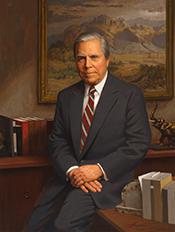
Historical · U.S. House · Arizona · District 1
John Rhodes
Former U.S. Representative · Arizona District 1 · 1953–1983 · Republican
John Rhodes represented Arizona's District 1 in the United States House of Representatives (1953–1983) for the Republican party. The page below collects sourced biographical facts, term history, committee roles, and provenance for Rhodes.
Bioguide ID: R000188
Key facts
- Full name
- John Rhodes
- State
- Arizona
- District
- District 1
- Party
- Republican
- House service
- 1953–1983
- First House term
- 1953
- Status
- Left office
- Current term ends
- —
- Born
- 1916
- Bioguide ID
- R000188
- Committee assignments
- —
- Dataset version
- 1.20260605
Biographical narrative
995 words · sourced from the Wikipedia REST extract
John J. Rhodes was a prominent American lawyer and politician who served as a U.S. Representative for Arizona's 1st congressional district from 1953 to 1983. A member of the Republican Party, Rhodes was known for his leadership role as the House Minority Leader from 1973 to 1981 and for advocating a conservative legislative agenda. Over his three-decade tenure in Congress, he became a significant figure in Arizona politics and played a key role in various legislative initiatives, particularly in water resource management and civil rights.
Early life and career
John J. Rhodes was born on September 18, 1916, in Council Grove, Kansas. He spent his formative years in Kansas, where he attended public schools. An early encounter with President Calvin Coolidge at the age of eleven left a lasting impression on him, reportedly leading him to refrain from washing his hand for a week after the handshake. Rhodes pursued higher education at Kansas State University in Manhattan, Kansas, graduating in 1938. During his time at university, he was an active member of the Beta Theta Pi fraternity and participated in the Reserve Officers Training Corps (ROTC), which allowed him to earn a commission in the U.S. Army Reserve.
In 1941, Rhodes graduated from Harvard Law School in Cambridge, Massachusetts. Shortly thereafter, he was called to active duty with the United States Army Air Corps, which was later restructured into the United States Army Air Forces. He served at Williams Field in Arizona from 1941 until 1946, where he gained valuable experience that would later inform his political career. After World War II, Rhodes chose to settle in Arizona with his wife, Elizabeth. His early professional life included serving as the staff judge advocate for the Arizona Air National Guard from 1947 to 1952. Additionally, he held the position of vice chairman of the Arizona Board of Public Welfare during the early 1950s.
House tenure
Rhodes entered the political arena in 1950 when he ran for the position of Attorney General of Arizona as a Republican. At that time, Arizona was predominantly Democratic, and his campaign did not succeed, a prediction made by his friend Barry Goldwater. However, Rhodes persisted and, in 1952, he ran for Arizona's 1st congressional district, which encompassed Phoenix and surrounding areas in Maricopa County. Despite facing a well-established Democratic incumbent, John Murdock, and having limited campaign resources, Rhodes won the election by a margin of eight percent, marking a significant milestone as the first Republican ever elected to represent Arizona in the House of Representatives.
Rhodes served in the U.S. House from January 3, 1953, until January 3, 1983, completing a total of 15 consecutive terms. His tenure spanned from the 83rd to the 97th Congresses. Throughout his time in office, he held various committee assignments that reflected his interests and expertise. Initially, he served on the Education and Labor and Interior and Insular Affairs committees from 1953 to 1959. He then transitioned to the Appropriations Committee, where he became the ranking minority member of the Public Works and Defense Subcommittees from 1959 to 1973. In the mid-1970s, he served on the Budget Committee and later on the Rules Committee until the end of his congressional career. Additionally, he chaired the House Republican Policy Committee from 1965 to 1973.
Rhodes's leadership capabilities were recognized when he was elected House Minority Leader on December 7, 1973, succeeding Gerald Ford, who had become Vice President. His leadership style was characterized as strong yet understated, which eventually led to dissatisfaction among some House Republicans. In 1979, he announced that he would not seek re-election as leader, although he continued to serve in Congress until his retirement in 1983. His popularity in his district was notable, especially considering that many constituents had not previously been represented by a Republican. He faced a close reelection contest in 1954 but was not significantly challenged until 1974, when the political climate surrounding the Watergate scandal affected his support.
Legislative focus and committees
Throughout his congressional career, Rhodes was involved in various legislative initiatives that shaped his reputation as a conservative leader. One of his most significant accomplishments was his role in the authorization of the Central Arizona Project, a major water resource project that delivers water from the Colorado River to Arizona. This initiative was crucial for the state's agricultural and urban development and underscored Rhodes's commitment to addressing water scarcity issues in the region.
Rhodes's involvement in civil rights legislation was also notable. He voted in favor of the Civil Rights Acts of 1957 and 1960, as well as the Voting Rights Act of 1965. Although he initially opposed the Civil Rights Act of 1964, he later supported the Senate amendment to the bill. His voting record reflected a complex stance on civil rights, as he also voted for the Civil Rights Act of 1968 while opposing certain amendments.
In addition to his legislative work, Rhodes was present at a pivotal moment in American history when he attended a meeting with President Richard Nixon on August 7, 1974. During this meeting, he, along with Barry Goldwater and Senator Hugh Scott, informed Nixon that he no longer had sufficient support in Congress to avoid impeachment. This moment was significant in the context of the Watergate scandal, and Rhodes's decision to support impeachment was seen as a critical turning point.
Rhodes authored a book in 1976 titled "The Futile System: How to Unchain Congress and Make the System Work Again," in which he discussed the challenges facing Congress and proposed reforms aimed at improving its functionality. His insights into the legislative process reflected his extensive experience and desire for a more effective government.
After retiring from Congress in 1982 at the age of 66, Rhodes expressed a desire to pursue new endeavors, reasoning that it was time to explore opportunities beyond his long political career. He passed away on August 24, 2003, leaving behind a legacy marked by his extensive service and contributions to American politics.
Notable legislation
Sponsored and co-sponsored legislation for John Rhodes is pending operator curation. The biographical narrative above carries the same provenance trail until per-bill rows are written.
Sources
- [1]https://en.wikipedia.org/wiki/John_Jacob_RhodesWikipedia · retrieved 2026-06-05
Notable quotes
Sourced quotes for John Rhodes are pending operator curation. Narrative-scope provenance remains attached below.
Sources
- [1]https://en.wikipedia.org/wiki/John_Jacob_RhodesWikipedia · retrieved 2026-06-05
Key positions
Curated policy positions for John Rhodes are pending operator review. The biographical narrative above carries the same provenance trail until per-topic positions are written.
Sources
- [1]https://en.wikipedia.org/wiki/John_Jacob_RhodesWikipedia · retrieved 2026-06-05
Terms served
- 1953–1955U.S. House · Term 1 · Republican
- 1955–1957U.S. House · Term 2 · Republican
- 1957–1959U.S. House · Term 3 · Republican
- 1959–1961U.S. House · Term 4 · Republican
- 1961–1963U.S. House · Term 5 · Republican
- 1963–1965U.S. House · Term 6 · Republican
- 1965–1967U.S. House · Term 7 · Republican
- 1967–1969U.S. House · Term 8 · Republican
- 1969–1971U.S. House · Term 9 · Republican
- 1971–1973U.S. House · Term 10 · Republican
- 1973–1975U.S. House · Term 11 · Republican
- 1975–1977U.S. House · Term 12 · Republican
- 1977–1979U.S. House · Term 13 · Republican
- 1979–1981U.S. House · Term 14 · Republican
- 1981–1983U.S. House · Term 15 · Republican
Sources & provenance
Every attributable claim above carries a per-section [N] marker that resolves to the corresponding URL below. Each entry records the upstream provider, the canonical URL, and the timestamp at which the source was retrieved by the ingest pipeline.
Key facts
- https://bioguide.congress.gov/search/bio/R000188bioguide · retrieved 2026-06-05
- https://www.govtrack.us/congress/members/409164govtrack · retrieved 2026-06-05
Biographical narrative
- https://en.wikipedia.org/wiki/John_Jacob_Rhodeswikipedia · retrieved 2026-06-05
Find your representative
Every U.S. state elects representatives by district. Browse Arizona’s delegation, the full former-representative roster, or explore the role and term length.
Related on The Candidate
- Preceded by John MurdockEarlier holder of the Arizona District 1 House seat · Democratic.Open
- Succeeded by John Rhodes IIILater holder of the Arizona District 1 House seat · Republican.Open
- Rick RenziFormer U.S. Representative · Arizona District 1 · RepublicanOpen
- Samuel CoppersmithFormer U.S. Representative · Arizona District 1 · DemocraticOpen
- Republican PartyFederal candidates and office holders on the Republican line.Open
- Representatives from ArizonaEvery former U.S. Representative who has represented Arizona.Open