
Historical · U.S. House · California · District 15
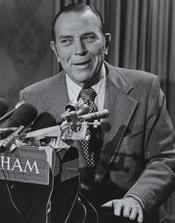
Bernice Sisk
Former U.S. Representative · California District 15 · 1955–1979 · Democratic
Bernice Sisk represented California's District 15 in the United States House of Representatives (1955–1979) for the Democratic party. The page below collects sourced biographical facts, term history, committee roles, and provenance for Sisk.
Bioguide ID: S000454
Key facts
- Full name
- Bernice Sisk
- State
- California
- District
- District 15
- Party
- Democratic
- House service
- 1955–1979
- First House term
- 1955
- Status
- Left office
- Current term ends
- —
- Born
- 1910
- Bioguide ID
- S000454
- Committee assignments
- —
- Dataset version
- 1.20260605
Biographical narrative
953 words · sourced from the Wikipedia REST extract
B. F. Sisk was an American politician who served as a U.S. Representative from California's 15th congressional district from 1955 until 1979. A member of the Democratic Party, Sisk was known for his significant contributions to agricultural legislation and water resource management in California. His tenure in Congress spanned twelve terms, during which he played a pivotal role in shaping policies that affected the agricultural landscape of the Central Valley and beyond.
Early life and career
B. F. Sisk was born on December 14, 1910, in Montague, Texas. He was the son of Lavina Thomas and Arthur Lee Sisk. Growing up in Texas, Sisk would later move to California, where he began his political career. His early life experiences and education laid the groundwork for his future involvement in public service and politics.
Before entering Congress, Sisk engaged in various professional pursuits that contributed to his understanding of the needs and concerns of his constituents. His background in agriculture and local community issues informed his later legislative priorities. Sisk's political career began to take shape when he decided to run for a seat in the U.S. House of Representatives.
In 1954, Sisk entered the political arena by challenging the incumbent Republican representative, Oakley Hunter, in the midterm elections. His campaign was marked by a focus on the needs of the agricultural community and the importance of federal support for local farmers. Sisk's victory in this election was notable, as he successfully unseated a long-standing Republican incumbent in a district that had historically leaned Republican. This upset was a significant moment in the political landscape of California, as it marked the beginning of a Democratic presence in a district that had been predominantly Republican for most of its history.
House tenure
Sisk was elected to the U.S. House of Representatives in 1954, officially beginning his first term in 1955. He represented California's 15th congressional district, which included key areas such as Fresno, Merced, and Modesto. Over the course of his twelve terms in office, Sisk became a prominent figure in Congress, known for his dedication to agricultural issues and his ability to navigate complex legislative challenges.
During his time in the House, Sisk established himself as a member of several important committees. He was a long-standing member of the House Rules Committee, which plays a crucial role in determining the legislative agenda and the procedures by which bills are considered. Additionally, he served on the Agriculture Committee, where he worked on policies that directly impacted farmers and agricultural producers in California.
One of Sisk's notable achievements was his chairmanship of the Cotton Subcommittee. In this role, he was instrumental in addressing the longstanding divisions between southern and western cotton producers, fostering collaboration and understanding among various stakeholders in the cotton industry. His approach emphasized production inducements rather than direct farm subsidies, reflecting his belief in supporting farmers through market-driven solutions.
Sisk's influence extended beyond cotton, as he advocated for legislation that benefited a variety of agricultural sectors, including dairy, wine, sugar, figs, and raisins. His efforts contributed to the development of policies that aimed to strengthen California's agricultural economy and ensure the viability of its diverse farming communities.
In addition to his work on agricultural issues, Sisk was a significant advocate for water resource management in California. He played a key role in the creation of the Central Valley Project, a major water management initiative that has had a lasting impact on the state's agricultural landscape. This project, which ultimately developed into a substantial water system, was designed to address the water needs of California's Central Valley, an area critical to the state's agricultural output.
Sisk's tenure in Congress lasted until January 3, 1979, when he chose to retire. His decision to step down marked the end of a lengthy and impactful career in public service. Following his retirement, he was succeeded by Tony Coelho, who had previously served as Sisk's chief of staff.
Legislative focus and committees
Throughout his congressional career, B. F. Sisk maintained a strong focus on agricultural issues, reflecting the needs of his constituents in California's Central Valley. His work on the Agriculture Committee allowed him to influence a wide range of policies that affected farmers and agricultural producers. Sisk's commitment to supporting the agricultural sector was evident in his advocacy for various industries, including cotton, dairy, and wine.
As a member of the House Rules Committee, Sisk was involved in shaping the legislative process and ensuring that agricultural issues received the attention they warranted. His role on this committee allowed him to navigate the complexities of Congress and advocate effectively for the interests of his district.
Sisk's chairmanship of the Cotton Subcommittee was particularly significant, as it provided him with a platform to address the challenges faced by cotton producers. His efforts to bridge the gap between southern and western cotton growers demonstrated his ability to foster cooperation among diverse agricultural interests.
In addition to his work on the Agriculture Committee, Sisk was also involved in broader legislative initiatives that impacted California's water resources. His advocacy for the Central Valley Project underscored his understanding of the critical relationship between water management and agricultural productivity. The project has been a cornerstone of California's water infrastructure, supporting the agricultural industry and contributing to the state's economy.
B. F. Sisk's legislative focus was characterized by a commitment to supporting the agricultural community and addressing the unique challenges faced by farmers in California. His work in Congress left a lasting legacy, contributing to the development of policies that continue to shape the agricultural landscape of the state. After retiring from Congress, Sisk remained a respected figure in California politics, and he passed away on October 25, 1995, in Fresno, California.
Notable legislation
Sponsored and co-sponsored legislation for Bernice Sisk is pending operator curation. The biographical narrative above carries the same provenance trail until per-bill rows are written.
Sources
- [1]https://en.wikipedia.org/wiki/B._F._SiskWikipedia · retrieved 2026-06-05
Notable quotes
Sourced quotes for Bernice Sisk are pending operator curation. Narrative-scope provenance remains attached below.
Sources
- [1]https://en.wikipedia.org/wiki/B._F._SiskWikipedia · retrieved 2026-06-05
Key positions
Curated policy positions for Bernice Sisk are pending operator review. The biographical narrative above carries the same provenance trail until per-topic positions are written.
Sources
- [1]https://en.wikipedia.org/wiki/B._F._SiskWikipedia · retrieved 2026-06-05
Terms served
- 1955–1957U.S. House · Term 1 · Democratic
- 1957–1959U.S. House · Term 2 · Democratic
- 1959–1961U.S. House · Term 3 · Democratic
- 1961–1963U.S. House · Term 4 · Democratic
- 1963–1965U.S. House · Term 5 · Democratic
- 1965–1967U.S. House · Term 6 · Democratic
- 1967–1969U.S. House · Term 7 · Democratic
- 1969–1971U.S. House · Term 8 · Democratic
- 1971–1973U.S. House · Term 9 · Democratic
- 1973–1975U.S. House · Term 10 · Democratic
- 1975–1977U.S. House · Term 11 · Democratic
- 1977–1979U.S. House · Term 12 · Democratic
Sources & provenance
Every attributable claim above carries a per-section [N] marker that resolves to the corresponding URL below. Each entry records the upstream provider, the canonical URL, and the timestamp at which the source was retrieved by the ingest pipeline.
Key facts
- https://bioguide.congress.gov/search/bio/S000454bioguide · retrieved 2026-06-05
- https://www.govtrack.us/congress/members/409946govtrack · retrieved 2026-06-05
Biographical narrative
- https://en.wikipedia.org/wiki/B._F._Siskwikipedia · retrieved 2026-06-05
Find your representative
Every U.S. state elects representatives by district. Browse California’s delegation, the full former-representative roster, or explore the role and term length.
Related on The Candidate
- Preceded by John CostelloEarlier holder of the California District 15 House seat · Democratic.Open
- Succeeded by Anthony CoelhoLater holder of the California District 15 House seat · Democratic.Open
- Barclay HenleyFormer U.S. Representative · California District 1 · DemocraticOpen
- Charles ClaytonFormer U.S. Representative · California District 1 · RepublicanOpen
- Clarence LeaFormer U.S. Representative · California District 1 · DemocraticOpen
- Clement MillerFormer U.S. Representative · California District 1 · DemocraticOpen