
Historical · U.S. House · California · District 15
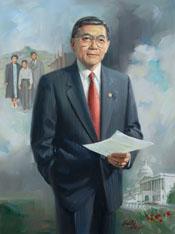
Norman Mineta
Former U.S. Representative · California District 15 · 1975–1995 · Democratic
Norman Mineta represented California's District 15 in the United States House of Representatives (1975–1995) for the Democratic party. The page below collects sourced biographical facts, term history, committee roles, and provenance for Mineta.
Bioguide ID: M000794
Key facts
- Full name
- Norman Mineta
- State
- California
- District
- District 15
- Party
- Democratic
- House service
- 1975–1995
- First House term
- 1975
- Status
- Left office
- Current term ends
- —
- Born
- 1931
- Bioguide ID
- M000794
- Committee assignments
- —
- Dataset version
- 1.20260605
Biographical narrative
978 words · sourced from the Wikipedia REST extract
Norman Y. Mineta was a prominent American politician and public servant who served as a U.S. Representative for California's 15th congressional district from 1975 until 1995. A member of the Democratic Party, Mineta was notable for his significant contributions to American politics, particularly in the areas of transportation and civil rights. He was also recognized for his historic roles as the first Asian American mayor of a major U.S. city and the first person of East Asian descent to serve in a U.S. Cabinet position. His career spanned multiple decades, during which he held various influential positions, including serving as Secretary of Commerce under President Bill Clinton and Secretary of Transportation under President George W. Bush.
Early life and career
Norman Yoshio Mineta was born on November 12, 1931, in San Jose, California, to Japanese immigrant parents, Kunisaku Mineta and Kane Watanabe. At the time of his birth, his parents were unable to become American citizens due to the restrictive Immigration Act of 1924. During World War II, Mineta and his family were forcibly relocated to an internment camp in Wyoming, where they spent several years alongside thousands of other Japanese Americans. This experience of internment profoundly impacted Mineta's life and later informed his political career, particularly his advocacy for civil rights and justice.
While in the internment camp, Mineta, who was a Boy Scout, formed a lasting friendship with Alan Simpson, a future U.S. Senator from Wyoming. Their bond, which began during their youth, would continue throughout their lives, reflecting a shared commitment to public service. After the war, Mineta completed his education, graduating from the University of California, Berkeley's School of Business Administration in 1953 with a degree in business administration. Following his graduation, he served in the United States Army as a military intelligence officer, stationed in Japan and South Korea. Upon completing his military service, Mineta returned to San Jose and joined his father in the family business, the Mineta Insurance Agency.
Mineta's political career began in local government when he was appointed to the San Jose City Council in 1967. He was elected to the council in his own right shortly thereafter and was subsequently elected vice mayor. In 1971, he ran for mayor of San Jose, winning decisively against a crowded field of candidates. His election marked a historic moment, as he became the first Japanese American mayor of a major U.S. city. During his tenure as mayor, which lasted until 1975, Mineta implemented policies that reshaped the city's growth and development, including the establishment of development-free zones in certain areas.
House tenure
In 1974, Mineta transitioned to national politics by running for the United States House of Representatives, representing California's 13th congressional district, which was later renumbered as the 15th district. He secured the Democratic nomination and won the election against California State Assembly member George W. Milias, garnering a significant portion of the vote. Over the course of his eleven terms in Congress, Mineta was re-elected ten additional times, consistently receiving strong support from his constituents in Silicon Valley. His electoral success was marked by never receiving less than 57 percent of the vote in any election.
During his time in the House, Mineta was a co-founder and the first chair of the Congressional Asian Pacific American Caucus, a group dedicated to addressing issues affecting Asian Pacific Americans. He played a critical role in various committees, notably serving as chairman of the House Committee on Transportation and Infrastructure from 1992 to 1994. His leadership extended to chairing the aviation subcommittee from 1981 to 1988 and the Surface Transportation subcommittee from 1989 to 1991.
Mineta's legislative contributions were significant, particularly in the realm of transportation. He was a key author of the Intermodal Surface Transportation Efficiency Act, which aimed to improve transportation infrastructure across the United States. Additionally, he advocated for increased funding for the Federal Aviation Administration, emphasizing the need for modernization and safety improvements in air travel. One of his most notable achievements was his instrumental role in the passage of the Civil Liberties Act of 1988, which formally acknowledged and apologized for the injustices faced by Japanese Americans during World War II. This legislation was a landmark moment in American history, reflecting Mineta's commitment to civil rights and justice.
Legislative focus and committees
Throughout his congressional career, Mineta's legislative focus was primarily on transportation, infrastructure, and civil rights. His work on the House Committee on Transportation and Infrastructure allowed him to influence key policies and initiatives that shaped the nation's transportation systems. He was particularly concerned with issues related to aviation safety and efficiency, advocating for reforms that would enhance the operational capabilities of the Federal Aviation Administration.
Mineta's commitment to civil rights was also a defining aspect of his legislative agenda. His efforts in co-founding the Congressional Asian Pacific American Caucus underscored his dedication to representing the interests of Asian Americans and advocating for policies that would address their unique challenges. His leadership in the passage of the Civil Liberties Act of 1988 was a testament to his resolve in seeking justice for those wronged by past government actions.
After resigning from Congress in 1995, Mineta continued to influence public policy through his work in the private sector and government. He took on a role with Lockheed Martin and chaired the National Civil Aviation Review Commission, which made recommendations for improving aviation safety and efficiency. His expertise in transportation led to his appointment as Secretary of Transportation under President George W. Bush, where he oversaw the establishment of the Transportation Security Administration in the wake of the September 11 attacks.
Mineta's legacy is marked by his trailblazing roles and significant contributions to American politics, particularly as a voice for civil rights and transportation reform. He passed away on May 3, 2022, leaving behind a legacy of public service that continues to inspire future generations.
Notable legislation
Sponsored and co-sponsored legislation for Norman Mineta is pending operator curation. The biographical narrative above carries the same provenance trail until per-bill rows are written.
Sources
- [1]https://en.wikipedia.org/wiki/Norman_MinetaWikipedia · retrieved 2026-06-05
Notable quotes
Sourced quotes for Norman Mineta are pending operator curation. Narrative-scope provenance remains attached below.
Sources
- [1]https://en.wikipedia.org/wiki/Norman_MinetaWikipedia · retrieved 2026-06-05
Key positions
Curated policy positions for Norman Mineta are pending operator review. The biographical narrative above carries the same provenance trail until per-topic positions are written.
Sources
- [1]https://en.wikipedia.org/wiki/Norman_MinetaWikipedia · retrieved 2026-06-05
Terms served
- 1975–1977U.S. House · Term 1 · Democratic
- 1977–1979U.S. House · Term 2 · Democratic
- 1979–1981U.S. House · Term 3 · Democratic
- 1981–1983U.S. House · Term 4 · Democratic
- 1983–1985U.S. House · Term 5 · Democratic
- 1985–1987U.S. House · Term 6 · Democratic
- 1987–1989U.S. House · Term 7 · Democratic
- 1989–1991U.S. House · Term 8 · Democratic
- 1991–1993U.S. House · Term 9 · Democratic
- 1993–1995U.S. House · Term 10 · Democratic
- 1995–1995U.S. House · Term 11 · Democratic
Sources & provenance
Every attributable claim above carries a per-section [N] marker that resolves to the corresponding URL below. Each entry records the upstream provider, the canonical URL, and the timestamp at which the source was retrieved by the ingest pipeline.
Key facts
- https://bioguide.congress.gov/search/bio/M000794bioguide · retrieved 2026-06-05
- https://www.govtrack.us/congress/members/407772govtrack · retrieved 2026-06-05
Biographical narrative
- https://en.wikipedia.org/wiki/Norman_Minetawikipedia · retrieved 2026-06-05
Find your representative
Every U.S. state elects representatives by district. Browse California’s delegation, the full former-representative roster, or explore the role and term length.
Related on The Candidate
- Preceded by Gordon McDonoughEarlier holder of the California District 15 House seat · Republican.Open
- Barclay HenleyFormer U.S. Representative · California District 1 · DemocraticOpen
- Charles ClaytonFormer U.S. Representative · California District 1 · RepublicanOpen
- Clarence LeaFormer U.S. Representative · California District 1 · DemocraticOpen
- Clement MillerFormer U.S. Representative · California District 1 · DemocraticOpen
- Democratic PartyFederal candidates and office holders on the Democratic line.Open