
Historical · U.S. House · California · District 18
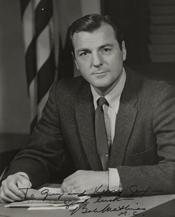
Bob Mathias
Former U.S. Representative · California District 18 · 1967–1975 · Republican
Bob Mathias represented California's District 18 in the United States House of Representatives (1967–1975) for the Republican party. The page below collects sourced biographical facts, term history, committee roles, and provenance for Mathias.
Bioguide ID: M000242
Key facts
- Full name
- Bob Mathias
- State
- California
- District
- District 18
- Party
- Republican
- House service
- 1967–1975
- First House term
- 1967
- Status
- Left office
- Current term ends
- —
- Born
- 1930
- Bioguide ID
- M000242
- Committee assignments
- —
- Dataset version
- 1.20260605
Biographical narrative
1,041 words · sourced from the Wikipedia REST extract
Robert B. (Bob) Mathias was an American decathlete, politician, and actor who served as a U.S. Representative for California's 18th congressional district from 1967 to 1975. A member of the Republican Party, Mathias is notable for his achievements in athletics, having won two Olympic gold medals in the decathlon during the 1948 and 1952 Summer Games. His transition from a celebrated athlete to a political figure marked a significant chapter in his life, reflecting his commitment to public service and community engagement.
Early life and career
Bob Mathias was born on November 17, 1930, in Tulare, California, into a family with partial Greek heritage. He grew up in Tulare and attended Tulare Union High School, where he developed a passion for athletics. During his time in high school, Mathias was encouraged by his track coach, Virgil Jackson, to take up the decathlon, a multi-event athletic competition. This decision would set the stage for his remarkable career in track and field.
In 1948, shortly after graduating from high school, Mathias qualified for the United States Olympic team for the London Summer Olympics. His Olympic debut was marked by challenges, as he was relatively inexperienced and unfamiliar with some of the event rules, particularly in the shot put. Despite these hurdles, Mathias demonstrated resilience and skill, ultimately winning the gold medal in the decathlon. At just 17 years old, he became the youngest gold medalist in a track and field event, a record that underscored his potential as an athlete.
Following his success in London, Mathias continued to excel in the decathlon, solidifying his status as one of the premier athletes in the sport. He received the James E. Sullivan Award in 1948, recognizing him as the nation's top amateur athlete. However, his academic performance did not match his athletic achievements, leading him to spend a year at The Kiski School, a prestigious all-boys boarding school in Pennsylvania. He subsequently enrolled at Stanford University in 1949, where he played college football and became a member of the Phi Gamma Delta fraternity.
Mathias's athletic prowess continued to shine at Stanford, where he set his first decathlon world record in 1950. He played a key role in leading the Stanford football team to a Rose Bowl appearance in 1952, which was notable for being the first nationally televised college football game. At the 1952 Helsinki Olympics, Mathias successfully defended his Olympic title, winning the decathlon by a significant margin and establishing a new world record. His performance at the games further elevated his status as a national hero, and his score of 7,887 points remained a Stanford record for over six decades.
After retiring from competitive athletics, Mathias graduated from Stanford in 1953 with a Bachelor of Arts in education. He then served in the U.S. Marine Corps for two and a half years, achieving the rank of captain before being honorably discharged. Following his military service, he became the first director of the United States Olympic Training Center, a position he held from 1977 to 1983. In addition to his athletic and military careers, Mathias appeared in various films and television shows throughout the 1950s, showcasing his versatility as a public figure.
House tenure
Bob Mathias's political career began when he was elected to the U.S. House of Representatives in 1966, representing California's 18th congressional district. His election came after he defeated the incumbent Democratic representative, Harlan Hagen, by a margin of approximately 11%. This victory was indicative of a broader political shift in the region, as the area began to move away from its New Deal Democratic roots. Mathias's tenure in Congress coincided with the governorship of Ronald Reagan, who served two terms during the same period.
During his four terms in the House, which lasted from 1967 until 1975, Mathias established himself as a prominent Republican voice in California. He was re-elected three times without facing significant opposition. However, in 1974, a mid-decade redistricting altered the boundaries of his congressional district, renumbering it as the 17th district. This change resulted in Mathias losing several rural areas while gaining a substantial section of Fresno. Ultimately, he was narrowly defeated in his bid for re-election by John Hans Krebs, a member of the Fresno County Board of Supervisors. This loss was part of a larger trend, as several Republicans were ousted from office in the aftermath of the Watergate scandal.
Following his congressional tenure, Mathias served as the deputy director of the Selective Service from June to August 1975. He also took on the role of regional director in the unsuccessful 1976 presidential campaign of Gerald Ford, further demonstrating his continued engagement in political and civic matters.
Legislative focus and committees
During his time in the U.S. House of Representatives, Bob Mathias was involved in various legislative initiatives and committee assignments. His political career was marked by a commitment to civil rights, as he voted in favor of the Civil Rights Act of 1968, aligning with the bipartisan support for civil rights legislation that characterized many politicians of his era. Mathias's background as an athlete and his experiences in the military likely influenced his perspectives on issues related to education, youth programs, and sports.
While specific details regarding the committees he served on during his congressional tenure are not provided, it is common for representatives to engage in committees that align with their interests and the needs of their constituents. Mathias's athletic background may have led him to advocate for policies that supported sports and physical education, as well as initiatives aimed at improving the welfare of young people.
After leaving Congress, Mathias remained active in various capacities, including his role at the Olympic Training Center, where he contributed to the development of future generations of athletes. His experiences as a public servant and his dedication to promoting sports and education continued to shape his legacy long after his departure from the political arena.
Bob Mathias passed away on September 2, 2006, after a battle with cancer. He was 75 years old at the time of his death and is interred at Tulare Cemetery in Tulare, California. He is survived by his wife, Gwen, and several children, reflecting the personal and familial aspects of his life that complemented his public achievements.
Notable legislation
Sponsored and co-sponsored legislation for Bob Mathias is pending operator curation. The biographical narrative above carries the same provenance trail until per-bill rows are written.
Sources
- [1]https://en.wikipedia.org/wiki/Bob_MathiasWikipedia · retrieved 2026-06-05
Notable quotes
Sourced quotes for Bob Mathias are pending operator curation. Narrative-scope provenance remains attached below.
Sources
- [1]https://en.wikipedia.org/wiki/Bob_MathiasWikipedia · retrieved 2026-06-05
Key positions
Curated policy positions for Bob Mathias are pending operator review. The biographical narrative above carries the same provenance trail until per-topic positions are written.
Sources
- [1]https://en.wikipedia.org/wiki/Bob_MathiasWikipedia · retrieved 2026-06-05
Terms served
- 1967–1969U.S. House · Term 1 · Republican
- 1969–1971U.S. House · Term 2 · Republican
- 1971–1973U.S. House · Term 3 · Republican
- 1973–1975U.S. House · Term 4 · Republican
Sources & provenance
Every attributable claim above carries a per-section [N] marker that resolves to the corresponding URL below. Each entry records the upstream provider, the canonical URL, and the timestamp at which the source was retrieved by the ingest pipeline.
Key facts
- https://bioguide.congress.gov/search/bio/M000242bioguide · retrieved 2026-06-05
- https://www.govtrack.us/congress/members/407260govtrack · retrieved 2026-06-05
Biographical narrative
- https://en.wikipedia.org/wiki/Bob_Mathiaswikipedia · retrieved 2026-06-05
Find your representative
Every U.S. state elects representatives by district. Browse California’s delegation, the full former-representative roster, or explore the role and term length.
Related on The Candidate
- Preceded by Harlan HagenEarlier holder of the California District 18 House seat · Democratic.Open
- Succeeded by Gary ConditLater holder of the California District 18 House seat · Democratic.Open
- Barclay HenleyFormer U.S. Representative · California District 1 · DemocraticOpen
- Charles ClaytonFormer U.S. Representative · California District 1 · RepublicanOpen
- Clarence LeaFormer U.S. Representative · California District 1 · DemocraticOpen
- Clement MillerFormer U.S. Representative · California District 1 · DemocraticOpen