
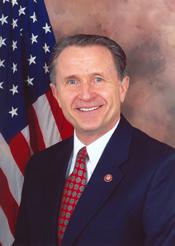
Historical · U.S. House · California · District 2
Wally Herger
Former U.S. Representative · California District 2 · 1987–2013 · Republican
Wally Herger represented California's District 2 in the United States House of Representatives (1987–2013) for the Republican party. The page below collects sourced biographical facts, term history, committee roles, and provenance for Herger.
Bioguide ID: H000528
Key facts
- Full name
- Wally Herger
- State
- California
- District
- District 2
- Party
- Republican
- House service
- 1987–2013
- First House term
- 1987
- Status
- Left office
- Current term ends
- —
- Born
- 1945
- Bioguide ID
- H000528
- Committee assignments
- —
- Dataset version
- 1.20260605
Biographical narrative
825 words · sourced from the Wikipedia REST extract
Walter William Herger Jr. is a former American politician who served as a U.S. Representative for California's 2nd congressional district from 1987 until 2013. A member of the Republican Party, Herger represented one of the largest congressional districts in California, encompassing a significant portion of interior Northern California, including cities such as Chico, Redding, and Red Bluff. Throughout his tenure, he was involved in various legislative efforts and served on key committees, particularly focusing on trade and welfare reform.
Early life and career
Wally Herger was born on May 20, 1945, in Yuba City, California. He has a diverse heritage that includes Swiss, German, and Irish ancestry, with his paternal grandfather having emigrated from the canton of Uri in Switzerland during the late 19th century. Growing up on a 200-acre cattle ranch and plum farm in Rio Oso, California, Herger was immersed in agricultural life from an early age. He also gained experience in the oil and gas exploration business, which was part of his family's ventures.
Herger's educational background includes an Associate of Arts degree from American River College, and he attended California State University, Sacramento, for a year. His political career began in 1976 when he was elected to the East Nicolaus School Board. He subsequently served in the California State Assembly from 1980 to 1986, where he represented northern California before transitioning to federal office.
In his personal life, Herger joined the Church of Jesus Christ of Latter-day Saints at around the age of 20. He is married to Pamela Sargent, and together they have nine children and 19 grandchildren.
House tenure
Wally Herger was first elected to the U.S. House of Representatives in 1986, officially beginning his congressional service in January 1987. Over the course of his political career, he was re-elected multiple times, benefiting from the Republican voter registration advantage in his district. His electoral campaigns faced challenges from Democratic opponents, particularly in his later years. Notably, he won significant victories against Democratic candidates such as Mike Johnson in 2002 and 2004, and Arjinderpal Sekhon in 2006. In 2008, he faced a more competitive race against Trinity County Supervisor Jeff Morris, who garnered a notable share of the vote. In 2010, Herger faced a primary challenge from retired Colonel Pete Stiglich but ultimately won the general election against Democrat Jim Reed.
Herger's tenure in the House was marked by his service on the influential House Committee on Ways and Means, a position he held throughout his time in Congress. Within this committee, he was involved in two subcommittees: the Subcommittee on Trade and the Subcommittee on Income Security and Family Support. His leadership roles included serving as the Ranking Member of the Republican delegation to the Trade Subcommittee during the 110th Congress and chairing the Subcommittee on Income Security and Family Support, previously known as the Subcommittee on Human Resources.
Herger's decision not to seek re-election was announced on January 10, 2012, concluding his 13 terms in the House when his final term ended on January 3, 2013.
Legislative focus and committees
Throughout his congressional career, Wally Herger focused on several key legislative areas, particularly those that aligned with the interests of his constituents in California's 2nd congressional district, which has a strong agricultural base. He supported initiatives aimed at promoting free and fair trade, recognizing the importance of these policies for the local economy. His role on the Trade Subcommittee positioned him to influence trade agreements and policies affecting the agricultural sector.
One of Herger's notable legislative efforts was his work on the Herger-Feinstein Quincy Library Group Forest Recovery Act. This legislation aimed to create a framework for managing federal forest assets in Lassen, Plumas, and Tehama counties, balancing the interests of environmental protection and logging. The act sought to reduce vegetation density in federal forest lands while enhancing biodiversity, addressing concerns about monoculture forests.
Additionally, Herger collaborated with Democratic Congressman Kendrick Meek to draft a bill aimed at repealing a 3 percent withholding tax that was scheduled to take effect in 2011. This tax would have applied to government contracts exceeding $100 million, requiring governments to withhold a portion of payments to contractors, which was expected to increase costs for local governments and potentially disadvantage them in procurement processes.
Herger's committee assignments included not only the Committee on Ways and Means but also specific subcommittees that allowed him to engage deeply with issues related to trade and health. His participation in the Congressional Biomass Caucus, the Congressional Caucus on Turkey and Turkish Americans, the Republican Study Committee, and the Tea Party Caucus further illustrated his engagement with a range of legislative interests and constituencies.
Throughout his congressional career, Herger's actions and decisions reflected the priorities of his district, particularly in areas related to agriculture, trade, and welfare reform. His long tenure in the House of Representatives was characterized by a commitment to addressing the needs of his constituents while navigating the complexities of federal legislation.
Notable legislation
Sponsored and co-sponsored legislation for Wally Herger is pending operator curation. The biographical narrative above carries the same provenance trail until per-bill rows are written.
Sources
- [1]https://en.wikipedia.org/wiki/Wally_HergerWikipedia · retrieved 2026-06-05
Notable quotes
Sourced quotes for Wally Herger are pending operator curation. Narrative-scope provenance remains attached below.
Sources
- [1]https://en.wikipedia.org/wiki/Wally_HergerWikipedia · retrieved 2026-06-05
Key positions
Curated policy positions for Wally Herger are pending operator review. The biographical narrative above carries the same provenance trail until per-topic positions are written.
Sources
- [1]https://en.wikipedia.org/wiki/Wally_HergerWikipedia · retrieved 2026-06-05
Terms served
- 1987–1989U.S. House · Term 1 · Republican
- 1989–1991U.S. House · Term 2 · Republican
- 1991–1993U.S. House · Term 3 · Republican
- 1993–1995U.S. House · Term 4 · Republican
- 1995–1997U.S. House · Term 5 · Republican
- 1997–1999U.S. House · Term 6 · Republican
- 1999–2001U.S. House · Term 7 · Republican
- 2001–2003U.S. House · Term 8 · Republican
- 2003–2005U.S. House · Term 9 · Republican
- 2005–2007U.S. House · Term 10 · Republican
- 2007–2009U.S. House · Term 11 · Republican
- 2009–2011U.S. House · Term 12 · Republican
- 2011–2013U.S. House · Term 13 · Republican
Sources & provenance
Every attributable claim above carries a per-section [N] marker that resolves to the corresponding URL below. Each entry records the upstream provider, the canonical URL, and the timestamp at which the source was retrieved by the ingest pipeline.
Key facts
- https://bioguide.congress.gov/search/bio/H000528bioguide · retrieved 2026-06-05
- http://www.house.gov/hergerhouse.gov · retrieved 2026-06-05
Biographical narrative
- https://en.wikipedia.org/wiki/Wally_Hergerwikipedia · retrieved 2026-06-05
Find your representative
Every U.S. state elects representatives by district. Browse California’s delegation, the full former-representative roster, or explore the role and term length.
Related on The Candidate
- Preceded by Eugene ChappieEarlier holder of the California District 2 House seat · Republican.Open
- Barclay HenleyFormer U.S. Representative · California District 1 · DemocraticOpen
- Charles ClaytonFormer U.S. Representative · California District 1 · RepublicanOpen
- Clarence LeaFormer U.S. Representative · California District 1 · DemocraticOpen
- Clement MillerFormer U.S. Representative · California District 1 · DemocraticOpen
- Republican PartyFederal candidates and office holders on the Republican line.Open