
Historical · U.S. House · California · District 20
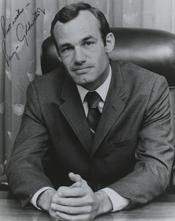
Barry Goldwater Jr.
Former U.S. Representative · California District 20 · 1969–1983 · Republican
Barry Goldwater Jr. represented California's District 20 in the United States House of Representatives (1969–1983) for the Republican party. The page below collects sourced biographical facts, term history, committee roles, and provenance for Jr..
Bioguide ID: G000268
Key facts
- Full name
- Barry Goldwater Jr.
- State
- California
- District
- District 20
- Party
- Republican
- House service
- 1969–1983
- First House term
- 1969
- Status
- Left office
- Current term ends
- —
- Born
- 1938
- Bioguide ID
- G000268
- Committee assignments
- —
- Dataset version
- 1.20260605
Biographical narrative
963 words · sourced from the Wikipedia REST extract
Barry Goldwater Jr. is a former American politician who served as a Republican member of the United States House of Representatives from California's 20th congressional district. His congressional career spanned from 1969 to 1983, during which he was known for his involvement in various legislative initiatives and his advocacy for conservative principles. He is the son of Barry Goldwater, a prominent U.S. Senator and the Republican presidential nominee in 1964, and the two served concurrently in Congress for a period of time.
Early life and career
Barry Morris Goldwater Jr. was born on July 15, 1938, in Los Angeles, California. He was raised in a politically active family, being the son of Barry Goldwater and Margaret Johnson. His father was a significant figure in American politics, which likely influenced Goldwater Jr.'s own political aspirations. He completed his secondary education at Staunton Military Academy in Virginia, graduating in 1957. Following high school, Goldwater attended the University of Colorado before transferring to Arizona State University, where he earned his degree in 1962.
After completing his education, Goldwater embarked on a career in the financial sector. He worked as a stockbroker in Los Angeles and later took on roles as a public relations executive and in an import-export business. His diverse professional background provided him with a foundation in business and finance, which would later inform his legislative priorities and policy positions.
In 1972, Goldwater married Susan Lee Gherman, whose family was well-established in Newport Beach, California. The couple had one son, Barry M. Goldwater III. However, their marriage ended in divorce in May 1979.
House tenure
Goldwater's political career began when he was elected to the U.S. House of Representatives in a special election held in January 1969. This election was necessitated by the resignation of Edwin Reinecke, who left his position to become the lieutenant governor of California. At the time, Goldwater represented California's 27th congressional district, which encompassed eastern Kern County and parts of northern Los Angeles County. He was nominated by the Republican Party and successfully won the special election, securing approximately 57% of the vote against his Democratic opponent, John Van de Kamp.
Following his initial victory, Goldwater was re-elected for two additional terms, demonstrating his electoral appeal and the support he garnered from constituents. In the lead-up to the 1974 elections, redistricting resulted in Goldwater being placed in California's 20th congressional district. He continued to serve in this new district, winning four more terms in office.
During his tenure in the House, Goldwater was a member of several key committees, including the Committee on Public Works and Transportation, the Joint Committee on Energy, and the Committee on Science and Technology. His involvement in these committees allowed him to contribute to a range of legislative issues, particularly those related to infrastructure, energy policy, and technological advancement. One of his notable legislative achievements was the drafting of the Privacy Act of 1974, which aimed to protect individuals' private information from being disclosed by government agencies and private businesses.
Goldwater's congressional career came to an end when he chose not to seek re-election in 1982. This decision was influenced by the redistricting process that merged his district with that of fellow Republican Bobbi Fiedler. Instead, Goldwater opted to run for the Republican nomination for the U.S. Senate. However, he lost the primary election to Pete Wilson, the mayor of San Diego, who subsequently won the general election and later served as governor of California. Goldwater attributed his defeat to various factors, including the challenges of running a campaign that he felt was not executed effectively.
Legislative focus and committees
Throughout his time in Congress, Goldwater's legislative focus reflected his conservative principles and commitment to limited government. He was particularly interested in issues related to individual rights, economic independence, and personal responsibility. His work on the Privacy Act of 1974 exemplified his dedication to protecting citizens' rights in the face of government and corporate overreach.
Goldwater's committee assignments provided him with opportunities to influence significant policy areas. As a member of the Committee on Public Works and Transportation, he was involved in discussions and decisions regarding infrastructure development and maintenance, which are critical components of national and local economies. His role on the Joint Committee on Energy allowed him to engage with energy policy at a time when the United States was grappling with energy crises and the need for sustainable energy solutions. Additionally, his participation in the Committee on Science and Technology highlighted his interest in promoting advancements in technology and innovation.
After leaving Congress, Goldwater continued to be active in political and public policy discussions. He returned to the financial sector, specializing in security law and underwriting, and became a member of the New York Stock Exchange. His professional experiences contributed to his understanding of economic issues, which he continued to advocate for in various capacities.
Goldwater's involvement in politics did not end with his congressional career. He supported several Republican candidates in subsequent elections, including Ronald Reagan in the 1980 presidential election and Arnold Schwarzenegger during the 2003 California gubernatorial recall election. His political engagement extended to endorsing Ron Paul in the 2008 presidential race, reflecting his ongoing commitment to conservative principles.
In addition to his political activities, Goldwater has served on the board of the Barry M. Goldwater Scholarship and Excellence in Education Program and the Goldwater Institute, a think tank that promotes conservative policies. Through these organizations, he has continued to influence public policy discussions, particularly in areas related to education and economic freedom.
Goldwater's legacy includes his contributions to the legislative process during his time in the House and his ongoing involvement in the conservative movement. His career reflects the complexities of American politics and the enduring impact of political families on the national stage.
Notable legislation
Sponsored and co-sponsored legislation for Barry Goldwater Jr. is pending operator curation. The biographical narrative above carries the same provenance trail until per-bill rows are written.
Sources
- [1]https://en.wikipedia.org/wiki/Barry_Goldwater_Jr.Wikipedia · retrieved 2026-06-05
Notable quotes
Sourced quotes for Barry Goldwater Jr. are pending operator curation. Narrative-scope provenance remains attached below.
Sources
- [1]https://en.wikipedia.org/wiki/Barry_Goldwater_Jr.Wikipedia · retrieved 2026-06-05
Key positions
Curated policy positions for Barry Goldwater Jr. are pending operator review. The biographical narrative above carries the same provenance trail until per-topic positions are written.
Sources
- [1]https://en.wikipedia.org/wiki/Barry_Goldwater_Jr.Wikipedia · retrieved 2026-06-05
Terms served
- 1969–1971U.S. House · Term 1 · Republican
- 1971–1973U.S. House · Term 2 · Republican
- 1973–1975U.S. House · Term 3 · Republican
- 1975–1977U.S. House · Term 4 · Republican
- 1977–1979U.S. House · Term 5 · Republican
- 1979–1981U.S. House · Term 6 · Republican
- 1981–1983U.S. House · Term 7 · Republican
Sources & provenance
Every attributable claim above carries a per-section [N] marker that resolves to the corresponding URL below. Each entry records the upstream provider, the canonical URL, and the timestamp at which the source was retrieved by the ingest pipeline.
Key facts
- https://bioguide.congress.gov/search/bio/G000268bioguide · retrieved 2026-06-05
- https://www.govtrack.us/congress/members/404630govtrack · retrieved 2026-06-05
Biographical narrative
- https://en.wikipedia.org/wiki/Barry_Goldwater_Jr.wikipedia · retrieved 2026-06-05
Find your representative
Every U.S. state elects representatives by district. Browse California’s delegation, the full former-representative roster, or explore the role and term length.
Related on The Candidate
- Preceded by John HinshawEarlier holder of the California District 20 House seat · Republican.Open
- Succeeded by Cal DooleyLater holder of the California District 20 House seat · Democratic.Open
- Barclay HenleyFormer U.S. Representative · California District 1 · DemocraticOpen
- Charles ClaytonFormer U.S. Representative · California District 1 · RepublicanOpen
- Clarence LeaFormer U.S. Representative · California District 1 · DemocraticOpen
- Clement MillerFormer U.S. Representative · California District 1 · DemocraticOpen