
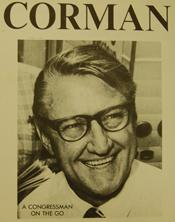
Historical · U.S. House · California · District 21
James Corman
Former U.S. Representative · California District 21 · 1961–1981 · Democratic
James Corman represented California's District 21 in the United States House of Representatives (1961–1981) for the Democratic party. The page below collects sourced biographical facts, term history, committee roles, and provenance for Corman.
Bioguide ID: C000780
Key facts
- Full name
- James Corman
- State
- California
- District
- District 21
- Party
- Democratic
- House service
- 1961–1981
- First House term
- 1961
- Status
- Left office
- Current term ends
- —
- Born
- 1920
- Bioguide ID
- C000780
- Committee assignments
- —
- Dataset version
- 1.20260605
Biographical narrative
985 words · sourced from the Wikipedia REST extract
James C. Corman was an American politician who served as a member of the United States House of Representatives from California's 21st congressional district from 1961 until 1981. A member of the Democratic Party, Corman's political career also included a term on the Los Angeles City Council from 1957 to 1961. Throughout his time in Congress, he was known for his involvement in significant legislative efforts, particularly in the areas of civil rights and healthcare.
Early life and career
James Charles Corman was born on October 20, 1920, in Galena, Kansas. He was the son of Ransford D. Corman and Edna V. Corman. His father worked as a silica miner but passed away due to lung disease attributed to his occupation. In 1933, Corman and his mother relocated to California, where he completed his education. He attended Belmont High School in Los Angeles and later pursued higher education at the University of California, Los Angeles (UCLA), earning a Bachelor of Arts degree. He continued his studies at the USC Gould School of Law, where he obtained his Juris Doctor degree.
Corman's military service began during World War II when he joined the U.S. Marine Corps after completing the Reserve Officer Training Corps program at UCLA. He was commissioned as a second lieutenant in June 1943. His service included time in the Mariana Islands, where he experienced combat and witnessed the realities of war. These experiences would later inform his perspectives and actions in public service.
Before entering Congress, Corman served on the Los Angeles City Council from 1957 to 1961. He was elected to represent District 7, a newly established district in the San Fernando Valley, after a campaign that garnered support from labor and Democratic voters. His tenure on the City Council was marked by his commitment to local issues, although he did not complete his full term as he was elected to the U.S. House of Representatives in 1960.
House tenure
Corman's congressional career began in 1961 when he was elected to represent California's 21st congressional district. He served in the House of Representatives for a total of ten terms, concluding his service on January 3, 1981. Throughout his time in Congress, Corman was known for his alignment with the Democratic Party and his active participation in various legislative initiatives.
During his tenure, Corman held the position of chair of the Democratic Congressional Campaign Committee from 1976 to 1981. This role involved overseeing campaign strategies and efforts to support Democratic candidates across the nation. His leadership in this capacity was significant, as he navigated the challenges of maintaining Democratic representation during a politically dynamic period in the United States.
Corman's legislative record includes support for several landmark pieces of legislation. He voted in favor of the 24th Amendment to the U.S. Constitution, which prohibited poll taxes in federal elections, and the Civil Rights Act of 1964, which aimed to end segregation in public places and ban employment discrimination. He also supported the Voting Rights Act of 1965, which sought to eliminate barriers to voting for African Americans and other minority groups.
In addition to civil rights legislation, Corman was a proponent of healthcare reform. He voted for the establishment of the Medicare program and was a co-sponsor of the Health Security Act, a universal healthcare proposal introduced by Senator Ted Kennedy in 1971. His commitment to healthcare issues reflected a broader Democratic agenda during the 1960s and 1970s, emphasizing the need for accessible medical care for all Americans.
Corman's congressional career came to an end in 1980 when he faced a narrow defeat in his bid for re-election against Bobbi Fiedler, a member of the Los Angeles School Board. This loss marked the conclusion of a significant chapter in his political life, during which he had established himself as a prominent figure in California politics.
Legislative focus and committees
Throughout his time in the House, Corman's legislative focus encompassed a range of issues, particularly those related to civil rights, healthcare, and social welfare. His support for civil rights legislation was consistent with the Democratic Party's platform during the 1960s and 1970s, as the nation grappled with issues of racial inequality and discrimination. Corman's votes on key pieces of legislation demonstrated his commitment to advancing civil rights and ensuring equal opportunities for all citizens.
In addition to civil rights, Corman's advocacy for healthcare reform was a defining aspect of his legislative career. His involvement in the Health Security Act highlighted his belief in the necessity of a comprehensive healthcare system that would provide coverage for all Americans. This initiative was part of a broader movement within the Democratic Party to address healthcare disparities and expand access to medical services.
Corman's committee assignments during his congressional tenure allowed him to influence various policy areas. While specific committee assignments are not detailed, members of Congress typically serve on committees that align with their legislative interests and the needs of their constituents. Corman's background in law and his experience on the City Council likely informed his contributions to discussions on legislation affecting urban development, public health, and social services.
After leaving Congress, Corman transitioned to a career in lobbying and consulting, establishing Corman Law Offices in Washington, D.C. His firm represented various clients, including major corporations and organizations. Corman's experience in Congress provided him with insights into the legislative process, which he leveraged in his post-congressional career.
Corman's legacy includes his contributions to civil rights and healthcare reform, as well as his role in shaping Democratic campaign strategies during a pivotal era in American politics. His commitment to public service and advocacy for social justice issues left a lasting impact on his constituents and the broader political landscape. In recognition of his contributions, the Van Nuys Federal Building was named in his honor in 2001. Corman passed away on December 30, 2000, leaving behind a legacy of dedication to public service and community engagement.
Notable legislation
Sponsored and co-sponsored legislation for James Corman is pending operator curation. The biographical narrative above carries the same provenance trail until per-bill rows are written.
Sources
- [1]https://en.wikipedia.org/wiki/James_C._CormanWikipedia · retrieved 2026-06-05
Notable quotes
Sourced quotes for James Corman are pending operator curation. Narrative-scope provenance remains attached below.
Sources
- [1]https://en.wikipedia.org/wiki/James_C._CormanWikipedia · retrieved 2026-06-05
Key positions
Curated policy positions for James Corman are pending operator review. The biographical narrative above carries the same provenance trail until per-topic positions are written.
Sources
- [1]https://en.wikipedia.org/wiki/James_C._CormanWikipedia · retrieved 2026-06-05
Terms served
- 1961–1963U.S. House · Term 1 · Democratic
- 1963–1965U.S. House · Term 2 · Democratic
- 1965–1967U.S. House · Term 3 · Democratic
- 1967–1969U.S. House · Term 4 · Democratic
- 1969–1971U.S. House · Term 5 · Democratic
- 1971–1973U.S. House · Term 6 · Democratic
- 1973–1975U.S. House · Term 7 · Democratic
- 1975–1977U.S. House · Term 8 · Democratic
- 1977–1979U.S. House · Term 9 · Democratic
- 1979–1981U.S. House · Term 10 · Democratic
Sources & provenance
Every attributable claim above carries a per-section [N] marker that resolves to the corresponding URL below. Each entry records the upstream provider, the canonical URL, and the timestamp at which the source was retrieved by the ingest pipeline.
Key facts
- https://bioguide.congress.gov/search/bio/C000780bioguide · retrieved 2026-06-05
- https://www.govtrack.us/congress/members/402900govtrack · retrieved 2026-06-05
Biographical narrative
- https://en.wikipedia.org/wiki/James_C._Cormanwikipedia · retrieved 2026-06-05
Find your representative
Every U.S. state elects representatives by district. Browse California’s delegation, the full former-representative roster, or explore the role and term length.
Related on The Candidate
- Succeeded by Bobbi FiedlerLater holder of the California District 21 House seat · Republican.Open
- Barclay HenleyFormer U.S. Representative · California District 1 · DemocraticOpen
- Charles ClaytonFormer U.S. Representative · California District 1 · RepublicanOpen
- Clarence LeaFormer U.S. Representative · California District 1 · DemocraticOpen
- Clement MillerFormer U.S. Representative · California District 1 · DemocraticOpen
- Democratic PartyFederal candidates and office holders on the Democratic line.Open