
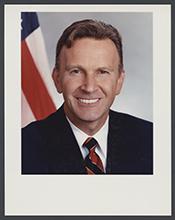
Historical · U.S. House · California · District 27
James Rogan
Former U.S. Representative · California District 27 · 1997–2001 · Republican
James Rogan represented California's District 27 in the United States House of Representatives (1997–2001) for the Republican party. The page below collects sourced biographical facts, term history, committee roles, and provenance for Rogan.
Bioguide ID: R000386
Key facts
- Full name
- James Rogan
- State
- California
- District
- District 27
- Party
- Republican
- House service
- 1997–2001
- First House term
- 1997
- Status
- Left office
- Current term ends
- —
- Born
- 1957
- Bioguide ID
- R000386
- Committee assignments
- —
- Dataset version
- 1.20260605
Biographical narrative
1,004 words · sourced from the Wikipedia REST extract
James E. Rogan is a former U.S. Representative from California, serving the 27th congressional district as a member of the Republican Party from 1997 to 2001. Following his tenure in Congress, he transitioned into a legal career, serving as a judge on the Orange County Superior Court from 2006 until 2023. Rogan's background includes a diverse range of experiences in law, politics, and academia, reflecting a career marked by significant roles in both state and federal government.
Early life and career
Born on August 21, 1957, Rogan's early life was marked by challenges, including being expelled from high school in the tenth grade. Despite this setback, he pursued higher education, initially attending Chabot Community College, which is now known as Las Positas Community College, located in Livermore, California. Rogan later earned a bachelor's degree in political science from the University of California, Berkeley. His academic journey culminated in a Juris Doctor degree from UCLA School of Law, where he was an active member of the UCLA Law Review. To support himself during law school, he worked various jobs, including as a bartender and bouncer in Hollywood nightclubs.
Rogan's professional career began in the legal field, where he worked briefly as a civil litigation attorney at one of Los Angeles' oldest law firms, Lillick McHose & Charles, from 1983 to 1985. He then transitioned to a role as a Deputy District Attorney for Los Angeles County, where he was later assigned to the Hardcore Gang Murder Unit. In this capacity, he prosecuted cases involving some of the city's most notorious street gangs. His effectiveness as a prosecutor was recognized in a statewide poll conducted by California Lawyer Magazine, which named him one of the state's most effective prosecutors.
In 1990, Rogan was appointed by Governor George Deukmejian to serve as a judge on the Glendale Municipal Court, making him the youngest sitting state court judge in California at that time. During his tenure on the municipal court from 1990 to 1994, he presided over thousands of civil and criminal cases. His peers recognized his leadership abilities, electing him as the presiding judge of the court in 1993. In addition to his judicial responsibilities, Rogan began teaching as an adjunct law professor in 1987, a role he maintained for over two decades, covering subjects such as criminal law, criminal procedure, trial practice, and trial advocacy, among others.
House tenure
In 1994, Rogan entered the political arena by winning a special election for the California State Assembly, succeeding former GOP minority leader Pat Nolan, who had resigned following a conviction related to illegal campaign contributions. During his time in the Assembly, Rogan quickly rose to prominence, being elected Majority Leader by his colleagues. His effectiveness as a legislator was acknowledged by California Journal Magazine, which ranked him highly in terms of integrity and effectiveness. He served on several important committees, including Appropriations, Budget, Public Safety, Natural Resources, and Education.
Rogan's political career advanced further when he was elected to the United States House of Representatives in 1996. He secured his seat with a narrow margin of 50.1%, marking the beginning of his first term in Congress. During his time in the House, he served on both the House Commerce Committee and the House Judiciary Committee, making him one of only two members to hold positions on both influential committees simultaneously. His work on the Judiciary Committee involved reviewing proposed legislation on a wide array of issues, including intellectual property, trade, and immigration. Notably, he played a significant role in advocating for an increase in H1-B immigration visas, which are vital for the high-tech sector.
As a member of the House Commerce Committee, Rogan contributed to legislation concerning interstate and foreign commerce, telecommunications, consumer protection, and national energy policy. His responsibilities included serving on two critical subcommittees: Telecommunications, Trade and Consumer Protection, and Energy and Power. In addition to his committee work, Rogan held the position of Assistant Majority Whip for the House Republican Conference, where he was instrumental in mobilizing votes on key legislative initiatives and coordinating strategies within Congress. He was also involved in advisory groups for Speaker Newt Gingrich and Majority Leader Dick Armey, participating in discussions about political and legislative strategies.
Rogan's congressional tenure was marked by his involvement in the impeachment trial of President Bill Clinton, where he was selected as one of thirteen House managers. His background as a prosecutor and his reputation for bipartisanship positioned him as a respected figure during this contentious period. However, the political landscape in his district was shifting, with increasing opposition to the impeachment among constituents. In 2000, Rogan faced a challenging re-election campaign against then-state senator Adam Schiff, ultimately losing in what was then the most expensive House race in history.
Legislative focus and committees
Throughout his time in Congress, Rogan's legislative focus encompassed a range of issues reflecting his legal background and political priorities. His work on the House Judiciary Committee involved addressing complex matters related to intellectual property, trade, and immigration, where he advocated for policies that supported the high-tech industry. His role on the House Commerce Committee allowed him to engage with critical issues surrounding consumer protection, telecommunications, and energy policy, contributing to the development of legislation that impacted various sectors of the economy.
Rogan's leadership as Assistant Majority Whip and his participation in advisory groups underscored his commitment to advancing the Republican agenda during a pivotal time in American politics. His involvement in the impeachment trial of President Clinton highlighted his legal expertise and ability to navigate contentious political issues. Despite the challenges he faced in his re-election bid, Rogan's tenure in the House was characterized by active engagement in legislative processes and a focus on issues relevant to his constituents and the nation.
After leaving Congress, Rogan continued his career in law, eventually serving as a judge on the Orange County Superior Court from 2006 until 2023. His diverse experiences in law, politics, and academia reflect a multifaceted career dedicated to public service and the legal profession.
Notable legislation
Sponsored and co-sponsored legislation for James Rogan is pending operator curation. The biographical narrative above carries the same provenance trail until per-bill rows are written.
Sources
- [1]https://en.wikipedia.org/wiki/James_E._RoganWikipedia · retrieved 2026-06-05
Notable quotes
Sourced quotes for James Rogan are pending operator curation. Narrative-scope provenance remains attached below.
Sources
- [1]https://en.wikipedia.org/wiki/James_E._RoganWikipedia · retrieved 2026-06-05
Key positions
Curated policy positions for James Rogan are pending operator review. The biographical narrative above carries the same provenance trail until per-topic positions are written.
Sources
- [1]https://en.wikipedia.org/wiki/James_E._RoganWikipedia · retrieved 2026-06-05
Terms served
- 1997–1999U.S. House · Term 1 · Republican
- 1999–2001U.S. House · Term 2 · Republican
Sources & provenance
Every attributable claim above carries a per-section [N] marker that resolves to the corresponding URL below. Each entry records the upstream provider, the canonical URL, and the timestamp at which the source was retrieved by the ingest pipeline.
Key facts
- https://bioguide.congress.gov/search/bio/R000386bioguide · retrieved 2026-06-05
- https://www.govtrack.us/congress/members/400605govtrack · retrieved 2026-06-05
Biographical narrative
- https://en.wikipedia.org/wiki/James_E._Roganwikipedia · retrieved 2026-06-05
Find your representative
Every U.S. state elects representatives by district. Browse California’s delegation, the full former-representative roster, or explore the role and term length.
Related on The Candidate
- Preceded by Carlos MoorheadEarlier holder of the California District 27 House seat · Republican.Open
- Succeeded by Mike GarciaLater holder of the California District 27 House seat · Republican.Open
- Barclay HenleyFormer U.S. Representative · California District 1 · DemocraticOpen
- Charles ClaytonFormer U.S. Representative · California District 1 · RepublicanOpen
- Clarence LeaFormer U.S. Representative · California District 1 · DemocraticOpen
- Clement MillerFormer U.S. Representative · California District 1 · DemocraticOpen