
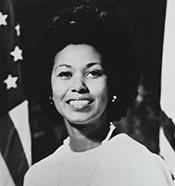
Historical · U.S. House · California · District 28
Yvonne Burke
Former U.S. Representative · California District 28 · 1973–1979 · Democratic
Yvonne Burke represented California's District 28 in the United States House of Representatives (1973–1979) for the Democratic party. The page below collects sourced biographical facts, term history, committee roles, and provenance for Burke.
Bioguide ID: B001102
Key facts
- Full name
- Yvonne Burke
- State
- California
- District
- District 28
- Party
- Democratic
- House service
- 1973–1979
- First House term
- 1973
- Status
- Left office
- Current term ends
- —
- Born
- 1932
- Bioguide ID
- B001102
- Committee assignments
- —
- Dataset version
- 1.20260605
Biographical narrative
965 words · sourced from the Wikipedia REST extract
Yvonne B. Burke is a notable American politician and lawyer who served as a U.S. Representative for California's 28th congressional district from 1973 to 1979. A member of the Democratic Party, she made history as the first African-American woman to represent the West Coast in Congress. Burke's career is marked by her advocacy for civil rights and social justice, as well as her significant contributions to local governance in Los Angeles County, where she served on the Board of Supervisors for over a decade. Her legacy includes breaking barriers for women and minorities in politics, as well as her role in shaping policies during her time in office.
Early life and career
Yvonne Pearl Watson, later known as Yvonne B. Burke, was born on October 5, 1932, in Los Angeles, California. She was the only child of James A. Watson and Lola Moore. Burke's early education began in public schools, but she later attended a model school designed for exceptional children. Her academic journey continued at Manual Arts High School, where she was an active participant in extracurricular activities, including the debate team and various leadership roles in school clubs.
Burke's higher education commenced at the University of California, Berkeley, where she studied from approximately 1949 to 1951. She then transferred to the University of California, Los Angeles (UCLA), where she earned a bachelor's degree in political science in 1953. Following her undergraduate studies, she pursued a legal education at the University of Southern California Law School, obtaining her Juris Doctor (J.D.) degree in 1956. Burke was among the first African-American women to gain admission to this law school, reflecting her pioneering spirit in a predominantly male and white profession.
Burke's entry into politics began in earnest when she volunteered for the reelection campaign of President Lyndon B. Johnson in 1964. Her political career took a significant step forward in 1966 when she was elected to the California State Assembly, representing the 63rd District of Los Angeles. During her six-year tenure in the Assembly, Burke focused on juvenile justice issues and worked on legislation aimed at limiting wage garnishment, demonstrating her commitment to social reform.
In 1972, Burke served as vice-chairperson of the Democratic National Convention, marking a historic achievement as the first African American and first woman of color to hold that position. Her leadership role at the convention showcased her growing influence within the Democratic Party and set the stage for her subsequent election to the U.S. Congress later that same year.
House tenure
Yvonne B. Burke's congressional career began when she was elected to the U.S. House of Representatives in 1973, representing California's 28th congressional district. During her time in Congress, she served three terms until her departure in 1979. Burke's tenure was marked by her involvement in various committees, including the House Select Committee on Assassinations, the House Beauty Shop Committee, and the House Committee on Appropriations. Her work on the Appropriations Committee was particularly notable, as she advocated for increased funding to assist local jurisdictions in complying with desegregation mandates.
In a groundbreaking moment for women in politics, Burke became the first member of Congress to give birth while in office in 1973. This milestone was significant not only for her personal life but also for the broader representation of women in government. Following the birth of her daughter, Autumn, Burke was granted maternity leave by the Speaker of the House, a historic first that highlighted the challenges faced by women in balancing family and professional responsibilities.
Despite her accomplishments, Burke chose not to seek reelection in 1978, opting instead to run for the position of Attorney General of California. However, she was defeated in the election by Republican candidate George Deukmejian.
Legislative focus and committees
Throughout her congressional career, Yvonne B. Burke was known for her commitment to civil rights and social justice. Her legislative focus included issues related to education, juvenile justice, and civil rights, reflecting her background and experiences in the California State Assembly. Burke's work on the House Committee on Appropriations was particularly impactful, as she sought to secure funding for programs that supported desegregation efforts in schools and communities.
Burke's involvement in the House Select Committee on Assassinations allowed her to contribute to investigations into significant historical events, further underscoring her commitment to transparency and accountability in government. Her participation in the House Beauty Shop Committee, while less conventional, highlighted her understanding of the social dynamics within Congress and her willingness to engage with diverse issues.
Following her departure from Congress, Burke continued her public service career. In 1979, shortly after leaving her congressional seat, she was appointed by Governor Jerry Brown to the Board of Regents of the University of California. However, she resigned later that year to fill a vacancy on the Los Angeles County Board of Supervisors, where she became the first female and first African-American supervisor. Her district was primarily composed of affluent, conservative areas, presenting unique challenges as she navigated her role in local governance.
Burke's political journey continued with her successful campaign for the District 2 seat on the Los Angeles County Board of Supervisors in 1992, shortly after the Los Angeles Riots. She served in this capacity until announcing her retirement in 2007, with her tenure marked by both accomplishments and controversies regarding her residency.
In addition to her local government work, Burke was appointed to the Amtrak Board of Directors by President Barack Obama in 2012, serving until 2024. This appointment further exemplified her ongoing commitment to public service and transportation issues.
Yvonne B. Burke's career reflects a significant chapter in American political history, particularly regarding the representation of women and minorities in government. Her contributions to legislation, local governance, and public service continue to resonate in discussions about diversity and inclusion in politics.
Notable legislation
Sponsored and co-sponsored legislation for Yvonne Burke is pending operator curation. The biographical narrative above carries the same provenance trail until per-bill rows are written.
Sources
- [1]https://en.wikipedia.org/wiki/Yvonne_Brathwaite_BurkeWikipedia · retrieved 2026-06-05
Notable quotes
Sourced quotes for Yvonne Burke are pending operator curation. Narrative-scope provenance remains attached below.
Sources
- [1]https://en.wikipedia.org/wiki/Yvonne_Brathwaite_BurkeWikipedia · retrieved 2026-06-05
Key positions
Curated policy positions for Yvonne Burke are pending operator review. The biographical narrative above carries the same provenance trail until per-topic positions are written.
Sources
- [1]https://en.wikipedia.org/wiki/Yvonne_Brathwaite_BurkeWikipedia · retrieved 2026-06-05
Terms served
- 1973–1975U.S. House · Term 1 · Democratic
- 1975–1977U.S. House · Term 2 · Democratic
- 1977–1979U.S. House · Term 3 · Democratic
Sources & provenance
Every attributable claim above carries a per-section [N] marker that resolves to the corresponding URL below. Each entry records the upstream provider, the canonical URL, and the timestamp at which the source was retrieved by the ingest pipeline.
Key facts
- https://bioguide.congress.gov/search/bio/B001102bioguide · retrieved 2026-06-05
- https://www.govtrack.us/congress/members/402047govtrack · retrieved 2026-06-05
Biographical narrative
- https://en.wikipedia.org/wiki/Yvonne_Brathwaite_Burkewikipedia · retrieved 2026-06-05
Find your representative
Every U.S. state elects representatives by district. Browse California’s delegation, the full former-representative roster, or explore the role and term length.
Related on The Candidate
- Succeeded by Howard BermanLater holder of the California District 28 House seat · Democratic.Open
- Barclay HenleyFormer U.S. Representative · California District 1 · DemocraticOpen
- Charles ClaytonFormer U.S. Representative · California District 1 · RepublicanOpen
- Clarence LeaFormer U.S. Representative · California District 1 · DemocraticOpen
- Clement MillerFormer U.S. Representative · California District 1 · DemocraticOpen
- Democratic PartyFederal candidates and office holders on the Democratic line.Open