
Historical · U.S. House · California · District 31
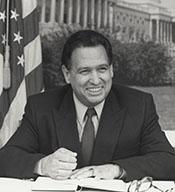
Matthew Martínez
Former U.S. Representative · California District 31 · 1981–2001 · Republican
Matthew Martínez represented California's District 31 in the United States House of Representatives (1981–2001) for the Republican party. The page below collects sourced biographical facts, term history, committee roles, and provenance for Martínez.
Bioguide ID: M000206
Key facts
- Full name
- Matthew Martínez
- State
- California
- District
- District 31
- Party
- Republican
- House service
- 1981–2001
- First House term
- 1981
- Status
- Left office
- Current term ends
- —
- Born
- 1929
- Bioguide ID
- M000206
- Committee assignments
- —
- Dataset version
- 1.20260605
Biographical narrative
988 words · sourced from the Wikipedia REST extract
Matthew G. Martinez was an American politician who served as a U.S. Representative for California's 30th and 31st congressional districts. His tenure in the U.S. House of Representatives spanned from 1982 to 2001, during which he was initially a member of the Democratic Party before switching to the Republican Party later in his career. Over the course of his political life, Martinez was involved in various local and state government roles, and he was known for his work on committees related to education, labor, and human resources.
Early life and career
Matthew Gilbert Martinez was born on February 14, 1929. He spent his formative years in Los Angeles, California, where he attended public schools. After graduating from Roosevelt High School in 1949, he enlisted in the U.S. Marine Corps, serving from 1947 to 1950 and achieving the rank of private first class. Following his military service, Martinez pursued further education and received a certificate of competence from the Los Angeles Trade-Technical College in 1956.
Martinez entered the workforce as a businessman, owning and operating a custom furniture upholstery company. He also worked as a building contractor for approximately fifteen years, gaining valuable experience in the private sector. His early career laid the groundwork for his later involvement in public service and politics.
Martinez's political career began in 1971 when he was appointed to the Monterey Park Planning Commission, a role he held until 1974. He then successfully ran for a seat on the Monterey Park City Council, serving from 1974 to 1980. During his time on the council, he held the position of mayor twice, first in 1974 and again in 1980. His local government experience provided him with insights into the needs and concerns of his constituents, which would later inform his work at the state and federal levels.
In 1980, Martinez transitioned to state politics by defeating incumbent Jack R. Fenton in the Democratic primary for California's 59th State Assembly district. He won the election without facing a major-party opponent, marking the beginning of his legislative career in the California State Assembly.
House tenure
Martinez's congressional career began in 1982 when he won a special election to succeed George E. Danielson, who had left the House to take a judicial position. He was subsequently re-elected to the House of Representatives nine times, serving a total of ten terms. His initial assignment in Congress was to the Education and Labor Committee, where he focused on issues related to education and workforce development.
During the 99th Congress, which spanned from 1985 to 1987, Martinez chaired the Subcommittee on Employment Opportunities, a role that allowed him to influence legislation concerning job creation and labor issues. His leadership in this subcommittee reflected his commitment to improving employment prospects for his constituents.
In 1991, Martinez was appointed chairman of the Human Resources Subcommittee, further expanding his influence in areas related to social services and public welfare. The following year, he joined the Foreign Affairs Committee, where he served on the Subcommittee on International Security, International Organizations, and Human Rights. This role enabled him to engage with global issues and advocate for human rights on an international stage.
Martinez's congressional career was marked by a focus on education, labor, and human rights, with his committee assignments reflecting his interests and expertise in these areas. Throughout his time in office, he maintained a strong connection to his district, addressing local concerns while also participating in broader national and international discussions.
Legislative focus and committees
Throughout his tenure in the U.S. House of Representatives, Martinez was involved in various legislative initiatives that aligned with his interests in education, labor, and human rights. His work on the Education and Labor Committee allowed him to advocate for policies that aimed to improve educational opportunities and workforce development programs. As chairman of the Subcommittee on Employment Opportunities, he played a significant role in shaping legislation that addressed employment challenges and aimed to enhance job prospects for individuals in his district and beyond.
Martinez's leadership in the Human Resources Subcommittee further underscored his commitment to social welfare issues. He worked on initiatives that sought to improve access to essential services for families and individuals in need. His focus on human resources reflected a broader concern for the well-being of his constituents, particularly those facing economic hardships.
In addition to his domestic policy work, Martinez's involvement in the Foreign Affairs Committee highlighted his interest in international relations and human rights advocacy. His participation in the Subcommittee on International Security, International Organizations, and Human Rights allowed him to engage with pressing global issues, emphasizing the importance of human rights in U.S. foreign policy.
Despite his long-standing affiliation with the Democratic Party, Martinez's political alignment shifted in the latter part of his career. After being defeated in the 2000 Democratic primary by Hilda Solis, he switched to the Republican Party, citing a feeling of abandonment by the Democratic Party. This change in party affiliation marked a significant shift in his political identity, as he began to align more closely with Republican values and policies.
Martinez's congressional career concluded on January 3, 2001, at the end of the 106th Congress. His departure from the House marked the end of a lengthy and varied political career that began at the local level and culminated in significant roles at both the state and federal levels.
Following his congressional tenure, Martinez remained active in political circles, particularly within the Republican Party. He continued to engage with community organizations and maintained a presence in local civic activities. His contributions to public service and politics were recognized by various organizations, reflecting his commitment to his constituents and the broader community.
Matthew G. Martinez passed away on October 15, 2011, at his home in Fredericksburg, Virginia, after suffering from congestive heart failure. His legacy includes a significant record of public service and a commitment to addressing the needs of his constituents throughout his political career.
Notable legislation
Sponsored and co-sponsored legislation for Matthew Martínez is pending operator curation. The biographical narrative above carries the same provenance trail until per-bill rows are written.
Sources
- [1]https://en.wikipedia.org/wiki/Matthew_G._Mart%C3%ADnezWikipedia · retrieved 2026-06-05
Notable quotes
Sourced quotes for Matthew Martínez are pending operator curation. Narrative-scope provenance remains attached below.
Sources
- [1]https://en.wikipedia.org/wiki/Matthew_G._Mart%C3%ADnezWikipedia · retrieved 2026-06-05
Key positions
Curated policy positions for Matthew Martínez are pending operator review. The biographical narrative above carries the same provenance trail until per-topic positions are written.
Sources
- [1]https://en.wikipedia.org/wiki/Matthew_G._Mart%C3%ADnezWikipedia · retrieved 2026-06-05
Terms served
- 1981–1983U.S. House · Term 1 · Democratic
- 1983–1985U.S. House · Term 2 · Democratic
- 1985–1987U.S. House · Term 3 · Democratic
- 1987–1989U.S. House · Term 4 · Democratic
- 1989–1991U.S. House · Term 5 · Democratic
- 1991–1993U.S. House · Term 6 · Democratic
- 1993–1995U.S. House · Term 7 · Democratic
- 1995–1997U.S. House · Term 8 · Democratic
- 1997–1999U.S. House · Term 9 · Democratic
- 1999–2001U.S. House · Term 10 · Republican
Sources & provenance
Every attributable claim above carries a per-section [N] marker that resolves to the corresponding URL below. Each entry records the upstream provider, the canonical URL, and the timestamp at which the source was retrieved by the ingest pipeline.
Key facts
- https://bioguide.congress.gov/search/bio/M000206bioguide · retrieved 2026-06-05
- https://www.govtrack.us/congress/members/400595govtrack · retrieved 2026-06-05
Biographical narrative
- https://en.wikipedia.org/wiki/Matthew_G._Mart%C3%ADnezwikipedia · retrieved 2026-06-05
Find your representative
Every U.S. state elects representatives by district. Browse California’s delegation, the full former-representative roster, or explore the role and term length.
Related on The Candidate
- Preceded by Charles WilsonEarlier holder of the California District 31 House seat · Democratic.Open
- Barclay HenleyFormer U.S. Representative · California District 1 · DemocraticOpen
- Charles ClaytonFormer U.S. Representative · California District 1 · RepublicanOpen
- Clarence LeaFormer U.S. Representative · California District 1 · DemocraticOpen
- Clement MillerFormer U.S. Representative · California District 1 · DemocraticOpen
- Republican PartyFederal candidates and office holders on the Republican line.Open