
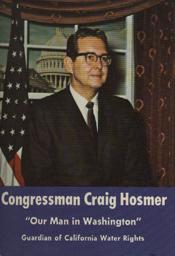
Historical · U.S. House · California · District 32
Craig Hosmer
Former U.S. Representative · California District 32 · 1953–1975 · Republican
Craig Hosmer represented California's District 32 in the United States House of Representatives (1953–1975) for the Republican party. The page below collects sourced biographical facts, term history, committee roles, and provenance for Hosmer.
Bioguide ID: H000802
Key facts
- Full name
- Craig Hosmer
- State
- California
- District
- District 32
- Party
- Republican
- House service
- 1953–1975
- First House term
- 1953
- Status
- Left office
- Current term ends
- —
- Born
- 1915
- Bioguide ID
- H000802
- Committee assignments
- —
- Dataset version
- 1.20260605
Biographical narrative
911 words · sourced from the Wikipedia REST extract
Chester Craig Hosmer was an American lawyer and politician who served as a U.S. Representative for California's 32nd congressional district from 1953 until 1974. A member of the Republican Party, Hosmer completed eleven terms in the House of Representatives, where he participated in significant legislative actions and was involved in various political issues of his time. His career spanned over two decades, during which he engaged in both military and legal professions before entering politics.
Early life and career
Craig Hosmer was born on May 6, 1915, in Brea, California, located in Orange County. He completed his primary and secondary education in local public schools, culminating in his graduation from Long Beach Polytechnic High School. Following high school, Hosmer pursued higher education at the University of California, Berkeley, where he earned his degree in 1937. His legal education continued at the University of Michigan Law School in 1938, and he ultimately graduated from the University of Southern California Law School in 1940. Upon his admission to the bar in the same year, he began practicing law in Long Beach, California.
In addition to his legal career, Hosmer served in the United States Navy, enlisting in July 1940. He advanced through the ranks to become a commander and later achieved the rank of rear admiral in the Naval Reserve. His military service provided him with valuable leadership experience and a sense of duty that would later inform his political career.
After his military service, Hosmer worked as an attorney for the U.S. Atomic Energy Commission at Los Alamos, New Mexico, and served as a special assistant United States District Attorney for New Mexico in 1948. Following this role, he returned to Long Beach to continue his private legal practice.
House tenure
Craig Hosmer's political career began with an unsuccessful bid for the U.S. House of Representatives in 1950, when he ran as a Republican candidate for the Eighty-second Congress. However, he was elected to the Eighty-third Congress and subsequently won election to ten additional Congresses, serving from January 3, 1953, until his resignation on December 31, 1974. Throughout his tenure, Hosmer was involved in various legislative initiatives and was known for his active participation in debates and discussions on key issues.
During his time in Congress, Hosmer voted in favor of several significant pieces of legislation, including the Civil Rights Acts of 1957, 1960, 1964, and 1968, which aimed to address racial discrimination and promote civil rights in the United States. He also supported the 24th Amendment to the U.S. Constitution, which prohibited poll taxes in federal elections. However, he did not cast a vote on the Voting Rights Act of 1965, a landmark piece of legislation that aimed to eliminate various barriers to voting for African Americans.
In addition to his legislative actions, Hosmer was known for his strong stance on certain foreign policy issues. He expressed outrage over the 1967 USS Liberty incident, where an attack on the U.S. Navy ship resulted in the deaths of 34 crew members and injuries to many others. Hosmer was one of the few Congress members to call for a thorough investigation into the incident, arguing that the attack was deliberate and demanding accountability from those responsible. His vocal criticism highlighted his commitment to military personnel and the principles of justice and accountability.
Hosmer chose not to seek reelection in 1974 for the Ninety-fourth Congress, concluding his lengthy and impactful tenure in the House of Representatives. His decision to step away from politics marked the end of an era in which he had established himself as a notable figure in California's political landscape.
Legislative focus and committees
Throughout his congressional career, Craig Hosmer was involved in various legislative committees and initiatives that reflected his interests and expertise. His background in law and military service informed his approach to legislation, particularly in areas related to national security, civil rights, and legal reform.
As a member of the House, Hosmer participated in discussions and votes on a range of issues that were critical to the American public during the mid-20th century. His support for civil rights legislation indicated a recognition of the importance of equality and justice in American society. By voting in favor of multiple Civil Rights Acts, he contributed to the legislative framework that sought to dismantle systemic discrimination and promote social justice.
In addition to civil rights, Hosmer's military background influenced his legislative priorities. His advocacy for military personnel and veterans was evident in his responses to incidents such as the USS Liberty attack, where he called for accountability and justice. This focus on military issues underscored his commitment to the welfare of service members and their families.
After leaving Congress, Hosmer continued to engage in public service and leadership roles. He served as the president of the American Nuclear Energy Council from 1975 to 1979, where he applied his legal and political expertise to issues related to nuclear energy and policy. His post-congressional career reflected his ongoing interest in energy and technology, as well as his commitment to public service.
Craig Hosmer passed away on October 11, 1982, while aboard a cruise ship bound for Mexico. He was laid to rest at Arlington National Cemetery in Arlington, Virginia, marking the end of a life dedicated to public service, law, and military duty. His legacy as a long-serving U.S. Representative from California remains a part of the historical narrative of American politics during a transformative period in the nation's history.
Notable legislation
Sponsored and co-sponsored legislation for Craig Hosmer is pending operator curation. The biographical narrative above carries the same provenance trail until per-bill rows are written.
Sources
- [1]https://en.wikipedia.org/wiki/Craig_HosmerWikipedia · retrieved 2026-06-05
Notable quotes
Sourced quotes for Craig Hosmer are pending operator curation. Narrative-scope provenance remains attached below.
Sources
- [1]https://en.wikipedia.org/wiki/Craig_HosmerWikipedia · retrieved 2026-06-05
Key positions
Curated policy positions for Craig Hosmer are pending operator review. The biographical narrative above carries the same provenance trail until per-topic positions are written.
Sources
- [1]https://en.wikipedia.org/wiki/Craig_HosmerWikipedia · retrieved 2026-06-05
Terms served
- 1953–1955U.S. House · Term 1 · Republican
- 1955–1957U.S. House · Term 2 · Republican
- 1957–1959U.S. House · Term 3 · Republican
- 1959–1961U.S. House · Term 4 · Republican
- 1961–1963U.S. House · Term 5 · Republican
- 1963–1965U.S. House · Term 6 · Republican
- 1965–1967U.S. House · Term 7 · Republican
- 1967–1969U.S. House · Term 8 · Republican
- 1969–1971U.S. House · Term 9 · Republican
- 1971–1973U.S. House · Term 10 · Republican
- 1973–1975U.S. House · Term 11 · Republican
Sources & provenance
Every attributable claim above carries a per-section [N] marker that resolves to the corresponding URL below. Each entry records the upstream provider, the canonical URL, and the timestamp at which the source was retrieved by the ingest pipeline.
Key facts
- https://bioguide.congress.gov/search/bio/H000802bioguide · retrieved 2026-06-05
- https://www.govtrack.us/congress/members/405651govtrack · retrieved 2026-06-05
Biographical narrative
- https://en.wikipedia.org/wiki/Craig_Hosmerwikipedia · retrieved 2026-06-05
Find your representative
Every U.S. state elects representatives by district. Browse California’s delegation, the full former-representative roster, or explore the role and term length.
Related on The Candidate
- Succeeded by Julian DixonLater holder of the California District 32 House seat · Democratic.Open
- Barclay HenleyFormer U.S. Representative · California District 1 · DemocraticOpen
- Charles ClaytonFormer U.S. Representative · California District 1 · RepublicanOpen
- Clarence LeaFormer U.S. Representative · California District 1 · DemocraticOpen
- Clement MillerFormer U.S. Representative · California District 1 · DemocraticOpen
- Republican PartyFederal candidates and office holders on the Republican line.Open