
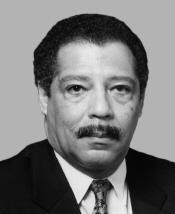
Historical · U.S. House · California · District 32
Julian Dixon
Former U.S. Representative · California District 32 · 1979–2001 · Democratic
Julian Dixon represented California's District 32 in the United States House of Representatives (1979–2001) for the Democratic party. The page below collects sourced biographical facts, term history, committee roles, and provenance for Dixon.
Bioguide ID: D000373
Key facts
- Full name
- Julian Dixon
- State
- California
- District
- District 32
- Party
- Democratic
- House service
- 1979–2001
- First House term
- 1979
- Status
- Left office
- Current term ends
- —
- Born
- 1934
- Bioguide ID
- D000373
- Committee assignments
- —
- Dataset version
- 1.20260605
Biographical narrative
1,073 words · sourced from the Wikipedia REST extract
Julian C. Dixon was an American politician who served as a Democratic member of the United States House of Representatives, representing California's 32nd congressional district from 1979 until his death in 2000. Prior to his tenure in Congress, Dixon was a member of the California State Assembly, where he served from 1973 to 1978. Throughout his political career, he was known for his leadership roles, including chairing the House Ethics Committee from 1985 to 1991. Dixon's contributions to California and the nation were significant, and he remains a notable figure in the history of African American representation in Congress.
Early life and career
Julian Carey Dixon was born on August 8, 1934, in Washington, D.C. He belonged to the Syphax family, which is recognized as an aristocratic lineage. Dixon's early education took place at Dorsey High School in Los Angeles, California. Following high school, he pursued higher education at California State University, Los Angeles, where he graduated in 1962. His academic background provided a foundation for his future endeavors in public service and politics.
Dixon's commitment to serving his country was evident when he enlisted in the United States Army, where he served from 1957 to 1960. After completing his military service, he transitioned into a career in politics. His political journey began in earnest when he was elected to the California State Assembly in 1972 as a member of the Democratic Party. During his time in the Assembly, he served three terms, which allowed him to gain valuable experience in legislative processes and governance.
His work in the California State Assembly laid the groundwork for his subsequent election to the U.S. House of Representatives. In 1978, Dixon successfully ran for Congress, marking the beginning of an extensive career in the federal legislature. His election to the House was a significant milestone, as he would go on to represent his constituents for over two decades.
House tenure
Julian Dixon's tenure in the U.S. House of Representatives began in 1979 and continued until his death in 2000. Over the course of his eleven terms in office, Dixon became a prominent figure in Congress, known for his dedication to his constituents and his active participation in legislative affairs. His long service is notable, as he was one of the few African American men to represent California in Congress at that time.
During his time in the House, Dixon was involved in various legislative initiatives and was recognized for his leadership abilities. He played a crucial role in several significant events, including the 1984 Democratic National Convention, where he chaired the rules committee. This position allowed him to influence the direction of the party and contribute to the shaping of its platform.
In addition to his work at the convention, Dixon was also involved in high-profile political actions, such as sponsoring a resolution in 1983 to impeach President Ronald Reagan in response to the U.S. invasion of Grenada. This action demonstrated his willingness to take a stand on contentious issues and highlighted his commitment to holding the executive branch accountable.
Dixon's leadership extended to his role as chair of the House Ethics Committee from 1985 to 1991. In this capacity, he oversaw investigations into ethical conduct among members of Congress, reinforcing the importance of integrity in public office. His work on the committee was significant in maintaining the standards of conduct expected of elected officials.
Throughout his congressional career, Dixon was known for his ability to build coalitions and work across party lines. He was respected by his colleagues for his dedication to public service and his efforts to address the needs of his constituents. His commitment to his district and the broader community was evident in his legislative priorities and the initiatives he supported.
Dixon's life came to an untimely end on December 8, 2000, when he passed away at a hospital in Marina Del Rey, California, following a heart attack. His death marked the conclusion of a significant chapter in California's political history, as he was the last Black American man to represent the state in Congress at that time.
Legislative focus and committees
Throughout his time in the House of Representatives, Julian Dixon focused on a variety of legislative issues that were important to his constituents and the broader community. His work encompassed areas such as civil rights, education, healthcare, and urban development. Dixon's commitment to these issues reflected his understanding of the challenges faced by the communities he represented.
Dixon was an advocate for civil rights and worked to promote policies that aimed to address inequalities and improve the quality of life for marginalized populations. His legislative efforts were often aligned with the broader goals of the Democratic Party, which sought to advance social justice and equity.
In addition to his focus on civil rights, Dixon was also involved in initiatives related to education and healthcare. He recognized the importance of access to quality education and healthcare services for all individuals, particularly those in underserved communities. His advocacy in these areas contributed to efforts aimed at improving educational opportunities and healthcare access for his constituents.
Dixon's role on the House Ethics Committee was particularly significant, as it allowed him to address issues of accountability and transparency within Congress. His leadership in this capacity was essential in promoting ethical standards among lawmakers and ensuring that public trust in government was upheld.
In recognition of his contributions to public service, several institutions and locations have been named in honor of Julian Dixon. The busy 7th Street / Metro Center / Julian Dixon transfer station in downtown Los Angeles serves as a testament to his efforts in securing federal funding for the construction of the Metro Rail system. Additionally, the Culver City branch of the Los Angeles County Library bears his name, further commemorating his legacy in the community.
Dixon's impact on California and the nation continues to be acknowledged, as evidenced by the dedication of the third revised edition of "Black Americans in Congress 1870-2007" to his memory. His colleagues in Congress recognized his contributions and the significance of his service, ensuring that his legacy would not be forgotten.
Julian C. Dixon's life and career exemplify the dedication of a public servant committed to improving the lives of others. His work in the California State Assembly and the U.S. House of Representatives reflects a legacy of leadership and advocacy that continues to resonate in contemporary discussions about representation and public service.
Notable legislation
Sponsored and co-sponsored legislation for Julian Dixon is pending operator curation. The biographical narrative above carries the same provenance trail until per-bill rows are written.
Sources
- [1]https://en.wikipedia.org/wiki/Julian_DixonWikipedia · retrieved 2026-06-05
Notable quotes
Sourced quotes for Julian Dixon are pending operator curation. Narrative-scope provenance remains attached below.
Sources
- [1]https://en.wikipedia.org/wiki/Julian_DixonWikipedia · retrieved 2026-06-05
Key positions
Curated policy positions for Julian Dixon are pending operator review. The biographical narrative above carries the same provenance trail until per-topic positions are written.
Sources
- [1]https://en.wikipedia.org/wiki/Julian_DixonWikipedia · retrieved 2026-06-05
Terms served
- 1979–1981U.S. House · Term 1 · Democratic
- 1981–1983U.S. House · Term 2 · Democratic
- 1983–1985U.S. House · Term 3 · Democratic
- 1985–1987U.S. House · Term 4 · Democratic
- 1987–1989U.S. House · Term 5 · Democratic
- 1989–1991U.S. House · Term 6 · Democratic
- 1991–1993U.S. House · Term 7 · Democratic
- 1993–1995U.S. House · Term 8 · Democratic
- 1995–1997U.S. House · Term 9 · Democratic
- 1997–1999U.S. House · Term 10 · Democratic
- 1999–2001U.S. House · Term 11 · Democratic
Sources & provenance
Every attributable claim above carries a per-section [N] marker that resolves to the corresponding URL below. Each entry records the upstream provider, the canonical URL, and the timestamp at which the source was retrieved by the ingest pipeline.
Key facts
- https://bioguide.congress.gov/search/bio/D000373bioguide · retrieved 2026-06-05
- https://www.govtrack.us/congress/members/400580govtrack · retrieved 2026-06-05
Biographical narrative
- https://en.wikipedia.org/wiki/Julian_Dixonwikipedia · retrieved 2026-06-05
Find your representative
Every U.S. state elects representatives by district. Browse California’s delegation, the full former-representative roster, or explore the role and term length.
Related on The Candidate
- Preceded by Craig HosmerEarlier holder of the California District 32 House seat · Republican.Open
- Succeeded by Hilda SolisLater holder of the California District 32 House seat · Democratic.Open
- Barclay HenleyFormer U.S. Representative · California District 1 · DemocraticOpen
- Charles ClaytonFormer U.S. Representative · California District 1 · RepublicanOpen
- Clarence LeaFormer U.S. Representative · California District 1 · DemocraticOpen
- Clement MillerFormer U.S. Representative · California District 1 · DemocraticOpen