
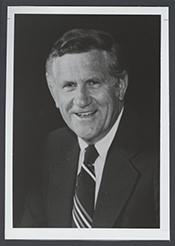
Historical · U.S. House · California · District 39
William Dannemeyer
Former U.S. Representative · California District 39 · 1979–1993 · Republican
William Dannemeyer represented California's District 39 in the United States House of Representatives (1979–1993) for the Republican party. The page below collects sourced biographical facts, term history, committee roles, and provenance for Dannemeyer.
Bioguide ID: D000044
Key facts
- Full name
- William Dannemeyer
- State
- California
- District
- District 39
- Party
- Republican
- House service
- 1979–1993
- First House term
- 1979
- Status
- Left office
- Current term ends
- —
- Born
- 1929
- Bioguide ID
- D000044
- Committee assignments
- —
- Dataset version
- 1.20260605
Biographical narrative
1,103 words · sourced from the Wikipedia REST extract
William E. Dannemeyer was a conservative American politician who served as a U.S. Representative for California's 39th congressional district from 1979 until 1993. A member of the Republican Party, he was known for his strong conservative stances on various social and fiscal issues, as well as his controversial views on LGBT rights and other topics. Throughout his political career, Dannemeyer was an active participant in legislative debates and was involved in numerous initiatives that reflected his conservative ideology.
Early life and career
William Edwin Dannemeyer was born on September 22, 1929, in Long Beach, California, to German immigrant parents, Charlotte Ernestine Knapp and Henry William Dannemeyer. His early education began at Trinity Lutheran School in Los Angeles, followed by attendance at Long Beach Polytechnic High School. Demonstrating leadership and commitment from a young age, he achieved the rank of Eagle Scout and was later honored with the Distinguished Eagle Scout Award from the Boy Scouts of America.
In 1947, Dannemeyer began his higher education at Santa Maria Junior College before transferring to Valparaiso University in Indiana, where he graduated in 1950. He continued his academic pursuits by earning a Juris Doctor degree from Hastings College of the Law at the University of California in 1952.
Following his education, Dannemeyer served in the United States Army from 1952 to 1954, specifically in the Counter Intelligence Corps during and after the Korean War. This military experience contributed to his understanding of national security and law enforcement, which would later influence his political career.
After completing his military service, Dannemeyer began practicing law in Santa Barbara in 1955, while also serving as a deputy district attorney for Santa Barbara County. In 1959, he moved to Fullerton, California, where he took on the role of assistant city attorney. His political career began in earnest when he was elected to the California State Assembly as a Democrat in 1962. He was re-elected in 1964 and participated as a member of the Electoral College, casting his vote for Lyndon Johnson in the presidential election that year.
In 1966, after deciding not to seek re-election to the Assembly, Dannemeyer made an unsuccessful attempt to secure a seat in the California State Senate. He subsequently served as a judge pro tempore in municipal and superior courts from 1966 to 1976. In a notable political shift, he publicly announced his departure from the Democratic Party to join the Republican Party in 1968 during a television appearance with future Congressman Bob Dornan. He returned to the California State Assembly for a final term in 1976 as a Republican.
House tenure
In November 1978, William E. Dannemeyer was elected to the United States House of Representatives, representing California's 39th congressional district. He was re-elected six additional times, serving a total of seven terms in Congress until his departure from office on January 3, 1993. Throughout his tenure, he established a reputation for his conservative positions, particularly in relation to fiscal policy, social issues, and national security.
Dannemeyer was a member of several key committees, including the Budget, Judiciary, and Energy and Commerce Committees. His legislative record included support for measures aimed at curbing illegal immigration, restricting telephone sex lines, and criminalizing flag desecration. He was also involved in efforts to limit federal funding for certain educational exhibits, notably attempting to block funding for evolution-related displays at the Smithsonian Institution in 1982.
On fiscal matters, Dannemeyer advocated for budget cuts to social programs, renegotiation of the national debt, tax reductions, and deregulation of various industries. He played a significant role as the lead Republican sponsor of the 1985 deregulation of natural gas prices, reflecting his commitment to free-market principles. In 1989, he was one of the House managers during the impeachment trial of Judge Walter Nixon, who faced charges of perjury before a grand jury.
Dannemeyer was also known for his outspoken criticism of LGBT rights. In 1989, he made headlines for reading a graphic description of homosexual acts into the Congressional Record, which drew significant attention and controversy. His views on AIDS and the LGBT community were particularly polarizing; he proposed measures such as banning HIV-positive immigrants and supported initiatives that would have mandated widespread testing and tracing of sexual partners. Although some of his proposals failed to gain traction, he did succeed in advocating for hospitals to inform recipients of blood transfusions about potential risks related to AIDS.
In 1990, Dannemeyer was one of the few representatives to vote against the Americans with Disabilities Act, a landmark piece of legislation aimed at protecting the rights of individuals with disabilities. His tenure in Congress was marked by a series of contentious debates and initiatives that reflected his conservative ideology.
In 1992, Dannemeyer chose not to seek re-election to the House. Instead, he pursued the Republican nomination for the U.S. Senate but was ultimately defeated by fellow Republican John F. Seymour.
Legislative focus and committees
Throughout his congressional career, William E. Dannemeyer was characterized by a strong commitment to conservative principles, which informed his legislative focus and committee work. His involvement in the Budget, Judiciary, and Energy and Commerce Committees allowed him to influence a range of issues, from fiscal policy to social matters.
Dannemeyer’s legislative agenda often included efforts to limit government intervention in the economy, advocating for deregulation and tax cuts. His support for the deregulation of natural gas prices exemplified his belief in free-market solutions to economic challenges. He consistently pushed for budgetary reforms aimed at reducing government spending on social programs, reflecting a broader conservative philosophy of fiscal responsibility.
On social issues, Dannemeyer was particularly vocal in his opposition to LGBT rights. His controversial statements and legislative proposals regarding homosexuality and AIDS garnered significant media attention and public debate. His attempts to restrict the rights of LGBT individuals and to impose measures related to AIDS prevention were indicative of his broader social conservative stance.
In addition to his work on social issues, Dannemeyer was involved in various initiatives related to national security and immigration. His support for measures to combat illegal immigration and his focus on law enforcement issues were consistent with his background in the legal field and his military service.
Overall, William E. Dannemeyer’s tenure in the U.S. House of Representatives was marked by a commitment to conservative values, a focus on fiscal responsibility, and a willingness to engage in contentious social debates. His legislative contributions and the controversies surrounding his views left a lasting impact on the political landscape of his time. After leaving Congress, he continued to be active in political discourse, maintaining his conservative viewpoints and engaging in public debates on various issues.
Notable legislation
Sponsored and co-sponsored legislation for William Dannemeyer is pending operator curation. The biographical narrative above carries the same provenance trail until per-bill rows are written.
Sources
- [1]https://en.wikipedia.org/wiki/William_DannemeyerWikipedia · retrieved 2026-06-05
Notable quotes
Sourced quotes for William Dannemeyer are pending operator curation. Narrative-scope provenance remains attached below.
Sources
- [1]https://en.wikipedia.org/wiki/William_DannemeyerWikipedia · retrieved 2026-06-05
Key positions
Curated policy positions for William Dannemeyer are pending operator review. The biographical narrative above carries the same provenance trail until per-topic positions are written.
Sources
- [1]https://en.wikipedia.org/wiki/William_DannemeyerWikipedia · retrieved 2026-06-05
Terms served
- 1979–1981U.S. House · Term 1 · Republican
- 1981–1983U.S. House · Term 2 · Republican
- 1983–1985U.S. House · Term 3 · Republican
- 1985–1987U.S. House · Term 4 · Republican
- 1987–1989U.S. House · Term 5 · Republican
- 1989–1991U.S. House · Term 6 · Republican
- 1991–1993U.S. House · Term 7 · Republican
Sources & provenance
Every attributable claim above carries a per-section [N] marker that resolves to the corresponding URL below. Each entry records the upstream provider, the canonical URL, and the timestamp at which the source was retrieved by the ingest pipeline.
Key facts
- https://bioguide.congress.gov/search/bio/D000044bioguide · retrieved 2026-06-05
- https://www.govtrack.us/congress/members/403184govtrack · retrieved 2026-06-05
Biographical narrative
- https://en.wikipedia.org/wiki/William_Dannemeyerwikipedia · retrieved 2026-06-05
Find your representative
Every U.S. state elects representatives by district. Browse California’s delegation, the full former-representative roster, or explore the role and term length.
Related on The Candidate
- Preceded by Charles WigginsEarlier holder of the California District 39 House seat · Republican.Open
- Succeeded by Ed RoyceLater holder of the California District 39 House seat · Republican.Open
- Barclay HenleyFormer U.S. Representative · California District 1 · DemocraticOpen
- Charles ClaytonFormer U.S. Representative · California District 1 · RepublicanOpen
- Clarence LeaFormer U.S. Representative · California District 1 · DemocraticOpen
- Clement MillerFormer U.S. Representative · California District 1 · DemocraticOpen