
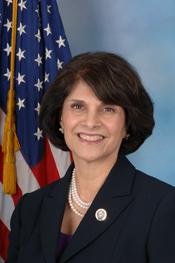
Historical · U.S. House · California · District 40
Lucille Roybal-Allard
Former U.S. Representative · California District 40 · 1993–2023 · Democratic
Lucille Roybal-Allard represented California's District 40 in the United States House of Representatives (1993–2023) for the Democratic party. The page below collects sourced biographical facts, term history, committee roles, and provenance for Roybal-Allard.
Bioguide ID: R000486
Key facts
- Full name
- Lucille Roybal-Allard
- State
- California
- District
- District 40
- Party
- Democratic
- House service
- 1993–2023
- First House term
- 1993
- Status
- Left office
- Current term ends
- —
- Born
- 1941
- Bioguide ID
- R000486
- Committee assignments
- —
- Dataset version
- 1.20260604
Biographical narrative
1,003 words · sourced from the Wikipedia REST extract
Lucille Roybal-Allard is a former U.S. Representative who served California's 40th congressional district from 2013 until her retirement in 2023. A member of the Democratic Party, she previously represented the 33rd and 34th districts, beginning her congressional career in 1993. Throughout her tenure, she was known for her advocacy on issues affecting her constituents, particularly in areas such as healthcare, education, and immigration reform. Roybal-Allard holds the distinction of being the first Latina to serve on the House Appropriations Committee and to chair the Congressional Hispanic Caucus.
Early life and career
Lucille Elsa Roybal-Allard was born on June 12, 1941, in Boyle Heights, California. She is the daughter of Edward R. Roybal, who served as a U.S. Representative from 1963 to 1993, and Lucille Beserra Roybal. Growing up in a politically active family, she was influenced by her father's commitment to public service. Roybal-Allard attended Ramona Convent Secondary School in Alhambra, California, where she graduated in 1959. She furthered her education at California State University, Los Angeles.
Before entering politics, Roybal-Allard worked as a public relations officer and fundraising executive, gaining experience that would later inform her political career. Her political journey began in the California State Assembly, where she served from 1987 until 1992. She was first elected in a special election on May 12, 1987, to fill the vacancy left by Gloria Molina, who had resigned after being elected to the Los Angeles City Council. During her time in the Assembly, Roybal-Allard focused on issues pertinent to her constituents and developed a reputation for her dedication to public service.
House tenure
Roybal-Allard's congressional career began in 1993 when she won the Democratic nomination for the newly established 33rd congressional district. This district encompassed parts of the area her father had represented for three decades. She won the general election decisively and was subsequently re-elected 14 times, facing little substantial opposition in a district characterized by a strong Democratic and Latino majority. The district was renumbered to the 34th after the 2000 census and again to the 40th following the 2010 census. By the time of the 2010 census, it was noted as the most Latino district in the nation, with an 86.5% Latino majority.
During her tenure in the House, Roybal-Allard made history by becoming the first Latina to serve as a chair of a House Appropriations Subcommittee, as well as the first Latina on the House Appropriations Committee. She also made significant strides as the first woman to chair the Congressional Hispanic Caucus and the California Democratic congressional delegation. Her leadership roles extended to founding the Women's Working Group on Immigration Reform, highlighting her commitment to issues affecting women and immigrant communities.
Roybal-Allard's legislative efforts included introducing the Sober Truth on Preventing Underage Drinking (STOP) Act, which aimed to reduce underage drinking and its associated consequences. She was instrumental in securing funding for various federal projects that benefited her constituents, such as the construction of a new federal courthouse in Downtown Los Angeles, the Metro Gold Line Lightrail Eastside Extension, and the deepening of the Port of Los Angeles. Additionally, she played a role in the ongoing revitalization of the Los Angeles River, demonstrating her commitment to urban development and infrastructure improvement.
In 1998-1999, Roybal-Allard chaired the California Democratic congressional delegation, further solidifying her influence within the party. She was actively involved in the Congressional Children's Caucus and participated in the Democratic Homeland Security and Livable Communities task forces, reflecting her broad interests in both social and security issues. Notably, she was the first Democratic Mexican-American woman to serve in Congress and was among the first Latinas elected to a full term, alongside Nydia Velazquez.
Legislative focus and committees
Throughout her congressional career, Roybal-Allard focused on a range of legislative issues that resonated with her constituents and the broader American public. She was particularly active in healthcare, education, and labor rights. One of her significant legislative achievements was the introduction of the Newborn Screening Saves Lives Reauthorization Act, which aimed to expand screening programs for newborns and children to detect heritable disorders. Roybal-Allard argued that such screenings not only save lives but also provide economic benefits by preventing more serious health issues later on.
In addition to her work on healthcare, Roybal-Allard was the original House author of the Security and Financial Empowerment (SAFE) Act, designed to protect survivors of domestic violence, sexual assault, and stalking. This legislation aimed to ensure that individuals could seek help without the fear of losing their jobs or financial stability. Portions of the SAFE Act were incorporated into the House's reauthorization of the Violence Against Women Act in 2019, underscoring her commitment to addressing domestic violence and supporting vulnerable populations.
Roybal-Allard also authored the Children's Act for Responsible Employment (CARE), which sought to address exploitative child labor practices in agriculture. This legislation reflected her dedication to protecting children and ensuring fair labor practices across industries.
In terms of committee assignments, Roybal-Allard served on the House Committee on Appropriations, where she chaired the Subcommittee on Homeland Security and was a member of the Subcommittee on Labor, Health and Human Services, Education, and Related Agencies. Her involvement in these committees allowed her to influence budgetary decisions and advocate for funding that aligned with her legislative priorities.
Roybal-Allard was a member of several caucuses, including the Congressional Asian Pacific American Caucus, the Congressional Arts Caucus, the Congressional Progressive Caucus, the House Baltic Caucus, the Medicare for All Caucus, and the Congressional Hispanic Caucus. Her participation in these groups demonstrated her commitment to a wide array of issues, from healthcare reform to cultural representation.
In summary, Lucille Roybal-Allard's career as a U.S. Representative was marked by significant contributions to her constituents and the broader legislative landscape. Her focus on healthcare, education, and labor rights, combined with her historic roles in Congress, established her as a prominent figure in American politics. After serving for 30 years, she announced her retirement at the end of the 117th Congress, concluding a notable chapter in her public service career.
Notable legislation
Sponsored and co-sponsored legislation for Lucille Roybal-Allard is pending operator curation. The biographical narrative above carries the same provenance trail until per-bill rows are written.
Sources
- [1]https://en.wikipedia.org/wiki/Lucille_Roybal-AllardWikipedia · retrieved 2026-06-04
Notable quotes
Sourced quotes for Lucille Roybal-Allard are pending operator curation. Narrative-scope provenance remains attached below.
Sources
- [1]https://en.wikipedia.org/wiki/Lucille_Roybal-AllardWikipedia · retrieved 2026-06-04
Key positions
Curated policy positions for Lucille Roybal-Allard are pending operator review. The biographical narrative above carries the same provenance trail until per-topic positions are written.
Sources
- [1]https://en.wikipedia.org/wiki/Lucille_Roybal-AllardWikipedia · retrieved 2026-06-04
Terms served
- 1993–1995U.S. House · Term 1 · Democratic
- 1995–1997U.S. House · Term 2 · Democratic
- 1997–1999U.S. House · Term 3 · Democratic
- 1999–2001U.S. House · Term 4 · Democratic
- 2001–2003U.S. House · Term 5 · Democratic
- 2003–2005U.S. House · Term 6 · Democratic
- 2005–2007U.S. House · Term 7 · Democratic
- 2007–2009U.S. House · Term 8 · Democratic
- 2009–2011U.S. House · Term 9 · Democratic
- 2011–2013U.S. House · Term 10 · Democratic
- 2013–2015U.S. House · Term 11 · Democratic
- 2015–2017U.S. House · Term 12 · Democratic
- 2017–2019U.S. House · Term 13 · Democratic
- 2019–2021U.S. House · Term 14 · Democratic
- 2021–2023U.S. House · Term 15 · Democratic
Sources & provenance
Every attributable claim above carries a per-section [N] marker that resolves to the corresponding URL below. Each entry records the upstream provider, the canonical URL, and the timestamp at which the source was retrieved by the ingest pipeline.
Key facts
- https://bioguide.congress.gov/search/bio/R000486bioguide · retrieved 2026-06-04
- https://roybal-allard.house.govhouse.gov · retrieved 2026-06-04
Biographical narrative
- https://en.wikipedia.org/wiki/Lucille_Roybal-Allardwikipedia · retrieved 2026-06-04
Find your representative
Every U.S. state elects representatives by district. Browse California’s delegation, the full former-representative roster, or explore the role and term length.
Related on The Candidate
- Preceded by Robert BadhamEarlier holder of the California District 40 House seat · Republican.Open
- Barclay HenleyFormer U.S. Representative · California District 1 · DemocraticOpen
- Charles ClaytonFormer U.S. Representative · California District 1 · RepublicanOpen
- Clarence LeaFormer U.S. Representative · California District 1 · DemocraticOpen
- Clement MillerFormer U.S. Representative · California District 1 · DemocraticOpen
- Democratic PartyFederal candidates and office holders on the Democratic line.Open