
Historical · U.S. House · California · District 41
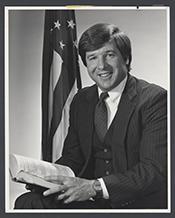
William Lowery
Former U.S. Representative · California District 41 · 1981–1993 · Republican
William Lowery represented California's District 41 in the United States House of Representatives (1981–1993) for the Republican party. The page below collects sourced biographical facts, term history, committee roles, and provenance for Lowery.
Bioguide ID: L000479
Key facts
- Full name
- William Lowery
- State
- California
- District
- District 41
- Party
- Republican
- House service
- 1981–1993
- First House term
- 1981
- Status
- Left office
- Current term ends
- —
- Born
- 1947
- Bioguide ID
- L000479
- Committee assignments
- —
- Dataset version
- 1.20260605
Biographical narrative
935 words · sourced from the Wikipedia REST extract
William David Lowery is a former American politician and lobbyist who served as a U.S. Representative for California's 41st congressional district from 1981 until 1993. A member of the Republican Party, Lowery was known for his focus on local issues in San Diego and his involvement in various political activities throughout his career. His tenure in Congress was marked by both legislative achievements and controversies, particularly related to financial scandals.
Early life and career
Bill Lowery was born on May 2, 1947, in San Diego, California. He grew up in a family where his father operated a hardware store, which provided a modest living for the family. However, tragedy struck when Lowery's father passed away when he was just nine years old. This event placed a significant burden on his mother, who worked to keep the family together in the wake of this loss.
Lowery's interest in politics began early, and he became actively involved in student politics during his time at San Diego State University. He aligned himself with conservative causes, organizing peaceful demonstrations advocating for free speech on campus and supporting the recruitment efforts of the ROTC. His political engagement deepened when he served as the National Youth Director for President Gerald Ford's campaign and later worked as a political operative for the California Republican Party.
In 1977, at the age of 30, Lowery was elected to the San Diego City Council. His tenure on the council was marked by close collaboration with then-Mayor Pete Wilson. Lowery was a strong advocate for urban development projects, including the San Diego Trolley, the revitalization of the Gaslamp Quarter, and the establishment of Horton Plaza. His commitment to local issues extended to environmental concerns, particularly his support for Mission Bay Park. In recognition of his leadership, his colleagues elected him as Deputy Mayor in 1980.
House tenure
In 1980, Bill Lowery transitioned to national politics by winning election to the U.S. House of Representatives, representing California's 41st congressional district. This district encompassed a significant portion of San Diego and was previously held by long-serving incumbent Bob Wilson, who retired after 28 years in office. Lowery's campaign was initially challenging; he started with a considerable deficit in the polls but ultimately won by a margin of ten points. His popularity as a congressman grew over his six terms in office, during which he was reelected multiple times with relative ease. However, in his last campaign in 1990, he faced a more competitive race, securing only 49% of the vote against his Democratic opponent.
Throughout his congressional career, Lowery focused on initiatives aimed at improving the San Diego area. He was a vocal opponent of offshore oil drilling, advocating instead for sustainable practices such as wastewater reclamation. Additionally, he supported the development of the Otay Mesa border crossing, which was intended to facilitate trade and improve border security.
Despite his legislative efforts, Lowery's career was not without controversy. He faced significant scrutiny during the House banking scandal, which involved allegations of improper banking practices among members of Congress. Although no government agency found any wrongdoing on Lowery's part, the negative press surrounding the scandal affected his public image. His association with Don Dixon, a prominent figure in the Savings and Loan scandal, also drew criticism.
Following the 1990 census, congressional redistricting placed Lowery in a challenging position, as he was moved into a district represented by fellow Republican Duke Cunningham. In the subsequent primary election, Lowery was defeated, receiving only a small percentage of the vote and finishing in third place. Cunningham won the primary and later became embroiled in a major bribery scandal that led to his resignation in 2005.
Legislative focus and committees
During his time in the House of Representatives, Bill Lowery served on various committees, where he was able to influence legislation pertinent to his constituents and the broader interests of California. His focus on local issues was evident in his efforts to secure funding and support for projects that would benefit the San Diego region. Lowery's work often involved advocating for infrastructure improvements, environmental protections, and economic development initiatives.
In addition to his legislative responsibilities, Lowery's role as a congressman included engaging with constituents and addressing their concerns. He was known for his ability to connect with the local community, which contributed to his electoral success during his initial terms. His commitment to representing the interests of San Diego residents was a defining aspect of his tenure.
After leaving Congress in 1993, Lowery transitioned to a career as a lobbyist in Washington, D.C. He specialized in securing earmarks for his clients, leveraging his connections and experience from his time in office. His lobbying efforts were particularly effective, as he maintained relationships with former colleagues, including ex-Representative Jerry Lewis. Lowery's firm and clients were significant contributors to Lewis's political action committee, highlighting the ongoing influence of his political network.
Lowery's post-congressional career has allowed him to remain active in political circles, and he continues to reside in the Washington, D.C. area, where he owns a townhouse on Capitol Hill, as well as a waterfront property in Virginia. His experiences in both local and national politics have shaped his understanding of governance and advocacy, allowing him to navigate the complexities of the political landscape effectively.
In summary, Bill Lowery's career spans significant roles in local and national politics, marked by his commitment to public service and advocacy for his constituents. His tenure in the U.S. House of Representatives reflects a focus on regional development and environmental issues, while his post-congressional work as a lobbyist demonstrates his continued engagement in the political arena.
Notable legislation
Sponsored and co-sponsored legislation for William Lowery is pending operator curation. The biographical narrative above carries the same provenance trail until per-bill rows are written.
Sources
- [1]https://en.wikipedia.org/wiki/Bill_Lowery_(politician)Wikipedia · retrieved 2026-06-05
Notable quotes
Sourced quotes for William Lowery are pending operator curation. Narrative-scope provenance remains attached below.
Sources
- [1]https://en.wikipedia.org/wiki/Bill_Lowery_(politician)Wikipedia · retrieved 2026-06-05
Key positions
Curated policy positions for William Lowery are pending operator review. The biographical narrative above carries the same provenance trail until per-topic positions are written.
Sources
- [1]https://en.wikipedia.org/wiki/Bill_Lowery_(politician)Wikipedia · retrieved 2026-06-05
Terms served
- 1981–1983U.S. House · Term 1 · Republican
- 1983–1985U.S. House · Term 2 · Republican
- 1985–1987U.S. House · Term 3 · Republican
- 1987–1989U.S. House · Term 4 · Republican
- 1989–1991U.S. House · Term 5 · Republican
- 1991–1993U.S. House · Term 6 · Republican
Sources & provenance
Every attributable claim above carries a per-section [N] marker that resolves to the corresponding URL below. Each entry records the upstream provider, the canonical URL, and the timestamp at which the source was retrieved by the ingest pipeline.
Key facts
- https://bioguide.congress.gov/search/bio/L000479bioguide · retrieved 2026-06-05
- https://www.govtrack.us/congress/members/406968govtrack · retrieved 2026-06-05
Biographical narrative
- https://en.wikipedia.org/wiki/Bill_Lowery_(politician)wikipedia · retrieved 2026-06-05
Find your representative
Every U.S. state elects representatives by district. Browse California’s delegation, the full former-representative roster, or explore the role and term length.
Related on The Candidate
- Preceded by Bob WilsonEarlier holder of the California District 41 House seat · Republican.Open
- Succeeded by Jay KimLater holder of the California District 41 House seat · Republican.Open
- Barclay HenleyFormer U.S. Representative · California District 1 · DemocraticOpen
- Charles ClaytonFormer U.S. Representative · California District 1 · RepublicanOpen
- Clarence LeaFormer U.S. Representative · California District 1 · DemocraticOpen
- Clement MillerFormer U.S. Representative · California District 1 · DemocraticOpen