
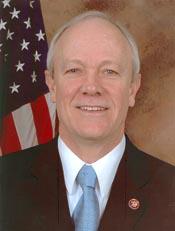
Historical · U.S. House · California · District 9
Jerry McNerney
Former U.S. Representative · California District 9 · 2007–2023 · Democratic
Jerry McNerney represented California's District 9 in the United States House of Representatives (2007–2023) for the Democratic party. The page below collects sourced biographical facts, term history, committee roles, and provenance for McNerney.
Bioguide ID: M001166
Key facts
- Full name
- Jerry McNerney
- State
- California
- District
- District 9
- Party
- Democratic
- House service
- 2007–2023
- First House term
- 2007
- Status
- Left office
- Current term ends
- —
- Born
- 1951
- Bioguide ID
- M001166
- Committee assignments
- —
- Dataset version
- 1.20260603
Biographical narrative
877 words · sourced from the Wikipedia REST extract
Jerry McNerney is a former U.S. Representative who served California's 9th congressional district from 2007 until 2023. A member of the Democratic Party, he was known for his focus on renewable energy, veterans' issues, and public health. Before his tenure in Congress, McNerney had a diverse career in engineering and business, particularly in the energy sector. His political career began with a notable campaign against an incumbent Republican, leading to multiple re-elections and a reputation for advocating progressive policies.
Early life and career
Jerry McNerney was born on June 18, 1951, in Albuquerque, New Mexico. He is the son of Rosemary and John E. McNerney and has Swiss and Irish ancestry. His early education included time at St. Joseph's Military Academy in Hays, Kansas, and he spent two years at the United States Military Academy at West Point. However, McNerney left West Point in 1971 in protest of the U.S. involvement in the Vietnam War. He subsequently enrolled at the University of New Mexico in Albuquerque, where he earned both bachelor's and master's degrees, culminating in a Ph.D. in mathematics in 1981. His doctoral dissertation focused on differential geometry, specifically a generalization of the Laplace–Beltrami operator.
Following his academic pursuits, McNerney worked as a contractor for Sandia National Laboratories at Kirtland Air Force Base, contributing to national security programs. In 1985, he transitioned to a senior engineering role with U.S. Windpower (Kenetech). By 1994, he had become an energy consultant, collaborating with various organizations, including Pacific Gas and Electric (PG&E), FloWind, and The Electric Power Research Institute. Before entering politics, McNerney served as the CEO of a start-up company that specialized in manufacturing wind turbines, known as HAWT Power (Horizontal Axis Wind Turbine Power).
House tenure
McNerney's political career began with his candidacy in the 2004 House elections, where he ran as a write-in candidate against incumbent Republican Richard Pombo in California's 11th congressional district. His campaign was initiated just two weeks before the primary election, spurred by encouragement from his son. McNerney successfully qualified for the primary and subsequently became the Democratic nominee for the general election, although he lost that race.
In 2006, McNerney launched another campaign, this time with more preparation and support. He won the Democratic primary with a significant portion of the vote, defeating several opponents. His campaign gained momentum as he received endorsements from former Republican candidates, and polling indicated a competitive race against Pombo. Ultimately, McNerney won the general election, marking the beginning of his congressional career.
During his time in the House, McNerney was re-elected multiple times, facing various Republican challengers. His district underwent redistricting in 2012, which altered its boundaries and demographics. McNerney adapted to these changes by relocating to Stockton, California, to align with his new constituency. He continued to secure victories in subsequent elections, demonstrating his ability to maintain support among voters in a shifting political landscape.
Legislative focus and committees
Throughout his tenure in the U.S. House of Representatives, McNerney focused on several key legislative areas. He was particularly active in promoting renewable energy initiatives and advocating for environmental policies. McNerney supported cap-and-trade legislation and was involved in various efforts to enhance energy efficiency and sustainability.
One of his notable legislative achievements occurred in 2010 when he authored a bill that established an evaluation panel to assess the treatments provided by the Veterans Administration for traumatic brain injury. This legislation aimed to improve care for veterans, a priority for McNerney throughout his time in office. In 2013, he introduced the METH Act, which sought to expand programs addressing methamphetamine abuse, reflecting his commitment to public health issues.
McNerney was also vocal about veterans' rights and benefits. He authored a bill in 2013 that allowed veterans to continue receiving their benefits during government shutdowns, showcasing his dedication to supporting those who have served in the military. His advocacy extended to calling for the resignation of VA Secretary Eric Shinseki amid controversies regarding delays in care at VA facilities.
In addition to his work on veterans' issues and renewable energy, McNerney was a founding member of the Congressional Freethought Caucus, which aimed to promote policies based on reason and science while advocating for the separation of church and state. This initiative highlighted his commitment to addressing issues related to religious freedom and discrimination against non-religious individuals.
McNerney's legislative activities also included co-sponsoring bills related to energy efficiency, such as one that required the Secretary of Energy to report on the impact of thermal insulation on energy and water use in federal buildings. His focus on practical solutions to energy challenges underscored his expertise in the field.
In 2019, McNerney authored the AI in Government Act, which aimed to integrate artificial intelligence into government operations, reflecting his interest in technology and innovation. This legislation was enacted in 2020, further illustrating his proactive approach to contemporary issues.
Overall, Jerry McNerney's congressional career was characterized by a commitment to addressing critical issues such as renewable energy, veterans' care, and public health. His ability to navigate the complexities of legislative processes and advocate for his constituents contributed to his long-standing presence in the U.S. House of Representatives. After serving eight terms, McNerney concluded his tenure on January 3, 2023, leaving behind a legacy of advocacy and public service.
Notable legislation
Sponsored and co-sponsored legislation for Jerry McNerney is pending operator curation. The biographical narrative above carries the same provenance trail until per-bill rows are written.
Sources
- [1]https://en.wikipedia.org/wiki/Jerry_McNerneyWikipedia · retrieved 2026-06-03
Notable quotes
Sourced quotes for Jerry McNerney are pending operator curation. Narrative-scope provenance remains attached below.
Sources
- [1]https://en.wikipedia.org/wiki/Jerry_McNerneyWikipedia · retrieved 2026-06-03
Key positions
Curated policy positions for Jerry McNerney are pending operator review. The biographical narrative above carries the same provenance trail until per-topic positions are written.
Sources
- [1]https://en.wikipedia.org/wiki/Jerry_McNerneyWikipedia · retrieved 2026-06-03
Terms served
- 2007–2009U.S. House · Term 1 · Democratic
- 2009–2011U.S. House · Term 2 · Democratic
- 2011–2013U.S. House · Term 3 · Democratic
- 2013–2015U.S. House · Term 4 · Democratic
- 2015–2017U.S. House · Term 5 · Democratic
- 2017–2019U.S. House · Term 6 · Democratic
- 2019–2021U.S. House · Term 7 · Democratic
- 2021–2023U.S. House · Term 8 · Democratic
Sources & provenance
Every attributable claim above carries a per-section [N] marker that resolves to the corresponding URL below. Each entry records the upstream provider, the canonical URL, and the timestamp at which the source was retrieved by the ingest pipeline.
Key facts
- https://bioguide.congress.gov/search/bio/M001166bioguide · retrieved 2026-06-03
- https://mcnerney.house.govhouse.gov · retrieved 2026-06-03
Biographical narrative
- https://en.wikipedia.org/wiki/Jerry_McNerneywikipedia · retrieved 2026-06-03
Find your representative
Every U.S. state elects representatives by district. Browse California’s delegation, the full former-representative roster, or explore the role and term length.
Related on The Candidate
- Preceded by Ronald DellumsEarlier holder of the California District 9 House seat · Democratic.Open
- Barclay HenleyFormer U.S. Representative · California District 1 · DemocraticOpen
- Charles ClaytonFormer U.S. Representative · California District 1 · RepublicanOpen
- Clarence LeaFormer U.S. Representative · California District 1 · DemocraticOpen
- Clement MillerFormer U.S. Representative · California District 1 · DemocraticOpen
- Democratic PartyFederal candidates and office holders on the Democratic line.Open