
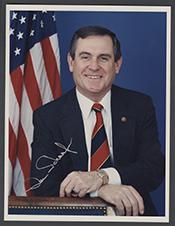
Historical · U.S. House · Colorado · District 6
Dan Schaefer
Former U.S. Representative · Colorado District 6 · 1983–1999 · Republican
Dan Schaefer represented Colorado's District 6 in the United States House of Representatives (1983–1999) for the Republican party. The page below collects sourced biographical facts, term history, committee roles, and provenance for Schaefer.
Bioguide ID: S000109
Key facts
- Full name
- Dan Schaefer
- State
- Colorado
- District
- District 6
- Party
- Republican
- House service
- 1983–1999
- First House term
- 1983
- Status
- Left office
- Current term ends
- —
- Born
- 1936
- Bioguide ID
- S000109
- Committee assignments
- —
- Dataset version
- 1.20260605
Biographical narrative
862 words · sourced from the Wikipedia REST extract
Daniel Schaefer was an American politician who served as a U.S. Representative for Colorado's 6th congressional district from 1983 until 1999. A member of the Republican Party, Schaefer's political career spanned over three decades, during which he was elected to eight consecutive terms in the House of Representatives. His tenure was marked by significant electoral success, as he consistently garnered a substantial majority of votes in his elections. Schaefer's background included military service, a career in public relations, and involvement in state politics before his election to Congress.
Early life and career
Daniel Schaefer was born on January 25, 1936, in Guttenberg, Iowa. He attended local public schools, where he began to develop an interest in leadership and civic engagement. Schaefer pursued higher education at Niagara University, where he earned a Bachelor of Arts degree. His academic journey also included attendance at Potsdam University from 1961 to 1964, which contributed to his educational background and understanding of public affairs.
Following his education, Schaefer enlisted in the United States Marine Corps, serving from 1955 to 1957. During his military service, he achieved the rank of sergeant, an experience that likely influenced his later leadership style and commitment to public service. After completing his military obligations, Schaefer transitioned into a career as a public relations consultant, where he honed his communication skills and developed a network that would later support his political ambitions.
Schaefer's entry into politics began in earnest in 1976 when he was elected to the Colorado General Assembly for a two-year term. This initial foray into state politics provided him with valuable experience in legislative processes and constituent engagement. Two years later, in 1978, he was elected to the Colorado State Senate, where he served until 1983. His time in the state legislature allowed him to build a reputation as a dedicated public servant and to establish connections within the Republican Party. Schaefer was also active in state party politics, serving as a delegate to Colorado State Republican conventions from 1972 to 1982, further solidifying his standing in the party.
House tenure
Schaefer's congressional career began when he was elected as a Republican to the Ninety-eighth United States Congress in a special election. This election was necessitated by the passing of Representative-elect Jack Swigert, a former astronaut who succumbed to cancer before he could take his seat. Schaefer won the special election decisively, receiving a significant majority of the votes cast. His victory marked the beginning of an extensive tenure in the U.S. House of Representatives, where he would serve for 16 years.
During his time in Congress, Schaefer was re-elected multiple times, often without facing a Democratic challenger. In the 1984 election, he did not encounter any opposition from the Democratic Party, which underscored his strong position within his district. In subsequent elections from 1986 to 1996, Schaefer consistently polled over 60 percent of the vote against his Democratic opponents, demonstrating his popularity and the effectiveness of his campaign strategies. His final election in 1996 saw him secure 62 percent of the vote against Democrat Joan Fitz-Gerald, further solidifying his status as a prominent figure in Colorado politics.
Schaefer chose not to seek re-election for the 106th United States Congress in 1998, concluding his congressional career after eight terms. He was succeeded by fellow Republican Tom Tancredo, who continued to represent the interests of Colorado's 6th congressional district. Schaefer's decision to step away from politics marked the end of a significant chapter in his life, during which he had established a legacy of public service and commitment to his constituents.
Legislative focus and committees
Throughout his tenure in the House of Representatives, Schaefer was involved in various legislative initiatives and committee assignments that reflected his interests and the needs of his constituents. While specific details regarding his committee assignments and the legislation he championed are not provided, it is common for members of Congress to serve on committees that align with their expertise and the priorities of their districts. These committees play a crucial role in shaping policy and overseeing the implementation of federal laws.
As a Republican representative, Schaefer's legislative focus likely aligned with the broader goals of his party during the 1980s and 1990s, which included issues such as fiscal conservatism, national defense, and limited government. His military background may have influenced his perspectives on defense and veterans' affairs, while his experience in public relations could have informed his approach to communication and constituent services.
Schaefer's long tenure in Congress allowed him to build relationships with colleagues across the aisle, which is often essential for effective governance. His ability to secure re-election in a competitive political landscape suggests that he was adept at addressing the concerns of his constituents and navigating the complexities of federal legislation.
After leaving Congress, Schaefer continued to be remembered for his contributions to Colorado politics and his service to the nation. He passed away on April 16, 2006, at the age of 70, after a battle with cancer. His legacy as a public servant remains a part of the history of Colorado's representation in the U.S. Congress, reflecting both the challenges and achievements of a career dedicated to public service.
Notable legislation
Sponsored and co-sponsored legislation for Dan Schaefer is pending operator curation. The biographical narrative above carries the same provenance trail until per-bill rows are written.
Sources
- [1]https://en.wikipedia.org/wiki/Daniel_SchaeferWikipedia · retrieved 2026-06-05
Notable quotes
Sourced quotes for Dan Schaefer are pending operator curation. Narrative-scope provenance remains attached below.
Sources
- [1]https://en.wikipedia.org/wiki/Daniel_SchaeferWikipedia · retrieved 2026-06-05
Key positions
Curated policy positions for Dan Schaefer are pending operator review. The biographical narrative above carries the same provenance trail until per-topic positions are written.
Sources
- [1]https://en.wikipedia.org/wiki/Daniel_SchaeferWikipedia · retrieved 2026-06-05
Terms served
- 1983–1985U.S. House · Term 1 · Republican
- 1985–1987U.S. House · Term 2 · Republican
- 1987–1989U.S. House · Term 3 · Republican
- 1989–1991U.S. House · Term 4 · Republican
- 1991–1993U.S. House · Term 5 · Republican
- 1993–1995U.S. House · Term 6 · Republican
- 1995–1997U.S. House · Term 7 · Republican
- 1997–1999U.S. House · Term 8 · Republican
Sources & provenance
Every attributable claim above carries a per-section [N] marker that resolves to the corresponding URL below. Each entry records the upstream provider, the canonical URL, and the timestamp at which the source was retrieved by the ingest pipeline.
Key facts
- https://bioguide.congress.gov/search/bio/S000109bioguide · retrieved 2026-06-05
- https://www.govtrack.us/congress/members/409618govtrack · retrieved 2026-06-05
Biographical narrative
- https://en.wikipedia.org/wiki/Daniel_Schaeferwikipedia · retrieved 2026-06-05
Find your representative
Every U.S. state elects representatives by district. Browse Colorado’s delegation, the full former-representative roster, or explore the role and term length.
Related on The Candidate
- Succeeded by Tom TancredoLater holder of the Colorado District 6 House seat · Republican.Open
- Atterson RuckerFormer U.S. Representative · Colorado District 1 · DemocraticOpen
- Benjamin HilliardFormer U.S. Representative · Colorado District 1 · DemocraticOpen
- Byron RogersFormer U.S. Representative · Colorado District 1 · DemocraticOpen
- Dean GillespieFormer U.S. Representative · Colorado District 1 · RepublicanOpen
- Republican PartyFederal candidates and office holders on the Republican line.Open