
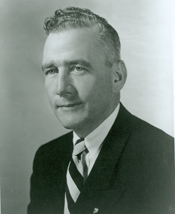
Historical · U.S. House · Connecticut · District 5
James Patterson
Former U.S. Representative · Connecticut District 5 · 1947–1959 · Republican
James Patterson represented Connecticut's District 5 in the United States House of Representatives (1947–1959) for the Republican party. The page below collects sourced biographical facts, term history, committee roles, and provenance for Patterson.
Bioguide ID: P000119
Key facts
- Full name
- James Patterson
- State
- Connecticut
- District
- District 5
- Party
- Republican
- House service
- 1947–1959
- First House term
- 1947
- Status
- Left office
- Current term ends
- —
- Born
- 1908
- Bioguide ID
- P000119
- Committee assignments
- —
- Dataset version
- 1.20260605
Biographical narrative
853 words · sourced from the Wikipedia REST extract
James Patterson was a U.S. Representative from Connecticut, serving as a member of the Republican Party. His congressional career spanned over a decade, during which he was elected to six consecutive terms in the House of Representatives. Patterson's legislative tenure began in 1947 and concluded in 1959. He is noted for his involvement in various legislative initiatives during a transformative period in American history, including the Civil Rights Act of 1957. After his departure from Congress, he remained active in his community until his passing in 1989.
Early life and career
James Thomas Patterson was born on October 20, 1908, in Naugatuck, Connecticut. He received his early education in the public school system of his hometown. Following his primary education, Patterson attended Peekskill Military Academy in New York, graduating in 1929. He pursued higher education at Georgetown University in Washington, D.C., where he earned his degree in 1933. Subsequently, he continued his studies at the University of Miami in Coral Gables, Florida, obtaining a Bachelor of Arts degree in 1934. Patterson later attended National University Law School, now known as George Washington University, where he completed his Bachelor of Laws (LL.B.) in 1939.
Throughout his academic journey, Patterson engaged in various professional roles. He began working for the Connecticut Highway Department in 1924, a position he held until 1933. Following this, he worked for the U.S. Rubber Company in 1934. His career in public service continued with positions at the United States Department of Labor from 1934 to 1937, the Social Security Board from 1937 to 1938, and the United States Treasury from 1938 to 1940. These experiences provided him with a solid foundation in both the private and public sectors, contributing to his understanding of governmental operations.
Patterson's military service began in September 1941 when he joined the United States Marine Corps. He also served in the Office of Strategic Services, where he was involved in intelligence operations during World War II. His military service included overseas deployments in the African and European theaters, as well as in India, Burma, and China. He was discharged as a major in July 1946, having gained valuable leadership experience and a deep commitment to public service during his time in the military.
House tenure
James Patterson's political career in the U.S. House of Representatives commenced when he was elected as a Republican to the Eightieth Congress, which began on January 3, 1947. He successfully secured re-election for five additional terms, serving in total for twelve years until January 3, 1959. During his tenure, Patterson was involved in various legislative activities and contributed to discussions on numerous issues facing the nation.
Throughout his time in Congress, Patterson participated in the legislative process during a period marked by significant social and political changes in the United States. His voting record included support for key pieces of legislation, such as the Civil Rights Act of 1957, which aimed to address racial discrimination and protect voting rights for African Americans. This act was one of the early legislative efforts to promote civil rights during the post-World War II era, reflecting the growing national awareness of civil rights issues.
Despite his accomplishments in Congress, Patterson faced challenges in his later political career. He ran for re-election in 1958 but was unsuccessful in his bid for a seventh term in the Eighty-sixth Congress. He also attempted to regain a seat in the House in subsequent elections, including the 1960 election for the Eighty-seventh Congress and the 1970 election for the Ninety-second Congress, but was not successful in these endeavors. His political career in the House concluded with his departure in 1959.
Legislative focus and committees
During his time in the House of Representatives, James Patterson was involved in various legislative initiatives and served on several committees. His work reflected the priorities and concerns of his constituents in Connecticut's Fifth Congressional District, as well as broader national issues. Although specific committee assignments during his tenure are not detailed, members of Congress typically engage in committee work that aligns with their interests and expertise, contributing to the legislative process through hearings, discussions, and the drafting of bills.
Patterson's support for the Civil Rights Act of 1957 indicates his engagement with the significant social issues of his time. This legislation was a response to the civil rights movement's demands for equality and justice, and Patterson's vote in favor of it suggests a willingness to address these pressing concerns. His legislative focus likely included a range of topics relevant to his constituents, including economic development, labor issues, and social welfare, reflecting the diverse needs of the population he represented.
After leaving Congress, Patterson continued to reside in Bethlehem, Connecticut, where he remained active in his community. He lived there until his death on February 7, 1989, in Camden, New Jersey. His life and career reflect a commitment to public service, shaped by his early experiences in education, military service, and various governmental roles. James Patterson's contributions to the U.S. House of Representatives and his involvement in significant legislative efforts during a pivotal era in American history remain a part of his legacy.
Notable legislation
Sponsored and co-sponsored legislation for James Patterson is pending operator curation. The biographical narrative above carries the same provenance trail until per-bill rows are written.
Sources
- [1]https://en.wikipedia.org/wiki/James_T._Patterson_(politician)Wikipedia · retrieved 2026-06-05
Notable quotes
Sourced quotes for James Patterson are pending operator curation. Narrative-scope provenance remains attached below.
Sources
- [1]https://en.wikipedia.org/wiki/James_T._Patterson_(politician)Wikipedia · retrieved 2026-06-05
Key positions
Curated policy positions for James Patterson are pending operator review. The biographical narrative above carries the same provenance trail until per-topic positions are written.
Sources
- [1]https://en.wikipedia.org/wiki/James_T._Patterson_(politician)Wikipedia · retrieved 2026-06-05
Terms served
- 1947–1949U.S. House · Term 1 · Republican
- 1949–1951U.S. House · Term 2 · Republican
- 1951–1953U.S. House · Term 3 · Republican
- 1953–1955U.S. House · Term 4 · Republican
- 1955–1957U.S. House · Term 5 · Republican
- 1957–1959U.S. House · Term 6 · Republican
Sources & provenance
Every attributable claim above carries a per-section [N] marker that resolves to the corresponding URL below. Each entry records the upstream provider, the canonical URL, and the timestamp at which the source was retrieved by the ingest pipeline.
Key facts
- https://bioguide.congress.gov/search/bio/P000119bioguide · retrieved 2026-06-05
- https://www.govtrack.us/congress/members/408527govtrack · retrieved 2026-06-05
Biographical narrative
- https://en.wikipedia.org/wiki/James_T._Patterson_(politician)wikipedia · retrieved 2026-06-05
Find your representative
Every U.S. state elects representatives by district. Browse Connecticut’s delegation, the full former-representative roster, or explore the role and term length.
Related on The Candidate
- Preceded by Joseph TalbotEarlier holder of the Connecticut District 5 House seat · Republican.Open
- Succeeded by John MonaganLater holder of the Connecticut District 5 House seat · Democratic.Open
- Barbara KennellyFormer U.S. Representative · Connecticut District 1 · DemocraticOpen
- Charles ChapmanFormer U.S. Representative · Connecticut District 1 · WhigOpen
- Dwight LoomisFormer U.S. Representative · Connecticut District 1 · RepublicanOpen
- Edward FennFormer U.S. Representative · Connecticut District 1 · RepublicanOpen