
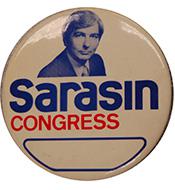
Historical · U.S. House · Connecticut · District 5
Ronald Sarasin
Former U.S. Representative · Connecticut District 5 · 1973–1979 · Republican
Ronald Sarasin represented Connecticut's District 5 in the United States House of Representatives (1973–1979) for the Republican party. The page below collects sourced biographical facts, term history, committee roles, and provenance for Sarasin.
Bioguide ID: S000062
Key facts
- Full name
- Ronald Sarasin
- State
- Connecticut
- District
- District 5
- Party
- Republican
- House service
- 1973–1979
- First House term
- 1973
- Status
- Left office
- Current term ends
- —
- Born
- 1934
- Bioguide ID
- S000062
- Committee assignments
- —
- Dataset version
- 1.20260605
Biographical narrative
825 words · sourced from the Wikipedia REST extract
Ronald A. Sarasin was an American lawyer, Navy veteran, and politician who served as a U.S. Representative for Connecticut's 5th congressional district from 1973 to 1979. A member of the Republican Party, Sarasin's political career began in the Connecticut House of Representatives, where he served two terms before his election to Congress. His tenure in the House was marked by significant political events, including the Watergate scandal and the shifting political landscape of Connecticut. After leaving Congress, Sarasin continued to engage in public service and advocacy, holding leadership roles in various organizations.
Early life and career
Ronald Arthur Sarasin was born on December 31, 1934. He pursued a career in law after completing his education, which laid the groundwork for his future in politics. Sarasin's early career included military service in the United States Navy, which contributed to his understanding of national issues and governance. His political journey began at the state level when he was elected to the Connecticut House of Representatives in 1968. During his time in the state legislature, he quickly rose through the ranks, becoming the assistant minority leader by 1970. This position allowed him to gain valuable experience in legislative processes and party leadership.
Sarasin's entry into national politics came in 1972 when he ran for the U.S. House of Representatives from Connecticut's 5th district. His candidacy was bolstered by redistricting that added several Republican-leaning areas to the district, as well as the broader political context of the time, including the impact of the 1972 presidential election on down-ballot races. Sarasin successfully defeated incumbent John Monagan, a seven-term veteran, marking the beginning of his congressional career.
House tenure
Sarasin's first term in the U.S. House of Representatives began in 1973. He was re-elected in 1974, despite a challenging political environment characterized by the emergence of the "Watergate babies," a group of Democratic candidates who won seats in Congress following the Watergate scandal. Sarasin's victory in this election demonstrated his ability to appeal to voters even amid a national trend favoring the Democratic Party.
During his time in the House, Sarasin focused on various issues pertinent to his constituents and the broader national agenda. He served on committees that addressed key legislative matters, although specific details of his committee assignments are not documented in the available records. His tenure lasted until January 3, 1979, when he vacated his seat to pursue a gubernatorial campaign.
In 1978, Sarasin secured the Republican nomination for Governor of Connecticut, running alongside Lewis Rome as his running mate. His campaign focused on tax reduction and welfare reform, positioning himself as a candidate for fiscal responsibility. However, he faced a formidable opponent in incumbent Governor Ella Grasso, who had made history as the first woman elected governor in her own right. Sarasin's campaign ultimately did not succeed, as Grasso won re-election by a significant margin.
Legislative focus and committees
Throughout his congressional career, Sarasin's legislative focus reflected the priorities of his constituents and the Republican Party during the 1970s. While specific bills and legislative initiatives he supported are not detailed in the available records, his positions likely aligned with the broader Republican agenda of the time, which included economic issues, tax policy, and government spending.
Sarasin's experience in the Connecticut House of Representatives and his subsequent service in Congress provided him with a deep understanding of both state and federal legislative processes. His leadership roles at the state level, including his position as assistant minority leader, equipped him with the skills necessary to navigate the complexities of national politics.
After leaving Congress, Sarasin continued to be active in public service and advocacy. He served as the chief lobbyist for the National Restaurant Association and later became the president of the National Beer Wholesalers Association. In these roles, he worked to influence policy and legislation affecting the restaurant and beverage industries, demonstrating his commitment to representing the interests of these sectors.
In addition to his lobbying efforts, Sarasin held a significant leadership position as president of the U.S. Capitol Historical Society from 2000 to 2019. During his tenure, he was instrumental in establishing a traveling exhibit that highlighted the contributions of enslaved people to the construction of the U.S. Capitol. He also initiated a popular civics education program aimed at promoting understanding of American government and history.
Sarasin's personal life included two marriages. He was first married to Marjorie Grazio Sarasin, with whom he had one son, Michael. The couple divorced in 1977, making Sarasin the first divorced candidate to run for governor in Connecticut. In 1988, he married Leslie Garmon Sarasin, and they had one son, Douglas. Sarasin's brother, Warren Sarasin, also pursued a political career, serving in the Connecticut House of Representatives after being elected in 1978.
Ronald A. Sarasin passed away on March 27, 2023, at the age of 88. His legacy includes his contributions to both state and national politics, as well as his efforts in civic education and historical preservation.
Notable legislation
Sponsored and co-sponsored legislation for Ronald Sarasin is pending operator curation. The biographical narrative above carries the same provenance trail until per-bill rows are written.
Sources
- [1]https://en.wikipedia.org/wiki/Ronald_A._SarasinWikipedia · retrieved 2026-06-05
Notable quotes
Sourced quotes for Ronald Sarasin are pending operator curation. Narrative-scope provenance remains attached below.
Sources
- [1]https://en.wikipedia.org/wiki/Ronald_A._SarasinWikipedia · retrieved 2026-06-05
Key positions
Curated policy positions for Ronald Sarasin are pending operator review. The biographical narrative above carries the same provenance trail until per-topic positions are written.
Sources
- [1]https://en.wikipedia.org/wiki/Ronald_A._SarasinWikipedia · retrieved 2026-06-05
Terms served
- 1973–1975U.S. House · Term 1 · Republican
- 1975–1977U.S. House · Term 2 · Republican
- 1977–1979U.S. House · Term 3 · Republican
Sources & provenance
Every attributable claim above carries a per-section [N] marker that resolves to the corresponding URL below. Each entry records the upstream provider, the canonical URL, and the timestamp at which the source was retrieved by the ingest pipeline.
Key facts
- https://bioguide.congress.gov/search/bio/S000062bioguide · retrieved 2026-06-05
- https://www.govtrack.us/congress/members/409575govtrack · retrieved 2026-06-05
Biographical narrative
- https://en.wikipedia.org/wiki/Ronald_A._Sarasinwikipedia · retrieved 2026-06-05
Find your representative
Every U.S. state elects representatives by district. Browse Connecticut’s delegation, the full former-representative roster, or explore the role and term length.
Related on The Candidate
- Preceded by John MonaganEarlier holder of the Connecticut District 5 House seat · Democratic.Open
- Succeeded by William RatchfordLater holder of the Connecticut District 5 House seat · Democratic.Open
- Barbara KennellyFormer U.S. Representative · Connecticut District 1 · DemocraticOpen
- Charles ChapmanFormer U.S. Representative · Connecticut District 1 · WhigOpen
- Dwight LoomisFormer U.S. Representative · Connecticut District 1 · RepublicanOpen
- Edward FennFormer U.S. Representative · Connecticut District 1 · RepublicanOpen