
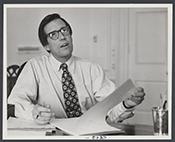
Historical · U.S. House · Delaware · At-Large
Pierre Du Pont
Former U.S. Representative · Delaware At-Large · 1971–1977 · Republican
Pierre Du Pont represented Delaware's At-Large in the United States House of Representatives (1971–1977) for the Republican party. The page below collects sourced biographical facts, term history, committee roles, and provenance for Pont.
Bioguide ID: D000558
Key facts
- Full name
- Pierre Du Pont
- State
- Delaware
- District
- At-Large
- Party
- Republican
- House service
- 1971–1977
- First House term
- 1971
- Status
- Left office
- Current term ends
- —
- Born
- 1935
- Bioguide ID
- D000558
- Committee assignments
- —
- Dataset version
- 1.20260605
Biographical narrative
862 words · sourced from the Wikipedia REST extract
Pierre S. du Pont IV was an American politician, attorney, and businessman who served as a U.S. Representative for Delaware's at-large congressional district from 1971 to 1977. A member of the Republican Party, he was part of the prominent Du Pont family and later became the 68th governor of Delaware, holding office from 1977 to 1985. His political career was marked by his involvement in state and national politics, as well as his contributions to various legislative initiatives and public policies.
Early life and career
Pierre Samuel du Pont IV was born on January 22, 1935, in Wilmington, Delaware. He belonged to the well-known Du Pont family, which has had a significant impact on American industry and politics. His father, Pierre Samuel du Pont III, and his mother, Jane Holcomb du Pont, were influential figures in their own right. He was also the grandson of Lammot du Pont II and the great-nephew of Pierre S. du Pont, the founder of Longwood Gardens, a renowned botanical garden in Pennsylvania.
Du Pont's educational background includes attendance at Phillips Exeter Academy, followed by Princeton University, where he completed his undergraduate studies. He furthered his education at Harvard Law School, earning his law degree. After completing his education, he served in the U.S. Naval Reserve, specifically with the Seabees, from 1957 until 1960. His military service provided him with valuable experience and discipline that would later influence his political career.
In his professional life, du Pont worked for E.I. du Pont de Nemours and Company from 1963 until 1970, where he gained experience in the family business and developed a strong understanding of corporate and economic matters. His entry into politics began in 1968 when he was elected unopposed to the Delaware House of Representatives, representing the 12th district. He served in this capacity until 1971, during which time he began to establish himself as a significant figure in Delaware politics.
Du Pont considered a run for the U.S. Senate in 1972, a seat that was ultimately won by Democrat Joe Biden. Initially, he faced the prospect of a primary challenge from former U.S. Representative Harry G. Haskell Jr. However, he decided to withdraw from the race, aligning with the wishes of Republican leaders who preferred that incumbent Senator J. Caleb Boggs seek re-election.
House tenure
In 1970, du Pont successfully ran for the U.S. House of Representatives, representing Delaware's at-large congressional district. He defeated Democrat John D. Daniello, who was a labor leader and New Castle County Councilman. Following his initial election, du Pont was re-elected two more times, defeating Democratic challengers Norma Handloff in 1972 and James R. Soles in 1974. His tenure in the House was characterized by his support for various legislative initiatives, including an attempt to limit presidential authority through the War Powers Act of 1973. Despite this, he remained one of the last supporters of President Richard Nixon during the impeachment proceedings that surrounded the Watergate scandal.
During his time in the U.S. House, du Pont participated in various debates and discussions on national issues, contributing to the legislative process and representing the interests of Delaware residents. His background in law and business informed his approach to governance, as he sought to balance the needs of his constituents with broader national concerns.
Du Pont's congressional career came to an end in 1977 when he chose not to seek re-election. Instead, he shifted his focus to a higher office, running for governor of Delaware, a position that would allow him to implement his vision for the state.
Legislative focus and committees
Throughout his time in the U.S. House of Representatives, du Pont was involved in several key legislative issues. His support for the War Powers Act of 1973 indicated his interest in curbing executive power and ensuring that Congress played a significant role in decisions related to military engagement. This legislative focus reflected a broader concern among some lawmakers regarding the balance of power between the executive and legislative branches of government.
Du Pont's tenure in the House also coincided with a period of significant political and social change in the United States. As a member of the Republican Party, he navigated the complexities of party politics during a time when the nation was grappling with issues such as civil rights, economic policy, and foreign relations. His ability to work across party lines was evident in his collaborations with colleagues on various initiatives.
After leaving the House, du Pont transitioned to the role of governor, where he continued to influence public policy in Delaware. His experience in the House provided him with valuable insights into governance, which he applied to his work as governor. During his time in office, he focused on economic development, tax policy, and education, leaving a lasting impact on the state.
Overall, Pierre S. du Pont IV's career in the U.S. House of Representatives was marked by his commitment to public service and his engagement with critical legislative issues. His background as a member of the Du Pont family, combined with his education and professional experience, shaped his approach to politics and governance, ultimately leading him to a prominent role in Delaware's political landscape.
Notable legislation
Sponsored and co-sponsored legislation for Pierre Du Pont is pending operator curation. The biographical narrative above carries the same provenance trail until per-bill rows are written.
Sources
- [1]https://en.wikipedia.org/wiki/Pete_du_PontWikipedia · retrieved 2026-06-05
Notable quotes
Sourced quotes for Pierre Du Pont are pending operator curation. Narrative-scope provenance remains attached below.
Sources
- [1]https://en.wikipedia.org/wiki/Pete_du_PontWikipedia · retrieved 2026-06-05
Key positions
Curated policy positions for Pierre Du Pont are pending operator review. The biographical narrative above carries the same provenance trail until per-topic positions are written.
Sources
- [1]https://en.wikipedia.org/wiki/Pete_du_PontWikipedia · retrieved 2026-06-05
Terms served
- 1971–1973U.S. House · Term 1 · Republican
- 1973–1975U.S. House · Term 2 · Republican
- 1975–1977U.S. House · Term 3 · Republican
Sources & provenance
Every attributable claim above carries a per-section [N] marker that resolves to the corresponding URL below. Each entry records the upstream provider, the canonical URL, and the timestamp at which the source was retrieved by the ingest pipeline.
Key facts
- https://bioguide.congress.gov/search/bio/D000558bioguide · retrieved 2026-06-05
- https://www.govtrack.us/congress/members/403617govtrack · retrieved 2026-06-05
Biographical narrative
- https://en.wikipedia.org/wiki/Pete_du_Pontwikipedia · retrieved 2026-06-05
Find your representative
Every U.S. state elects representatives by district. Browse Delaware’s delegation, the full former-representative roster, or explore the role and term length.
Related on The Candidate
- Preceded by Harris McDowell Jr.Earlier holder of the Delaware At-Large House seat · Democratic.Open
- Succeeded by Thomas Evans Jr.Later holder of the Delaware At-Large House seat · Republican.Open
- Albert PolkFormer U.S. Representative · Delaware At-Large · DemocraticOpen
- Benjamin BiggsFormer U.S. Representative · Delaware At-Large · DemocraticOpen
- Caleb LaytonFormer U.S. Representative · Delaware At-Large · RepublicanOpen
- Charles LoreFormer U.S. Representative · Delaware At-Large · DemocraticOpen