
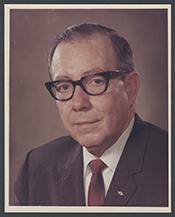
Historical · U.S. House · Florida · District 11
Paul Rogers
Former U.S. Representative · Florida District 11 · 1955–1979 · Democratic
Paul Rogers represented Florida's District 11 in the United States House of Representatives (1955–1979) for the Democratic party. The page below collects sourced biographical facts, term history, committee roles, and provenance for Rogers.
Bioguide ID: R000401
Key facts
- Full name
- Paul Rogers
- State
- Florida
- District
- District 11
- Party
- Democratic
- House service
- 1955–1979
- First House term
- 1955
- Status
- Left office
- Current term ends
- —
- Born
- 1921
- Bioguide ID
- R000401
- Committee assignments
- —
- Dataset version
- 1.20260605
Biographical narrative
896 words · sourced from the Wikipedia REST extract
Paul G. Rogers was a prominent American lawyer and politician who served as a Democratic member of the U.S. House of Representatives from Florida's 11th congressional district from 1955 until 1979. He succeeded his father, Dwight L. Rogers, in Congress and became known for his significant contributions to health policy during his long tenure. Rogers was also involved in various health-related organizations after leaving office and was recognized for his advocacy in the medical field.
Early life and career
Paul Grant Rogers was born on June 4, 1921, in Ocilla, Georgia, as the middle child in a family of three sons. His father, Dwight Laing Rogers Sr., was an attorney and U.S. congressman, which likely influenced Rogers' future political career. His brothers, Dwight L. Rogers Jr. and Doyle Rogers, both pursued careers in law, establishing a family legacy in the legal profession.
Rogers attended the University of Florida, where he became actively involved in student leadership, serving as President of Florida Blue Key. He graduated with a Bachelor of Arts degree in 1942. Following his graduation, he joined the U.S. Army and served during World War II from 1942 to 1946. Rising to the rank of Major, he was awarded the Bronze Star Medal for his service.
After the war, Rogers pursued a legal education at George Washington University Law School but ultimately graduated from the University of Florida College of Law in 1948. He began his professional career as a lawyer in private practice and held positions on the boards of directors for notable companies, including Merck & Co. and Mutual Life Insurance Co. of New York.
House tenure
Rogers entered politics when he was elected as a Democrat to the 84th Congress in a special election held to fill the vacancy left by his father's death. His congressional career spanned 12 terms, from January 11, 1955, to January 3, 1979. During this time, he was reelected to eleven subsequent congresses, demonstrating a sustained level of support from his constituents.
Throughout his tenure, Rogers was known for his leadership in health-related legislation. He served as the chair of the Subcommittee on Health and the Environment from 1971 to 1979. His nickname, "Mr. Health," reflected his commitment to health policy and reform. Rogers played a crucial role in the passage of several significant pieces of legislation, including the National Cancer Act of 1971, the Medical Device Amendments of 1976, and the Health Maintenance Organization Act. He also contributed to the Emergency Medical Service Act and the Medicare-Medicaid Anti-Fraud and Abuse Amendments of 1977, as well as the Clean Air Act of 1970.
Rogers' political stance on civil rights was complex. He was a signatory to the 1956 Southern Manifesto, which opposed the desegregation of public schools mandated by the Supreme Court's decision in Brown v. Board of Education. He voted against several key civil rights measures, including the Civil Rights Acts of 1957, 1960, 1964, and 1968. However, he did support the Voting Rights Act of 1965, indicating a nuanced position on civil rights issues during a transformative period in American history.
Rogers chose not to seek reelection for the 96th Congress, concluding his congressional career after 24 years of service. His legislative legacy remains significant, particularly in the areas of health policy and medical research.
Legislative focus and committees
During his time in the House of Representatives, Paul G. Rogers focused primarily on health-related issues, reflecting his background and interests. His leadership as chair of the Subcommittee on Health and the Environment allowed him to influence a wide range of health policies and initiatives. He was instrumental in the development and passage of landmark legislation aimed at improving public health and medical care in the United States.
The National Cancer Act of 1971, which Rogers helped to champion, marked a pivotal moment in the fight against cancer, establishing a comprehensive national strategy for cancer research and treatment. The Medical Device Amendments of 1976 addressed the regulation of medical devices, ensuring their safety and effectiveness. The Health Maintenance Organization Act promoted the establishment of health maintenance organizations, which aimed to provide comprehensive health care services to enrolled members.
Rogers' involvement in the Emergency Medical Service Act contributed to the improvement of emergency medical services across the nation, enhancing the response capabilities of health care providers in critical situations. His work on the Medicare-Medicaid Anti-Fraud and Abuse Amendments of 1977 aimed to protect the integrity of these vital programs, ensuring that they served their intended populations without misuse.
In addition to his legislative work, Rogers was active in various organizations related to health and medical research after leaving Congress. He served as a partner in the Washington, D.C., office of the law firm Hogan & Hartson and held leadership roles in several health advocacy organizations, including the National Osteoporosis Foundation and the National Leadership Coalition on Health Care.
Rogers received numerous awards and honors throughout his career, recognizing his contributions to health policy and advocacy. His commitment to improving public health was further commemorated when the main plaza at the National Institutes of Health was named in his honor by an act of Congress in June 2001.
Paul G. Rogers passed away on October 13, 2008, in Washington, D.C., after battling lung cancer. His legacy continues through the various health initiatives he supported and the organizations that honor his dedication to health care policy.
Notable legislation
Sponsored and co-sponsored legislation for Paul Rogers is pending operator curation. The biographical narrative above carries the same provenance trail until per-bill rows are written.
Sources
- [1]https://en.wikipedia.org/wiki/Paul_Rogers_(politician)Wikipedia · retrieved 2026-06-05
Notable quotes
Sourced quotes for Paul Rogers are pending operator curation. Narrative-scope provenance remains attached below.
Sources
- [1]https://en.wikipedia.org/wiki/Paul_Rogers_(politician)Wikipedia · retrieved 2026-06-05
Key positions
Curated policy positions for Paul Rogers are pending operator review. The biographical narrative above carries the same provenance trail until per-topic positions are written.
Sources
- [1]https://en.wikipedia.org/wiki/Paul_Rogers_(politician)Wikipedia · retrieved 2026-06-05
Terms served
- 1955–1957U.S. House · Term 1 · Democratic
- 1957–1959U.S. House · Term 2 · Democratic
- 1959–1961U.S. House · Term 3 · Democratic
- 1961–1963U.S. House · Term 4 · Democratic
- 1963–1965U.S. House · Term 5 · Democratic
- 1965–1967U.S. House · Term 6 · Democratic
- 1967–1969U.S. House · Term 7 · Democratic
- 1969–1971U.S. House · Term 8 · Democratic
- 1971–1973U.S. House · Term 9 · Democratic
- 1973–1975U.S. House · Term 10 · Democratic
- 1975–1977U.S. House · Term 11 · Democratic
- 1977–1979U.S. House · Term 12 · Democratic
Sources & provenance
Every attributable claim above carries a per-section [N] marker that resolves to the corresponding URL below. Each entry records the upstream provider, the canonical URL, and the timestamp at which the source was retrieved by the ingest pipeline.
Key facts
- https://bioguide.congress.gov/search/bio/R000401bioguide · retrieved 2026-06-05
- https://www.govtrack.us/congress/members/409368govtrack · retrieved 2026-06-05
Biographical narrative
- https://en.wikipedia.org/wiki/Paul_Rogers_(politician)wikipedia · retrieved 2026-06-05
Find your representative
Every U.S. state elects representatives by district. Browse Florida’s delegation, the full former-representative roster, or explore the role and term length.
Related on The Candidate
- Succeeded by Jim DavisLater holder of the Florida District 11 House seat · Democratic.Open
- Augustus MaxwellFormer U.S. Representative · Florida District 1 · DemocraticOpen
- Charles HamiltonFormer U.S. Representative · Florida District 1 · RepublicanOpen
- Chester McMullenFormer U.S. Representative · Florida District 1 · DemocraticOpen
- Courtney CampbellFormer U.S. Representative · Florida District 1 · DemocraticOpen
- Democratic PartyFederal candidates and office holders on the Democratic line.Open