
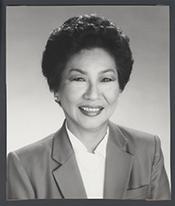
Historical · U.S. House · Hawaii · District 1
Patricia Saiki
Former U.S. Representative · Hawaii District 1 · 1987–1991 · Republican
Patricia Saiki represented Hawaii's District 1 in the United States House of Representatives (1987–1991) for the Republican party. The page below collects sourced biographical facts, term history, committee roles, and provenance for Saiki.
Bioguide ID: S000014
Key facts
- Full name
- Patricia Saiki
- State
- Hawaii
- District
- District 1
- Party
- Republican
- House service
- 1987–1991
- First House term
- 1987
- Status
- Left office
- Current term ends
- —
- Born
- 1930
- Bioguide ID
- S000014
- Committee assignments
- —
- Dataset version
- 1.20260605
Biographical narrative
916 words · sourced from the Wikipedia REST extract
Patricia Saiki is a former American politician and educator who served as a U.S. Representative for Hawaii's 1st congressional district from 1987 to 1991. A member of the Republican Party, she made history as the first Republican elected to represent Hawaii in the House of Representatives since the state's admission to the Union. Saiki's political career also included significant roles in state government and federal administration, reflecting her commitment to public service and education.
Early life and career
Patricia Hatsue Saiki was born on May 28, 1930, in Hilo, Hawaii, where she spent her formative years. She graduated from Hilo High School in 1948 and pursued higher education at the University of Hawaiʻi at Mānoa, earning her bachelor's degree in 1952. Following her graduation, Saiki embarked on a career in education, teaching at several institutions, including Punahou School, Kaimuki Intermediate School, and Kalani High School in Hawaii. Her teaching career also took her to Toledo, Ohio, where she taught while her husband, Stanley Saiki, completed his medical residency.
Saiki's involvement in education extended beyond the classroom. She became actively engaged in educational policy and advocacy, particularly through her role in establishing the teacher's chapter of the Hawaii Government Employees Association. Her commitment to education and her experiences as a teacher inspired her to enter politics, encouraged by her colleagues who recognized her leadership potential. In 1968, she joined the Hawaii Republican Party and successfully ran for a seat in the Hawaii State House of Representatives, marking the beginning of her political career.
House tenure
After serving in the Hawaii State House of Representatives, Saiki transitioned to the Hawaii State Senate in 1974, where she represented her district until 1982. During her time in the state legislature, she developed a reputation for her dedication to education and public service. Her political journey took a significant turn in 1986 when a vacancy arose in the U.S. House of Representatives following the resignation of Congressman Cecil Heftel. Saiki ran in a special election but was defeated by Democrat Neil Abercrombie. However, she did not deter from her political ambitions and subsequently won a separate election against Democrat Mufi Hannemann, securing her place in Congress.
Saiki's election in 1986 was historic, as she became the first Republican to represent Hawaii in the U.S. House since the state achieved statehood in 1959. Her victory was notable not only for her party affiliation but also because she was one of only two Republicans from Hawaii to serve in Congress, the other being Senator Hiram Fong. Additionally, she was the second woman from Hawaii to be elected to Congress, following Patsy Mink, with whom she served for two years. Saiki was re-elected in 1988, defeating Mary Bitterman, a Democrat and former head of Voice of America.
During her tenure in the House, Saiki was known for her focus on education-related issues, reflecting her background as an educator. She was appointed as a commissioner for the Western Interstate Commission on Higher Education and participated in the Fund for the Improvement of Higher Education, both of which aimed to enhance educational opportunities and resources. Her legislative efforts included advocating for the redress of Japanese Americans who were interned during World War II, demonstrating her commitment to addressing historical injustices.
Legislative focus and committees
Throughout her time in Congress, Saiki maintained a strong focus on educational policy and fiscal responsibility. She was known for her conservative stance on financial matters while also championing initiatives that aimed to improve educational access and quality. One of her notable legislative achievements was her support for the Abandoned Shipwrecks Act, which was signed into law by President Ronald Reagan in 1988. This legislation asserted U.S. title to certain abandoned shipwrecks located in submerged lands under state jurisdiction, allowing states to manage these cultural and historical resources effectively.
Saiki's legislative priorities were reflective of her background and experiences, as she sought to advocate for the interests of her constituents in Hawaii. Her work on educational issues was complemented by her involvement in various committees, where she contributed to discussions and decisions that shaped national policy. While specific committee assignments during her tenure are not detailed, her focus on education and fiscal matters suggests she was engaged in relevant legislative discussions.
Despite her accomplishments, Saiki's congressional career came to an end when she lost a bid for re-election in 1990 to Daniel Akaka, a Democrat. Following her departure from Congress, she continued her public service by being appointed as the Administrator of the Small Business Administration under President George H. W. Bush. In this role, she worked to support small businesses across the nation, furthering her commitment to economic development and entrepreneurship.
Saiki's political career did not conclude with her time at the Small Business Administration. In 1994, she ran for Governor of Hawaii but was defeated by Democratic challenger Ben Cayetano. Later, she took on leadership roles within the Republican Party, including chairing the Hawaii Presidential campaign of former New York Mayor Rudy Giuliani in 2008, as well as supporting the congressional campaigns of Charles Djou in 2010 and 2012. From 2014 to 2015, she served as chair of the Republican Party of Hawaii, demonstrating her ongoing commitment to political engagement and party leadership.
Patricia Saiki's career reflects a significant contribution to both education and public service in Hawaii and the United States. Her historical role as a Republican representative from Hawaii and her advocacy for educational issues have left a lasting impact on the state's political landscape.
Notable legislation
Sponsored and co-sponsored legislation for Patricia Saiki is pending operator curation. The biographical narrative above carries the same provenance trail until per-bill rows are written.
Sources
- [1]https://en.wikipedia.org/wiki/Pat_SaikiWikipedia · retrieved 2026-06-05
Notable quotes
Sourced quotes for Patricia Saiki are pending operator curation. Narrative-scope provenance remains attached below.
Sources
- [1]https://en.wikipedia.org/wiki/Pat_SaikiWikipedia · retrieved 2026-06-05
Key positions
Curated policy positions for Patricia Saiki are pending operator review. The biographical narrative above carries the same provenance trail until per-topic positions are written.
Sources
- [1]https://en.wikipedia.org/wiki/Pat_SaikiWikipedia · retrieved 2026-06-05
Terms served
- 1987–1989U.S. House · Term 1 · Republican
- 1989–1991U.S. House · Term 2 · Republican
Sources & provenance
Every attributable claim above carries a per-section [N] marker that resolves to the corresponding URL below. Each entry records the upstream provider, the canonical URL, and the timestamp at which the source was retrieved by the ingest pipeline.
Key facts
- https://bioguide.congress.gov/search/bio/S000014bioguide · retrieved 2026-06-05
- https://www.govtrack.us/congress/members/409534govtrack · retrieved 2026-06-05
Biographical narrative
- https://en.wikipedia.org/wiki/Pat_Saikiwikipedia · retrieved 2026-06-05
Find your representative
Every U.S. state elects representatives by district. Browse Hawaii’s delegation, the full former-representative roster, or explore the role and term length.
Related on The Candidate
- Preceded by Cecil HeftelEarlier holder of the Hawaii District 1 House seat · Democratic.Open
- Succeeded by Charles DjouLater holder of the Hawaii District 1 House seat · Republican.Open
- Colleen HanabusaFormer U.S. Representative · Hawaii District 1 · DemocraticOpen
- Mark TakaiFormer U.S. Representative · Hawaii District 1 · DemocraticOpen
- Republican PartyFederal candidates and office holders on the Republican line.Open
- Representatives from HawaiiEvery former U.S. Representative who has represented Hawaii.Open