
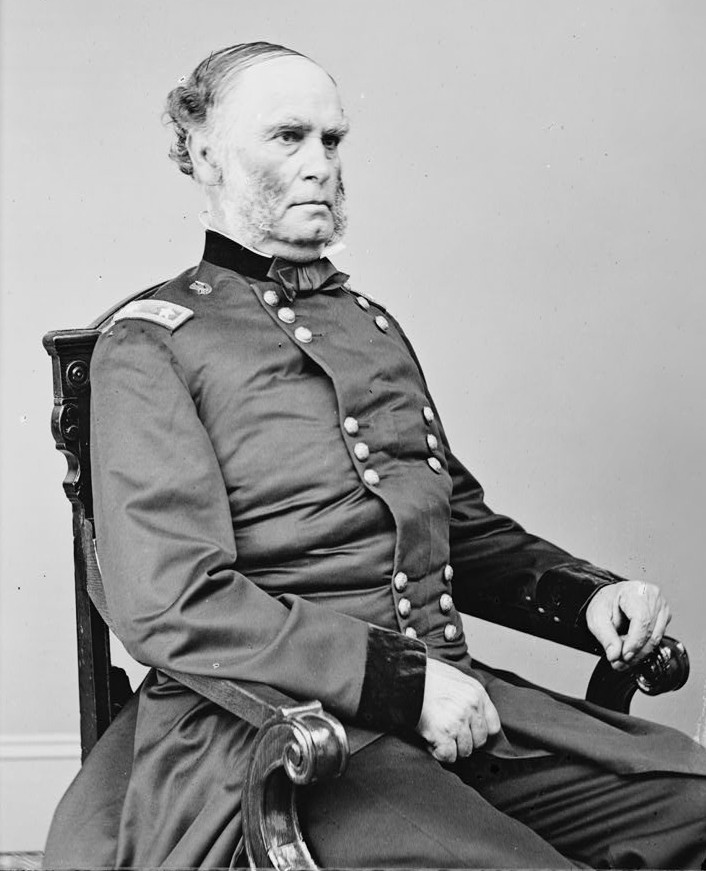
Historical · U.S. House · Iowa · District 1
Samuel Curtis
Former U.S. Representative · Iowa District 1 · 1857–1863 · Republican
Samuel Curtis represented Iowa's District 1 in the United States House of Representatives (1857–1863) for the Republican party. The page below collects sourced biographical facts, term history, committee roles, and provenance for Curtis.
Bioguide ID: C001013
Key facts
- Full name
- Samuel Curtis
- State
- Iowa
- District
- District 1
- Party
- Republican
- House service
- 1857–1863
- First House term
- 1857
- Status
- Left office
- Current term ends
- —
- Born
- 1805
- Bioguide ID
- C001013
- Committee assignments
- —
- Dataset version
- 1.20260606
Biographical narrative
833 words · sourced from the Wikipedia REST extract
Samuel Curtis was an American military officer and politician who served as a U.S. Representative for Iowa's 1st congressional district. A member of the Republican Party, he was one of the first individuals from Iowa to be elected to Congress, holding office from 1857 until 1861, when he resigned to serve in the Union Army during the American Civil War. Curtis is noted for his military leadership, particularly in the Trans-Mississippi Theater, where he achieved significant victories at the Battles of Pea Ridge and Westport.
Early life and career
Samuel Curtis was born on February 3, 1805, near Champlain, New York. He pursued a military education and graduated from the United States Military Academy in 1831. Following his graduation, Curtis was stationed at Fort Gibson in the Indian Territories, which is now part of Oklahoma. However, he resigned from the Army in 1832, transitioning to a civilian career.
After leaving the military, Curtis relocated to Ohio, where he worked as a civil engineer. His engineering work included projects focused on improving the Muskingum River, which were vital for navigation and commerce. In 1841, he expanded his professional qualifications by becoming a lawyer. His legal and engineering expertise positioned him well for public service.
During the Mexican-American War, Curtis was appointed as colonel of the 3rd Regiment of Ohio Volunteers. He served in various capacities, including as military governor of several cities that were occupied during the conflict. This experience further solidified his reputation as a capable leader.
In the 1850s, Curtis continued to engage in public service and infrastructure projects. He served as the chief engineer for river improvements in Des Moines, Iowa, and worked on public infrastructure projects in St. Louis. Additionally, he was involved with the American Central Railroad in Iowa. His contributions to public works and local governance culminated in his election as Mayor of Keokuk in 1856.
That same year, Curtis made a significant political leap by being elected as a Republican to represent Iowa's 1st congressional district in the United States House of Representatives. He, along with Timothy Davis, who represented Iowa's 2nd congressional district, became one of the first Republicans from Iowa to serve in Congress. Curtis was re-elected in 1858 and again in 1860, during which time he was a strong advocate for the establishment of a transcontinental railroad, recognizing its potential to enhance commerce and connectivity across the nation.
House tenure
Curtis's congressional career began in 1857, during a period of significant political and social change in the United States. As a member of the Republican Party, which was relatively new at the time, he was part of a movement that sought to address issues such as slavery and the expansion of the nation. His tenure in the House was marked by his commitment to infrastructure development, particularly in relation to railroads, which were seen as crucial to the economic growth of the nation.
However, Curtis's time in Congress was cut short by the outbreak of the Civil War. He was a supporter of President Abraham Lincoln and was considered for a position in Lincoln's cabinet. Nevertheless, on June 1, 1861, he was appointed colonel of the 2nd Iowa Infantry, leading him to resign from his congressional seat on August 4, 1861. His military service would soon take precedence over his political career.
Legislative focus and committees
During his time in the House, Curtis was primarily focused on issues related to infrastructure, particularly the development of a transcontinental railroad. This focus reflected the broader Republican agenda of the time, which included promoting economic development and facilitating westward expansion. His engineering background informed his advocacy for infrastructure improvements, and he sought to leverage federal support for these initiatives.
Curtis's contributions to Congress were significant in the context of the political landscape of the late 1850s and early 1860s. As one of the first Republicans from Iowa, he played a role in establishing the party's presence in the region and contributed to the broader national dialogue on issues of governance and infrastructure.
Although his legislative career was relatively brief, the impact of his work in Congress was felt in the subsequent years, particularly as the nation grappled with the challenges of the Civil War and its aftermath. After resigning from Congress to serve in the military, Curtis's focus shifted entirely to his role as a general in the Union Army, where he would achieve notable military successes.
In summary, Samuel Curtis's early life and career were characterized by a blend of military service, engineering, and political engagement. His tenure in the U.S. House of Representatives was marked by a commitment to infrastructure development, particularly railroads, which were seen as essential for the nation's growth. His subsequent military service during the Civil War further defined his legacy, as he became known for his leadership and strategic victories in key battles. Curtis's contributions to both military and public service reflect a significant chapter in the history of Iowa and the United States during a transformative period.
Notable legislation
Sponsored and co-sponsored legislation for Samuel Curtis is pending operator curation. The biographical narrative above carries the same provenance trail until per-bill rows are written.
Sources
- [1]https://en.wikipedia.org/wiki/Samuel_Ryan_CurtisWikipedia · retrieved 2026-06-06
Notable quotes
Sourced quotes for Samuel Curtis are pending operator curation. Narrative-scope provenance remains attached below.
Sources
- [1]https://en.wikipedia.org/wiki/Samuel_Ryan_CurtisWikipedia · retrieved 2026-06-06
Key positions
Curated policy positions for Samuel Curtis are pending operator review. The biographical narrative above carries the same provenance trail until per-topic positions are written.
Sources
- [1]https://en.wikipedia.org/wiki/Samuel_Ryan_CurtisWikipedia · retrieved 2026-06-06
Terms served
- 1857–1859U.S. House · Term 1 · Republican
- 1859–1861U.S. House · Term 2 · Republican
- 1861–1863U.S. House · Term 3 · Republican
Sources & provenance
Every attributable claim above carries a per-section [N] marker that resolves to the corresponding URL below. Each entry records the upstream provider, the canonical URL, and the timestamp at which the source was retrieved by the ingest pipeline.
Key facts
- https://bioguide.congress.gov/search/bio/C001013bioguide · retrieved 2026-06-06
- https://www.govtrack.us/congress/members/403120govtrack · retrieved 2026-06-06
Biographical narrative
- https://en.wikipedia.org/wiki/Samuel_Ryan_Curtiswikipedia · retrieved 2026-06-06
Find your representative
Every U.S. state elects representatives by district. Browse Iowa’s delegation, the full former-representative roster, or explore the role and term length.
Related on The Candidate
- Preceded by Augustus HallEarlier holder of the Iowa District 1 House seat · Democratic.Open
- Succeeded by George McCraryLater holder of the Iowa District 1 House seat · Republican.Open
- Abby FinkenauerFormer U.S. Representative · Iowa District 1 · DemocraticOpen
- Benton HallFormer U.S. Representative · Iowa District 1 · DemocraticOpen
- Bernhart HennFormer U.S. Representative · Iowa District 1 · DemocraticOpen
- Republican PartyFederal candidates and office holders on the Republican line.Open