
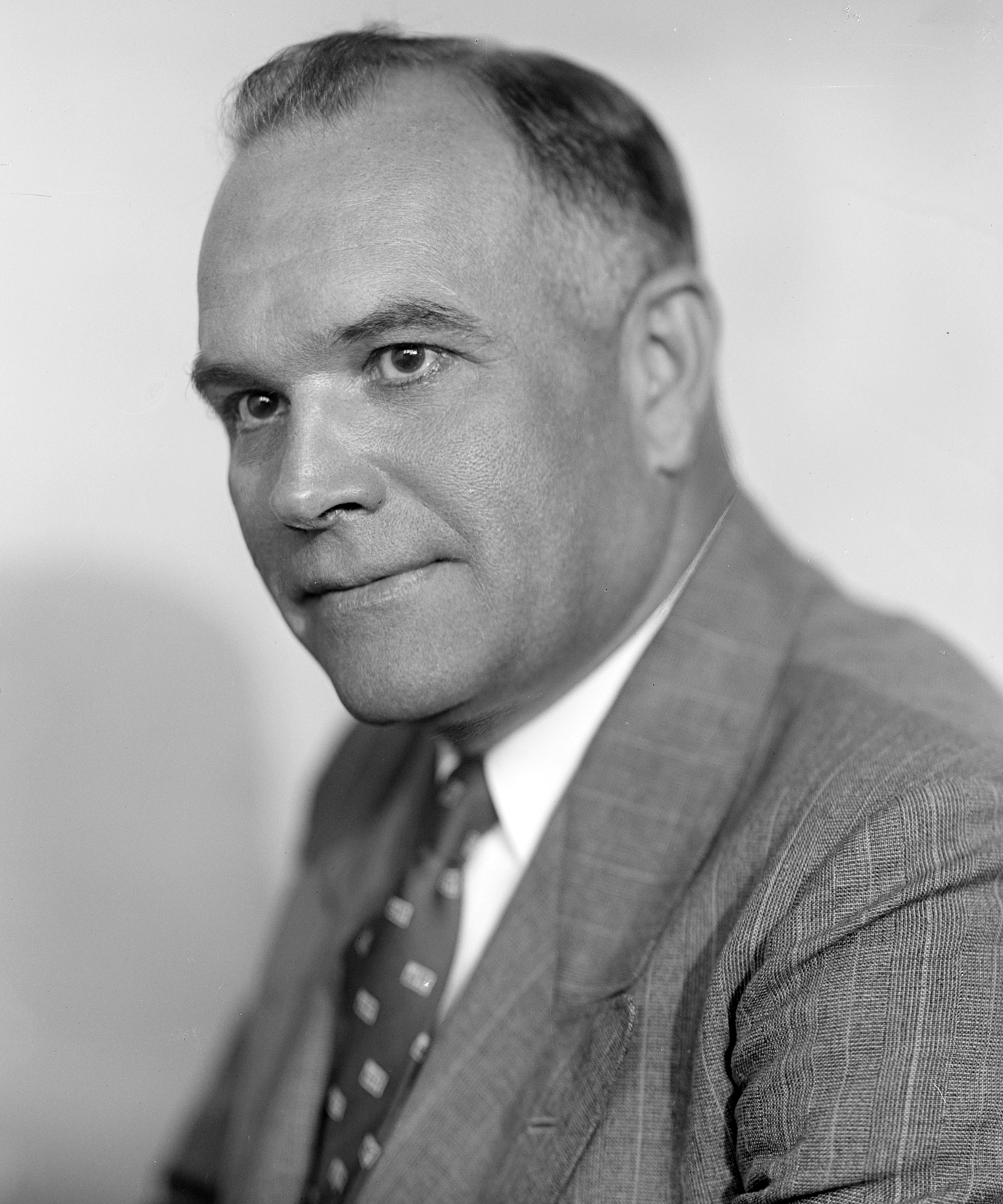
Historical · U.S. House · Iowa · District 2
William Jacobsen
Former U.S. Representative · Iowa District 2 · 1937–1943 · Democratic
William Jacobsen represented Iowa's District 2 in the United States House of Representatives (1937–1943) for the Democratic party. The page below collects sourced biographical facts, term history, committee roles, and provenance for Jacobsen.
Bioguide ID: J000039
Key facts
- Full name
- William Jacobsen
- State
- Iowa
- District
- District 2
- Party
- Democratic
- House service
- 1937–1943
- First House term
- 1937
- Status
- Left office
- Current term ends
- —
- Born
- 1887
- Bioguide ID
- J000039
- Committee assignments
- —
- Dataset version
- 1.20260605
Biographical narrative
843 words · sourced from the Wikipedia REST extract
William Jacobsen was a Democratic politician who served as a U.S. Representative for Iowa's 2nd congressional district from 1937 until 1943. He succeeded his father, Bernhard M. Jacobsen, who had held the same congressional seat prior to him. Throughout his political career, William Jacobsen was involved in various capacities within his community and the Democratic Party, contributing to local and national politics during a significant period in American history.
Early life and career
William Jacobsen was born on January 15, 1887, in Clinton, Iowa. He grew up in a family that was politically active; his father, Bernhard M. Jacobsen, served as a U.S. Representative, which would later influence William's own political aspirations. Jacobsen received his early education in the public school system of Clinton and furthered his studies at the Normal College of American Gymnastics Union located in Indianapolis, Indiana.
In the early years of his career, Jacobsen worked in the field of physical education. From 1910 to 1915, he served as the director of physical education for the Turner Society and the Y.M.C.A. in Clinton. This role allowed him to engage with the community and promote physical fitness and well-being. Following this period, he transitioned into the business sector, becoming a manager and part owner of his family’s department store from 1915 to 1927. His involvement in the family business provided him with valuable experience in management and community engagement.
In 1927, Jacobsen took on a new role as the secretary, treasurer, manager, and organizer of the Clinton Thrift Company, a position he held until he was elected to Congress. His business acumen was complemented by his management of various business properties and farm interests, which further solidified his standing in the local economy. Jacobsen also demonstrated his commitment to the Democratic Party by serving as a delegate to state conventions from 1932 to 1944 and participating in national conventions in 1936 and 1944.
Jacobsen's entry into politics was marked by a significant family event. In June 1936, his father, who was a candidate for re-election to Congress, fell ill and subsequently passed away shortly after winning the Democratic primary. In the wake of this tragedy, a special nominating convention selected William Jacobsen to replace his father on the ballot for the upcoming general election.
House tenure
William Jacobsen officially began his congressional career on January 3, 1937, after winning the general election. He successfully navigated the political landscape of Iowa, securing re-election in both 1938 and 1940. His tenure in the U.S. House of Representatives spanned three terms, during which he represented Iowa's 2nd congressional district. Jacobsen's time in Congress coincided with a period of significant Democratic influence in Iowa, particularly following his father’s earlier tenure.
In the 1940s, demographic changes in Iowa, as reflected in the census, led to a reduction in the state's congressional representation. Iowa lost one congressional seat, necessitating a redistricting process that placed Jacobsen in direct competition with another incumbent, Republican Henry O. Talle, for re-election in 1942. This election marked a turning point, as Jacobsen was defeated by Talle, concluding his congressional service on January 3, 1943.
Throughout his time in office, Jacobsen was part of a broader Democratic presence in Iowa's congressional delegation. His father’s initial election in 1930 had marked a resurgence for Democrats in the state, breaking a fourteen-year drought. However, following Jacobsen's defeat, the Democratic representation in Iowa's congressional delegation would diminish significantly, with another fourteen years passing before a Democrat would win a U.S. House seat in Iowa.
Legislative focus and committees
During his tenure in Congress, Jacobsen was involved in various legislative activities and initiatives that reflected the priorities of the Democratic Party and the needs of his constituents in Iowa. While specific details of his legislative focus and committee assignments are not extensively documented, it is known that he participated actively in the political discourse of the time, contributing to discussions on issues pertinent to his district and the nation.
After leaving Congress, Jacobsen continued to serve his community in different capacities. He worked as a liaison officer for the War Assets Administration in Washington, D.C., from July 1945 to January 1947. This role involved facilitating the transition of war-related assets during the post-World War II period, a time when many communities were adjusting to peacetime economies.
In addition to his work with the War Assets Administration, Jacobsen was appointed as the postmaster for Clinton, Iowa, a position he held from August 1, 1951, until January 1954. This role was significant, as it connected him to the daily lives of his constituents and allowed him to continue serving his community after his congressional career.
William Jacobsen passed away on April 10, 1955, in Dubuque, Iowa, while attending a family funeral. He was interred in Springdale Cemetery in Clinton, Iowa, leaving behind a legacy tied to both his family’s political history and his own contributions to the state of Iowa and the Democratic Party. His life and career reflect the complexities of American politics during a transformative era, marked by both local engagement and national challenges.
Notable legislation
Sponsored and co-sponsored legislation for William Jacobsen is pending operator curation. The biographical narrative above carries the same provenance trail until per-bill rows are written.
Sources
- [1]https://en.wikipedia.org/wiki/William_S._JacobsenWikipedia · retrieved 2026-06-05
Notable quotes
Sourced quotes for William Jacobsen are pending operator curation. Narrative-scope provenance remains attached below.
Sources
- [1]https://en.wikipedia.org/wiki/William_S._JacobsenWikipedia · retrieved 2026-06-05
Key positions
Curated policy positions for William Jacobsen are pending operator review. The biographical narrative above carries the same provenance trail until per-topic positions are written.
Sources
- [1]https://en.wikipedia.org/wiki/William_S._JacobsenWikipedia · retrieved 2026-06-05
Terms served
- 1937–1939U.S. House · Term 1 · Democratic
- 1939–1941U.S. House · Term 2 · Democratic
- 1941–1943U.S. House · Term 3 · Democratic
Sources & provenance
Every attributable claim above carries a per-section [N] marker that resolves to the corresponding URL below. Each entry records the upstream provider, the canonical URL, and the timestamp at which the source was retrieved by the ingest pipeline.
Key facts
- https://bioguide.congress.gov/search/bio/J000039bioguide · retrieved 2026-06-05
- https://www.govtrack.us/congress/members/405944govtrack · retrieved 2026-06-05
Biographical narrative
- https://en.wikipedia.org/wiki/William_S._Jacobsenwikipedia · retrieved 2026-06-05
Find your representative
Every U.S. state elects representatives by district. Browse Iowa’s delegation, the full former-representative roster, or explore the role and term length.
Related on The Candidate
- Preceded by Bernhard JacobsenEarlier holder of the Iowa District 2 House seat · Democratic.Open
- Succeeded by Leonard WolfLater holder of the Iowa District 2 House seat · Democratic.Open
- Abby FinkenauerFormer U.S. Representative · Iowa District 1 · DemocraticOpen
- Augustus HallFormer U.S. Representative · Iowa District 1 · DemocraticOpen
- Benton HallFormer U.S. Representative · Iowa District 1 · DemocraticOpen
- Bernhart HennFormer U.S. Representative · Iowa District 1 · DemocraticOpen