
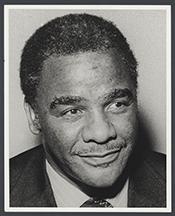
Historical · U.S. House · Illinois · District 1
Harold Washington
Former U.S. Representative · Illinois District 1 · 1981–1985 · Democratic
Harold Washington represented Illinois's District 1 in the United States House of Representatives (1981–1985) for the Democratic party. The page below collects sourced biographical facts, term history, committee roles, and provenance for Washington.
Bioguide ID: W000180
Key facts
- Full name
- Harold Washington
- State
- Illinois
- District
- District 1
- Party
- Democratic
- House service
- 1981–1985
- First House term
- 1981
- Status
- Left office
- Current term ends
- —
- Born
- 1922
- Bioguide ID
- W000180
- Committee assignments
- —
- Dataset version
- 1.20260605
Biographical narrative
914 words · sourced from the Wikipedia REST extract
Harold Washington was an American politician and lawyer who served as a U.S. Representative for Illinois's 1st congressional district from 1981 until 1983, before becoming the 51st mayor of Chicago, a position he held until his death in 1987. A member of the Democratic Party, Washington was notable for being the first African American mayor of Chicago. His political career was marked by a commitment to civil rights and social justice, as well as a focus on addressing the needs of marginalized communities.
Early life and career
Harold Lee Washington was born on April 15, 1922, at Cook County Hospital in Chicago, Illinois, to Roy and Bertha Washington. His father, Roy Washington, was a lawyer and a Methodist minister who became one of the first African American precinct captains for the Chicago Democratic Party. This early involvement in politics would later influence Harold's own political aspirations. Bertha Washington left the family when Harold was four years old, possibly to pursue a career as a singer, leaving Harold and his brother Edward to be raised by their father in the Douglas neighborhood of Chicago, a hub of African American culture during the early to mid-20th century.
Harold Washington's education began at St. Benedict the Moor Boarding School in Milwaukee, where he attended from 1928 to 1932. He later enrolled at DuSable High School, a racially segregated public school in Chicago, from 1936 to 1939. During his time at DuSable, Washington excelled in athletics, particularly in track and field, where he contributed to his school's victory in the Chicago Public League Championship.
After leaving high school during his senior year, Washington joined the Civilian Conservation Corps in 1939 and later worked at a meatpacking plant. His father eventually helped him secure a position at the U.S. Treasury branch in Chicago, where he met Nancy Dorothy Finch, whom he married shortly thereafter.
In 1942, Washington was drafted into the United States Army during World War II. He served in the 1887th Engineer Aviation Battalion, a racially segregated unit, and was involved in constructing a bomber landing strip on Angaur Island in Palau. His unit's efforts earned them a Meritorious Service Unit Award. Washington rose to the rank of First Sergeant and was honorably discharged in 1946, receiving his high school diploma from DuSable High School upon his return.
After the war, Washington enrolled at Roosevelt College (now Roosevelt University) in 1946. He became actively involved in student government and civil rights initiatives, advocating against housing discrimination and restrictive covenants that prevented ethnic minorities from purchasing homes in predominantly white neighborhoods. Washington was elected the third president of Roosevelt's student council, making history as the first Black student to hold that position.
House tenure
Harold Washington's political career in the U.S. Congress began when he was elected to the United States House of Representatives in 1980, representing Illinois's 1st congressional district. He served two terms in the House, with his first term commencing in 1981. Washington's tenure in Congress was characterized by his advocacy for civil rights, social justice, and economic equity. He focused on issues affecting his constituents, particularly those in marginalized communities.
During his time in the House, Washington was known for his commitment to addressing the needs of the African American community and other minority groups. He worked on legislation aimed at improving access to education, healthcare, and economic opportunities for disadvantaged populations. His experience as a lawyer and community activist informed his legislative priorities and approach to governance.
Washington's congressional career was relatively brief, as he chose to run for mayor of Chicago in the 1983 election. He successfully defeated incumbent mayor Jane Byrne and State's Attorney Richard M. Daley in the Democratic primary, a significant upset that highlighted the shifting political landscape in Chicago. Washington's victory in the primary set the stage for a competitive general election against Republican candidate Bernard Epton.
Legislative focus and committees
Throughout his time in the U.S. House of Representatives, Harold Washington was involved in various legislative initiatives that reflected his commitment to civil rights and social justice. His work often centered on issues pertinent to his constituents in Chicago, particularly those related to economic development, education, and healthcare access. Washington's background as a lawyer and community organizer informed his approach to legislation, allowing him to advocate effectively for policies that aimed to uplift marginalized communities.
In addition to his legislative work, Washington served on several committees during his time in Congress. These committees provided him with platforms to influence policy and advocate for the needs of his district. His focus on civil rights and social equity was evident in his participation in discussions and initiatives aimed at addressing systemic inequalities.
Washington's tenure in the House was marked by his ability to navigate the complexities of political life in a racially and politically diverse city. His experiences as a member of the Illinois General Assembly prior to his congressional service equipped him with the skills necessary to engage with a wide range of stakeholders, from community leaders to fellow lawmakers.
After serving two terms in the House, Washington transitioned to the role of mayor of Chicago, where he continued to champion the causes he had prioritized during his congressional career. His election as mayor marked a significant milestone in Chicago's political history, as he became the first African American to hold that office. Washington's legacy as a politician and advocate for civil rights continues to resonate in Chicago and beyond, inspiring future generations of leaders.
Notable legislation
Sponsored and co-sponsored legislation for Harold Washington is pending operator curation. The biographical narrative above carries the same provenance trail until per-bill rows are written.
Sources
- [1]https://en.wikipedia.org/wiki/Harold_WashingtonWikipedia · retrieved 2026-06-05
Notable quotes
Sourced quotes for Harold Washington are pending operator curation. Narrative-scope provenance remains attached below.
Sources
- [1]https://en.wikipedia.org/wiki/Harold_WashingtonWikipedia · retrieved 2026-06-05
Key positions
Curated policy positions for Harold Washington are pending operator review. The biographical narrative above carries the same provenance trail until per-topic positions are written.
Sources
- [1]https://en.wikipedia.org/wiki/Harold_WashingtonWikipedia · retrieved 2026-06-05
Terms served
- 1981–1983U.S. House · Term 1 · Democratic
- 1983–1985U.S. House · Term 2 · Democratic
Sources & provenance
Every attributable claim above carries a per-section [N] marker that resolves to the corresponding URL below. Each entry records the upstream provider, the canonical URL, and the timestamp at which the source was retrieved by the ingest pipeline.
Key facts
- https://bioguide.congress.gov/search/bio/W000180bioguide · retrieved 2026-06-05
- https://www.govtrack.us/congress/members/411353govtrack · retrieved 2026-06-05
Biographical narrative
- https://en.wikipedia.org/wiki/Harold_Washingtonwikipedia · retrieved 2026-06-05
Find your representative
Every U.S. state elects representatives by district. Browse Illinois’s delegation, the full former-representative roster, or explore the role and term length.
Related on The Candidate
- Preceded by Bennett StewartEarlier holder of the Illinois District 1 House seat · Democratic.Open
- Succeeded by Bobby RushLater holder of the Illinois District 1 House seat · Democratic.Open
- Abner TaylorFormer U.S. Representative · Illinois District 1 · RepublicanOpen
- Adam SnyderFormer U.S. Representative · Illinois District 1 · DemocraticOpen
- Arthur MitchellFormer U.S. Representative · Illinois District 1 · DemocraticOpen
- Democratic PartyFederal candidates and office holders on the Democratic line.Open