
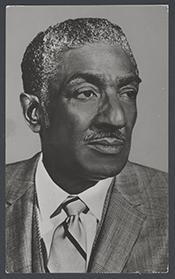
Historical · U.S. House · Illinois · District 1
Ralph Metcalfe
Former U.S. Representative · Illinois District 1 · 1971–1979 · Democratic
Ralph Metcalfe represented Illinois's District 1 in the United States House of Representatives (1971–1979) for the Democratic party. The page below collects sourced biographical facts, term history, committee roles, and provenance for Metcalfe.
Bioguide ID: M000675
Key facts
- Full name
- Ralph Metcalfe
- State
- Illinois
- District
- District 1
- Party
- Democratic
- House service
- 1971–1979
- First House term
- 1971
- Status
- Left office
- Current term ends
- —
- Born
- 1910
- Bioguide ID
- M000675
- Committee assignments
- —
- Dataset version
- 1.20260605
Biographical narrative
1,022 words · sourced from the Wikipedia REST extract
Ralph H. Metcalfe was an American politician and former track and field athlete who served as a U.S. Representative for Illinois' 1st congressional district from 1971 until 1979. A member of the Democratic Party, Metcalfe was notable for his athletic achievements, including winning four Olympic medals and holding world records in sprinting events. Following his athletic career, he transitioned into politics, where he became a prominent figure in Chicago and a co-founder of the Congressional Black Caucus.
Early life and career
Ralph Harold Metcalfe was born on May 29, 1910, in Atlanta, Georgia. He spent much of his formative years in Chicago, Illinois, where he attended Tilden Technical High School, graduating in 1930. Metcalfe's athletic prowess became evident during his high school years, leading him to accept a track scholarship to Marquette University in Milwaukee, Wisconsin. At Marquette, he made a significant mark in collegiate athletics, notably equaling the 100-meter dash record of 10.3 seconds multiple times and matching the 200-meter record of 20.6 seconds. His exceptional talent earned him the distinction of being the first athlete to win the NCAA 200-meter title three consecutive times.
Metcalfe's track and field career reached its zenith when he competed in the 1932 Summer Olympics held in Los Angeles. He finished second in the 100 meters, narrowly losing to Eddie Tolan in a race that ended in a virtual dead heat, with both athletes clocking a time of 10.38 seconds. Metcalfe also secured a bronze medal in the 200 meters at these games. His Olympic journey continued in 1936 at the Berlin Olympics, where he again claimed silver in the 100 meters, this time finishing behind Jesse Owens, who won four gold medals in that event. Metcalfe was part of the U.S. team that won gold in the 4 × 100 meter relay, alongside Owens, Foy Draper, and Frank Wykoff.
Following his athletic career, Metcalfe pursued higher education, earning a bachelor's degree from Marquette University in 1936 and a master's degree in political science from the University of Southern California in 1939. He began his professional career as an educator, teaching political science and coaching track at Xavier University in New Orleans. During World War II, he served in the U.S. Army's transportation corps, achieving the rank of first lieutenant and receiving the Legion of Merit for his service.
After the war, Metcalfe returned to Chicago, where he became involved in local politics. He was appointed to lead the state's athletic commission and later won his first election as an alderman in 1955, representing the South Side of Chicago. His political career would eventually lead him to the U.S. Congress.
House tenure
Ralph Metcalfe was elected to the U.S. House of Representatives in 1970, representing Illinois' 1st congressional district. This district had been held for nearly three decades by William L. Dawson, who retired due to health issues shortly before Metcalfe's election. Metcalfe's victory marked a significant transition in the district's representation, as he became one of the first African American congressmen from Illinois.
During his four terms in Congress, which lasted from 1971 until 1979, Metcalfe was known for his commitment to civil rights and social justice. He played a vital role in the establishment of the Congressional Black Caucus (CBC) in 1971, an organization aimed at addressing the legislative concerns of African Americans and advocating for policies that would benefit minority communities. Metcalfe's tenure in Congress was marked by his efforts to address issues affecting his constituents, including education, housing, and employment opportunities.
Throughout his time in office, Metcalfe maintained a focus on the needs of his district, which encompassed a diverse population in Chicago. He was known for his willingness to engage with community members and address their concerns directly. His political career was characterized by a commitment to improving the lives of those he represented, as well as a willingness to challenge the status quo, particularly in relation to issues of police brutality and civil rights.
Metcalfe's political alignment sometimes put him at odds with established figures in Chicago politics, including Mayor Richard Daley. His willingness to break ranks with the mayor on issues of police conduct demonstrated his commitment to advocating for justice and accountability, particularly in the context of the African American community.
Legislative focus and committees
During his time in the House of Representatives, Ralph Metcalfe served on several committees that aligned with his interests and the needs of his constituents. His legislative focus included civil rights, education, and urban development, reflecting the priorities of the communities he represented. He was particularly concerned with issues that affected the African American community, advocating for policies that aimed to promote equality and opportunity.
Metcalfe's involvement in the Congressional Black Caucus allowed him to collaborate with other African American legislators to address systemic issues facing minority populations. This collaboration was crucial in amplifying the voices of African Americans in Congress and ensuring that their concerns were represented in national policy discussions.
In addition to his work on civil rights, Metcalfe also focused on education reform. He recognized the importance of access to quality education as a means of empowering individuals and communities. His legislative efforts aimed to improve educational opportunities for students in his district and beyond, advocating for increased funding and resources for schools serving low-income populations.
Metcalfe's commitment to urban development was also evident in his legislative initiatives. He sought to address the challenges faced by urban communities, including housing shortages and economic disparities. His work in Congress reflected a broader understanding of the interconnectedness of social issues and the need for comprehensive solutions to improve the quality of life for residents in urban areas.
Ralph Metcalfe's congressional career came to an end in 1979, but his legacy as a trailblazer in both athletics and politics continues to resonate. His contributions to civil rights, education, and urban development remain significant, reflecting his dedication to serving his community and advocating for justice and equality. Metcalfe passed away on October 10, 1978, from a heart attack, shortly before the end of his term, leaving behind a legacy of public service that bridged the worlds of sports and politics.
Notable legislation
Sponsored and co-sponsored legislation for Ralph Metcalfe is pending operator curation. The biographical narrative above carries the same provenance trail until per-bill rows are written.
Sources
- [1]https://en.wikipedia.org/wiki/Ralph_MetcalfeWikipedia · retrieved 2026-06-05
Notable quotes
Sourced quotes for Ralph Metcalfe are pending operator curation. Narrative-scope provenance remains attached below.
Sources
- [1]https://en.wikipedia.org/wiki/Ralph_MetcalfeWikipedia · retrieved 2026-06-05
Key positions
Curated policy positions for Ralph Metcalfe are pending operator review. The biographical narrative above carries the same provenance trail until per-topic positions are written.
Sources
- [1]https://en.wikipedia.org/wiki/Ralph_MetcalfeWikipedia · retrieved 2026-06-05
Terms served
- 1971–1973U.S. House · Term 1 · Democratic
- 1973–1975U.S. House · Term 2 · Democratic
- 1975–1977U.S. House · Term 3 · Democratic
- 1977–1979U.S. House · Term 4 · Democratic
Sources & provenance
Every attributable claim above carries a per-section [N] marker that resolves to the corresponding URL below. Each entry records the upstream provider, the canonical URL, and the timestamp at which the source was retrieved by the ingest pipeline.
Key facts
- https://bioguide.congress.gov/search/bio/M000675bioguide · retrieved 2026-06-05
- https://www.govtrack.us/congress/members/407660govtrack · retrieved 2026-06-05
Biographical narrative
- https://en.wikipedia.org/wiki/Ralph_Metcalfewikipedia · retrieved 2026-06-05
Find your representative
Every U.S. state elects representatives by district. Browse Illinois’s delegation, the full former-representative roster, or explore the role and term length.
Related on The Candidate
- Preceded by William DawsonEarlier holder of the Illinois District 1 House seat · Democratic.Open
- Succeeded by Bennett StewartLater holder of the Illinois District 1 House seat · Democratic.Open
- Abner TaylorFormer U.S. Representative · Illinois District 1 · RepublicanOpen
- Adam SnyderFormer U.S. Representative · Illinois District 1 · DemocraticOpen
- Arthur MitchellFormer U.S. Representative · Illinois District 1 · DemocraticOpen
- Democratic PartyFederal candidates and office holders on the Democratic line.Open