
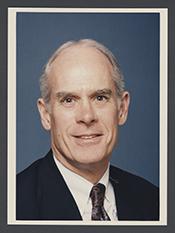
Historical · U.S. House · Illinois · District 10
John Porter
Former U.S. Representative · Illinois District 10 · 1979–2001 · Republican
John Porter represented Illinois's District 10 in the United States House of Representatives (1979–2001) for the Republican party. The page below collects sourced biographical facts, term history, committee roles, and provenance for Porter.
Bioguide ID: P000444
Key facts
- Full name
- John Porter
- State
- Illinois
- District
- District 10
- Party
- Republican
- House service
- 1979–2001
- First House term
- 1979
- Status
- Left office
- Current term ends
- —
- Born
- 1935
- Bioguide ID
- P000444
- Committee assignments
- —
- Dataset version
- 1.20260605
Biographical narrative
837 words · sourced from the Wikipedia REST extract
John Edward Porter was an American lawyer and politician who served as a U.S. Representative for Illinois's 10th congressional district from 1980 until 2001. A member of the Republican Party, Porter had a notable career in public service, marked by his extensive involvement in health and education appropriations, as well as his commitment to human rights advocacy. His legislative efforts significantly influenced funding for medical research and established various initiatives aimed at promoting global human rights.
Early life and career
John Edward Porter was born on June 1, 1935. He pursued higher education at several prestigious institutions, including the Massachusetts Institute of Technology, Northwestern University, and the University of Michigan Law School, where he graduated with distinction. Following his academic achievements, Porter began his professional career as an Honor Law Graduate Attorney with the U.S. Department of Justice during the Kennedy Administration. This early experience in government service laid the groundwork for his future political career.
Before entering the U.S. House of Representatives, Porter served in the Illinois House of Representatives, where he gained valuable insights into state-level governance and legislative processes. His background in law and public service equipped him with the skills necessary to navigate the complexities of federal legislation and advocacy.
House tenure
Porter's tenure in the U.S. House of Representatives began in 1980 and lasted until January 3, 2001. Over the course of his eleven terms, he became known for his leadership roles, particularly on the United States House Committee on Appropriations. He served as the chair of the Appropriations Subcommittee on Labor, Health and Human Services, Education, and Related Agencies. This subcommittee was responsible for overseeing a wide array of health and education programs, including significant agencies such as the National Institutes of Health (NIH) and the Centers for Disease Control and Prevention (CDC).
During his time as chair, Porter was instrumental in advocating for increased funding for medical research, notably leading efforts that resulted in a doubling of the NIH budget. His work in this area underscored his commitment to advancing health initiatives and supporting scientific research, which had lasting impacts on public health policy and funding.
In addition to his appropriations work, Porter was a founding member and Co-Chairman of the Congressional Human Rights Caucus. This voluntary association comprised over 250 Members of Congress dedicated to identifying, monitoring, and addressing human rights violations globally. His commitment to human rights was further exemplified by his co-authorship of legislation that established Radio Free Asia, an initiative aimed at promoting freedom of expression in Asia.
Porter also played a significant role in environmental advocacy as the chair of Global Legislators Organized for a Balanced Environment (GLOBE USA), where he worked alongside international legislators to address pressing environmental issues.
Legislative focus and committees
Throughout his congressional career, Porter focused on several key areas, including health care, education, and human rights. His leadership on the Appropriations Subcommittee on Labor, Health and Human Services, Education, and Related Agencies allowed him to influence funding and policy decisions that affected millions of Americans. His efforts to secure increased funding for the NIH were particularly noteworthy, as they contributed to advancements in medical research and public health initiatives.
Porter's dedication to human rights was a defining aspect of his legislative focus. Through the Congressional Human Rights Caucus, he sought to raise awareness and promote action against human rights abuses worldwide. This commitment was reflected in his legislative initiatives and public statements, which aimed to foster a greater understanding of global human rights issues among his colleagues and constituents.
In addition to his work in Congress, Porter was involved in various organizations and initiatives that furthered his interests in health and science. After leaving Congress, he continued to advocate for medical research as a partner and Senior Advisor at the international law firm Hogan Lovells. He also served as Research!America Chair Emeritus and was Vice-Chair of the Foundation for the National Institutes of Health, demonstrating his ongoing commitment to advancing health research and policy.
Porter's legacy in the field of science and medicine was recognized through numerous awards, including the Mary Wood Lasker Award for Public Service and the Public Welfare Medal from the National Academy of Sciences. His contributions to medical research and public health were further acknowledged by his receipt of the Albert Sabin Hero of Science Award for his advocacy efforts.
In recognition of his significant contributions to neuroscience research, the John Edward Porter Neuroscience Research Center, located on the campus of the National Institutes of Health, was named in his honor. This facility serves as a testament to his enduring impact on the field of medical research and public health.
John Edward Porter passed away on June 3, 2022, just two days after his 87th birthday. His death marked the end of a distinguished career dedicated to public service, human rights advocacy, and the advancement of medical research. His legacy continues to influence the fields of health and education, reflecting his lifelong commitment to improving the lives of individuals both domestically and internationally.
Notable legislation
Sponsored and co-sponsored legislation for John Porter is pending operator curation. The biographical narrative above carries the same provenance trail until per-bill rows are written.
Sources
- [1]https://en.wikipedia.org/wiki/John_Porter_(Illinois_politician)Wikipedia · retrieved 2026-06-05
Notable quotes
Sourced quotes for John Porter are pending operator curation. Narrative-scope provenance remains attached below.
Sources
- [1]https://en.wikipedia.org/wiki/John_Porter_(Illinois_politician)Wikipedia · retrieved 2026-06-05
Key positions
Curated policy positions for John Porter are pending operator review. The biographical narrative above carries the same provenance trail until per-topic positions are written.
Sources
- [1]https://en.wikipedia.org/wiki/John_Porter_(Illinois_politician)Wikipedia · retrieved 2026-06-05
Terms served
- 1979–1981U.S. House · Term 1 · Republican
- 1981–1983U.S. House · Term 2 · Republican
- 1983–1985U.S. House · Term 3 · Republican
- 1985–1987U.S. House · Term 4 · Republican
- 1987–1989U.S. House · Term 5 · Republican
- 1989–1991U.S. House · Term 6 · Republican
- 1991–1993U.S. House · Term 7 · Republican
- 1993–1995U.S. House · Term 8 · Republican
- 1995–1997U.S. House · Term 9 · Republican
- 1997–1999U.S. House · Term 10 · Republican
- 1999–2001U.S. House · Term 11 · Republican
Sources & provenance
Every attributable claim above carries a per-section [N] marker that resolves to the corresponding URL below. Each entry records the upstream provider, the canonical URL, and the timestamp at which the source was retrieved by the ingest pipeline.
Key facts
- https://bioguide.congress.gov/search/bio/P000444bioguide · retrieved 2026-06-05
- https://www.govtrack.us/congress/members/400604govtrack · retrieved 2026-06-05
Biographical narrative
- https://en.wikipedia.org/wiki/John_Porter_(Illinois_politician)wikipedia · retrieved 2026-06-05
Find your representative
Every U.S. state elects representatives by district. Browse Illinois’s delegation, the full former-representative roster, or explore the role and term length.
Related on The Candidate
- Preceded by Samuel YoungEarlier holder of the Illinois District 10 House seat · Republican.Open
- Succeeded by Bob DoldLater holder of the Illinois District 10 House seat · Republican.Open
- Abner TaylorFormer U.S. Representative · Illinois District 1 · RepublicanOpen
- Adam SnyderFormer U.S. Representative · Illinois District 1 · DemocraticOpen
- Arthur MitchellFormer U.S. Representative · Illinois District 1 · DemocraticOpen
- Bennett StewartFormer U.S. Representative · Illinois District 1 · DemocraticOpen