
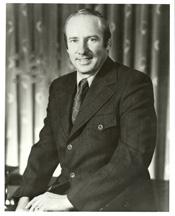
Historical · U.S. House · Illinois · District 19
Thomas Railsback
Former U.S. Representative · Illinois District 19 · 1967–1983 · Republican
Thomas Railsback represented Illinois's District 19 in the United States House of Representatives (1967–1983) for the Republican party. The page below collects sourced biographical facts, term history, committee roles, and provenance for Railsback.
Bioguide ID: R000012
Key facts
- Full name
- Thomas Railsback
- State
- Illinois
- District
- District 19
- Party
- Republican
- House service
- 1967–1983
- First House term
- 1967
- Status
- Left office
- Current term ends
- —
- Born
- 1932
- Bioguide ID
- R000012
- Committee assignments
- —
- Dataset version
- 1.20260605
Biographical narrative
963 words · sourced from the Wikipedia REST extract
Thomas F. Railsback was an American politician and lawyer who served as a U.S. Representative for Illinois's 19th congressional district from 1967 until 1983. A member of the Republican Party, Railsback was known for his moderate stance within the party, particularly during a time of significant political upheaval in the United States. His tenure in the House of Representatives included participation in pivotal legislative actions, notably the impeachment proceedings against President Richard Nixon. Railsback's career spanned eight terms, during which he built a reputation for bipartisanship and legislative effectiveness.
Early life and career
Thomas Fisher Railsback was born on January 22, 1932, in Moline, Illinois. He was the son of Fred Railsback, a municipal lawyer, and Elizabeth (Johnson) Railsback. Growing up in Moline, he attended local public schools before pursuing higher education. Railsback earned a Bachelor of Arts degree from Grinnell College in 1954 and subsequently obtained a Juris Doctor degree from Northwestern University School of Law in Chicago in 1957. Following his education, he served in the United States Army from 1957 to 1959.
Railsback's political career began in November 1962 when he was elected to the Illinois House of Representatives as a Republican. His initial foray into politics was influenced by the conservative ideals of Barry Goldwater, but he would later adopt a more moderate Republican stance. In 1966, Railsback successfully ran for the U.S. House of Representatives, defeating the incumbent Democratic representative Gale Schisler. This marked the beginning of his eight-term tenure in Congress, where he would become known for his legislative contributions and moderate approach to governance.
House tenure
Railsback's time in the U.S. House of Representatives began in 1967 and lasted until January 3, 1983. Throughout his eight terms, he developed a strong political base in his district, which included a mix of rural Republican areas and labor strongholds, particularly in Moline and Rock Island. His ability to navigate the complexities of his district's political landscape was noted by various observers, including the Washington Post, which highlighted his strategy of balancing his Republican voting record with support for civil rights and labor issues.
A significant aspect of Railsback's congressional career was his involvement in the House Judiciary Committee. He played a crucial role in the impeachment process of President Richard Nixon during the Watergate scandal. Railsback, along with his Democratic colleague Walter Flowers, was instrumental in forming a bipartisan coalition that crafted articles of impeachment against Nixon. This coalition ultimately led to the referral of the articles to the full House, marking a historic moment in American politics. Despite facing backlash from Nixon's supporters, Railsback's actions were pivotal in the political landscape of the time.
In addition to his role in the impeachment proceedings, Railsback was active in various legislative initiatives. He contributed to the passage of the Juvenile Justice and Delinquency Prevention Act of 1974, which aimed to reform the juvenile justice system. In 1979, he co-sponsored legislation with Wisconsin Democrat David Obey to address the influence of political action committees in election spending, reflecting his commitment to campaign finance reform. Railsback also opposed efforts by President Ronald Reagan to eliminate funding for the Legal Services Corporation, which provided legal assistance to low-income individuals.
Despite his moderate positions, Railsback's political career faced challenges. In 1982, following the reapportionment process that resulted from the 1980 census, his district underwent significant changes, becoming more conservative in composition. This shift ultimately led to his defeat in the Republican primary by State Senator Kenneth G. McMillan, who held more conservative views. McMillan would later lose the general election to Democrat Lane Evans.
Legislative focus and committees
During his time in Congress, Railsback was a member of the House Judiciary Committee, where he engaged in some of the most significant legislative actions of the era. His participation in the impeachment proceedings against President Nixon showcased his commitment to constitutional principles and the rule of law. Railsback's decision to support the articles of impeachment was rooted in his belief that his duty to uphold the Constitution outweighed personal loyalties, a stance that resonated with many constituents and colleagues alike.
Railsback's legislative focus extended beyond impeachment. He was involved in various initiatives aimed at improving the juvenile justice system, reflecting his interest in social issues. The Juvenile Justice and Delinquency Prevention Act of 1974, which he helped pass, aimed to address the needs of young offenders and promote rehabilitation over punishment. This legislation was part of a broader movement during the 1970s to reform the criminal justice system and address the challenges faced by youth.
In addition to his work on juvenile justice, Railsback's co-sponsorship of legislation to limit the influence of political action committees demonstrated his concern for campaign finance reform. By advocating for measures to reduce the impact of money in politics, he sought to promote a more equitable electoral process. His opposition to the abolition of the Legal Services Corporation further illustrated his commitment to ensuring access to legal representation for marginalized populations.
Railsback's tenure in the House was marked by a blend of bipartisanship and a willingness to address contentious issues. His ability to work across party lines, particularly during the impeachment process, highlighted the importance of collaboration in achieving legislative goals. Despite the challenges he faced, including the changing political landscape of his district, Railsback's contributions to American politics during his time in office left a lasting impact.
After leaving Congress, Railsback transitioned to a career as a lobbyist, serving as executive vice president of the Motion Picture Association of America and working for the Federal Judges Association. He remained active in public life until his passing on January 20, 2020, in Mesa, Arizona. His legacy as a moderate Republican and a dedicated public servant continues to be remembered in the context of American political history.
Notable legislation
Sponsored and co-sponsored legislation for Thomas Railsback is pending operator curation. The biographical narrative above carries the same provenance trail until per-bill rows are written.
Sources
- [1]https://en.wikipedia.org/wiki/Tom_RailsbackWikipedia · retrieved 2026-06-05
Notable quotes
Sourced quotes for Thomas Railsback are pending operator curation. Narrative-scope provenance remains attached below.
Sources
- [1]https://en.wikipedia.org/wiki/Tom_RailsbackWikipedia · retrieved 2026-06-05
Key positions
Curated policy positions for Thomas Railsback are pending operator review. The biographical narrative above carries the same provenance trail until per-topic positions are written.
Sources
- [1]https://en.wikipedia.org/wiki/Tom_RailsbackWikipedia · retrieved 2026-06-05
Terms served
- 1967–1969U.S. House · Term 1 · Republican
- 1969–1971U.S. House · Term 2 · Republican
- 1971–1973U.S. House · Term 3 · Republican
- 1973–1975U.S. House · Term 4 · Republican
- 1975–1977U.S. House · Term 5 · Republican
- 1977–1979U.S. House · Term 6 · Republican
- 1979–1981U.S. House · Term 7 · Republican
- 1981–1983U.S. House · Term 8 · Republican
Sources & provenance
Every attributable claim above carries a per-section [N] marker that resolves to the corresponding URL below. Each entry records the upstream provider, the canonical URL, and the timestamp at which the source was retrieved by the ingest pipeline.
Key facts
- https://bioguide.congress.gov/search/bio/R000012bioguide · retrieved 2026-06-05
- https://www.govtrack.us/congress/members/408994govtrack · retrieved 2026-06-05
Biographical narrative
- https://en.wikipedia.org/wiki/Tom_Railsbackwikipedia · retrieved 2026-06-05
Find your representative
Every U.S. state elects representatives by district. Browse Illinois’s delegation, the full former-representative roster, or explore the role and term length.
Related on The Candidate
- Preceded by Darwin SchislerEarlier holder of the Illinois District 19 House seat · Democratic.Open
- Succeeded by Terry BruceLater holder of the Illinois District 19 House seat · Democratic.Open
- Abner TaylorFormer U.S. Representative · Illinois District 1 · RepublicanOpen
- Adam SnyderFormer U.S. Representative · Illinois District 1 · DemocraticOpen
- Arthur MitchellFormer U.S. Representative · Illinois District 1 · DemocraticOpen
- Bennett StewartFormer U.S. Representative · Illinois District 1 · DemocraticOpen