
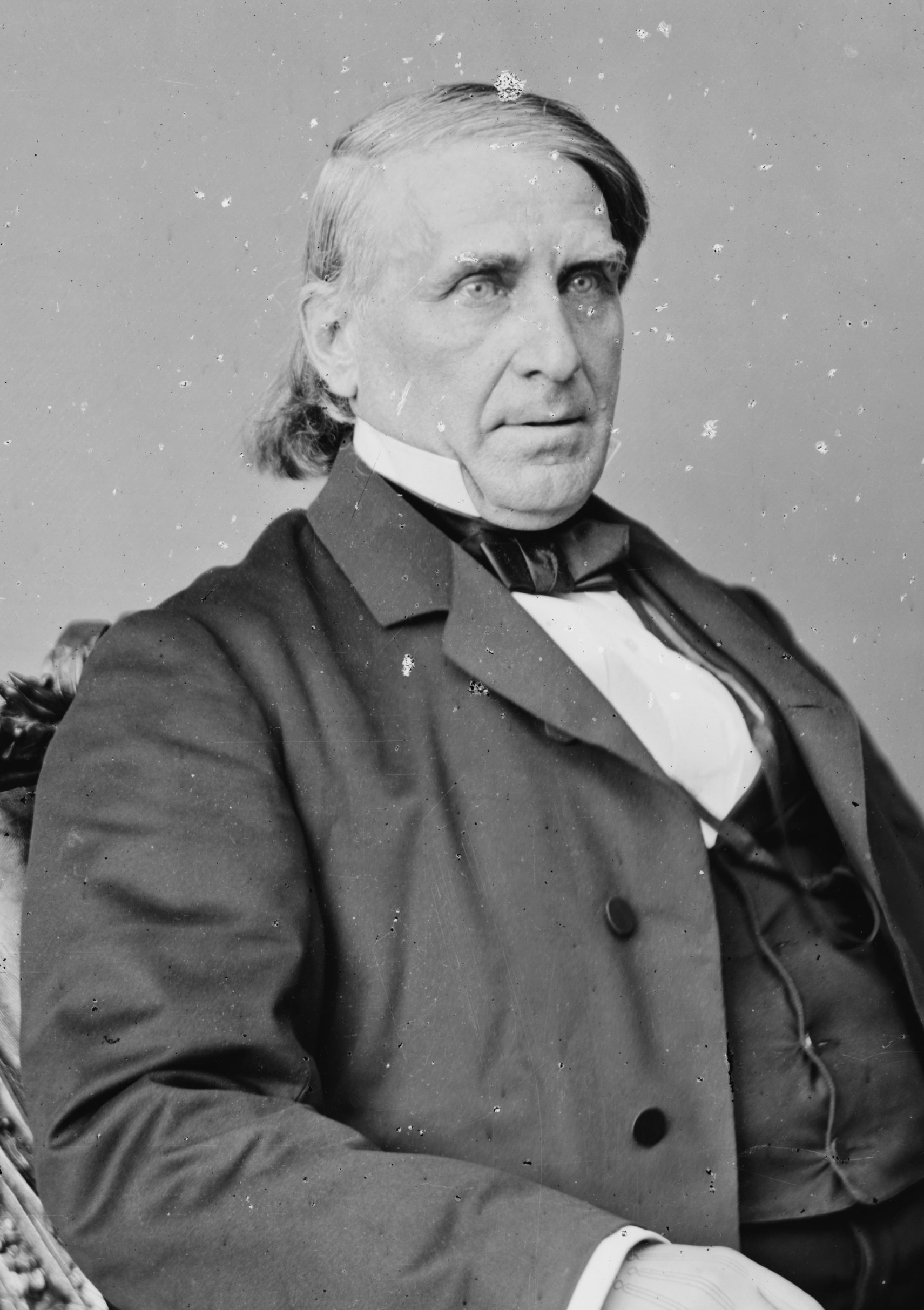
Historical · U.S. House · Illinois · District 3
Elihu Washburne
Former U.S. Representative · Illinois District 3 · 1853–1871 · Republican
Elihu Washburne represented Illinois's District 3 in the United States House of Representatives (1853–1871) for the Republican party. The page below collects sourced biographical facts, term history, committee roles, and provenance for Washburne.
Bioguide ID: W000176
Key facts
- Full name
- Elihu Washburne
- State
- Illinois
- District
- District 3
- Party
- Republican
- House service
- 1853–1871
- First House term
- 1853
- Status
- Left office
- Current term ends
- —
- Born
- 1816
- Bioguide ID
- W000176
- Committee assignments
- —
- Dataset version
- 1.20260606
Biographical narrative
946 words · sourced from the Wikipedia REST extract
Elihu Washburne was a prominent American politician and member of the Republican Party who served as a U.S. Representative from Illinois's 3rd congressional district. His congressional career spanned from 1853 to 1869, during which he played a significant role in the political landscape of the United States, particularly during the American Civil War and the early Reconstruction era. Washburne was known for his close associations with key figures such as President Abraham Lincoln and General Ulysses S. Grant. In addition to his legislative work, he briefly held the position of Secretary of State in 1869 and served as the U.S. Minister to France from 1869 to 1877.
Early life and career
Elihu Washburne was born on September 23, 1816, in Livermore, Maine, which was then part of Massachusetts. He was the third of eleven children born to Israel and Martha Washburn. His family had a notable lineage, with his grandfather, Captain Israel Washburne, serving as an officer in the Continental Army during the American Revolution. The Washburn family had deep roots in American history, tracing their ancestry back to John Washburne, a Puritan colonist who emigrated to America in 1631.
Washburne's early life was marked by hardship. His father, who initially established a shipbuilding business, faced financial difficulties in 1829, leading the family to a state of destitution. As a result, Washburne and his siblings were required to work on the family farm, leaving little time for leisure or education. Despite these challenges, Washburne pursued his education with determination. He attended local district schools, where he experienced strict discipline, including corporal punishment.
At the age of 14, after his family fell into financial ruin, Washburne left home to seek better educational opportunities and a career. He worked as a printer for the Christian Intelligencer in Gardiner, Maine, and later taught school. His commitment to education led him to attend Maine Wesleyan Seminary and study law under Judge John Otis. He furthered his legal education at Harvard Law School, completing his studies in 1840. After passing the bar exam, Washburne moved to Galena, Illinois, where he formed a law partnership with Charles S. Hempstead.
In his personal life, Washburne married Adele Gratiot on July 31, 1845. Adele was the niece of his law partner and came from a prominent family in Galena. The couple had seven children together, and their marriage lasted for 42 years until Adele's death in 1887, just months before Washburne's own passing.
House tenure
Elihu Washburne's political career began as a member of the Whig Party, where he became actively involved in politics. He served as a delegate to the Whig National Convention in both 1844 and 1852 and ran unsuccessfully for Congress in 1848. However, his political fortunes changed in 1852 when he was elected to the United States House of Representatives. He officially took office in 1853 and represented northwestern Illinois for a total of nine terms until 1869.
During his time in Congress, Washburne was a significant figure, particularly during the tumultuous years of the American Civil War. He was a staunch supporter of President Lincoln's policies and played a crucial role in advocating for the Union's war efforts. His close relationship with Ulysses S. Grant, who had moved to Galena shortly before the war, allowed Washburne to champion Grant's military promotions and defend him against critics. This advocacy was instrumental in Grant's rise within the Union Army and later his presidency.
Washburne's congressional leadership included serving as chairman of the Committee on Commerce during the 34th Congress and again during the 36th through 40th Congresses. He also chaired the Committee on Appropriations, where he was involved in critical funding decisions during the war and the early Reconstruction period. His legislative activities were characterized by a commitment to the Republican Party's principles and a focus on issues pertinent to his constituents in Illinois.
Legislative focus and committees
Throughout his tenure in the House of Representatives, Elihu Washburne was known for his alignment with the Radical Republicans, a faction that advocated for strong measures during Reconstruction and supported civil rights for African Americans. He was a vocal opponent of President Andrew Johnson's Reconstruction policies, which he believed were too lenient towards the South. Washburne's commitment to civil rights and African American suffrage was a defining aspect of his legislative focus during this period.
In addition to his work on civil rights, Washburne's role in Congress extended to various committees that shaped national policy. His leadership on the Committee on Commerce and the Committee on Appropriations allowed him to influence legislation related to trade, infrastructure, and funding for the federal government. His experience and knowledge in these areas contributed to his effectiveness as a legislator during a time of great national strife and transformation.
Washburne's political career reached a brief pinnacle when he was appointed as the 25th Secretary of State by President Grant in 1869. Though his tenure in this role lasted only eleven days, it underscored his importance in Grant's administration and his influence in shaping foreign policy. Following this brief appointment, Washburne served as the U.S. Minister to France from 1869 to 1877, where he gained recognition for his diplomatic integrity and humanitarian efforts during the Franco-Prussian War.
In retirement, Washburne continued to engage with historical and political discourse. He authored a biography of Edward Coles, an anti-slavery politician, and published a memoir detailing his diplomatic experiences in France. His contributions to American politics and diplomacy left a lasting legacy, reflecting the complexities of his era and the evolution of the Republican Party. Washburne passed away on October 22, 1887, leaving behind a significant record of public service and commitment to the principles of his time.
Notable legislation
Sponsored and co-sponsored legislation for Elihu Washburne is pending operator curation. The biographical narrative above carries the same provenance trail until per-bill rows are written.
Sources
- [1]https://en.wikipedia.org/wiki/Elihu_B._WashburneWikipedia · retrieved 2026-06-06
Notable quotes
Sourced quotes for Elihu Washburne are pending operator curation. Narrative-scope provenance remains attached below.
Sources
- [1]https://en.wikipedia.org/wiki/Elihu_B._WashburneWikipedia · retrieved 2026-06-06
Key positions
Curated policy positions for Elihu Washburne are pending operator review. The biographical narrative above carries the same provenance trail until per-topic positions are written.
Sources
- [1]https://en.wikipedia.org/wiki/Elihu_B._WashburneWikipedia · retrieved 2026-06-06
Terms served
- 1853–1855U.S. House · Term 1 · Whig
- 1855–1857U.S. House · Term 2 · Ind. Republican-Democrat
- 1857–1859U.S. House · Term 3 · Republican
- 1859–1861U.S. House · Term 4 · Republican
- 1861–1863U.S. House · Term 5 · Republican
- 1863–1865U.S. House · Term 6 · Republican
- 1865–1867U.S. House · Term 7 · Republican
- 1867–1869U.S. House · Term 8 · Republican
- 1869–1871U.S. House · Term 9 · Republican
Sources & provenance
Every attributable claim above carries a per-section [N] marker that resolves to the corresponding URL below. Each entry records the upstream provider, the canonical URL, and the timestamp at which the source was retrieved by the ingest pipeline.
Key facts
- https://bioguide.congress.gov/search/bio/W000176bioguide · retrieved 2026-06-06
- https://www.govtrack.us/congress/members/411349govtrack · retrieved 2026-06-06
Biographical narrative
- https://en.wikipedia.org/wiki/Elihu_B._Washburnewikipedia · retrieved 2026-06-06
Find your representative
Every U.S. state elects representatives by district. Browse Illinois’s delegation, the full former-representative roster, or explore the role and term length.
Related on The Candidate
- Preceded by Orlando FicklinEarlier holder of the Illinois District 3 House seat · Democratic.Open
- Succeeded by John Le MoyneLater holder of the Illinois District 3 House seat · Democratic.Open
- Abner TaylorFormer U.S. Representative · Illinois District 1 · RepublicanOpen
- Adam SnyderFormer U.S. Representative · Illinois District 1 · DemocraticOpen
- Arthur MitchellFormer U.S. Representative · Illinois District 1 · DemocraticOpen
- Bennett StewartFormer U.S. Representative · Illinois District 1 · DemocraticOpen