
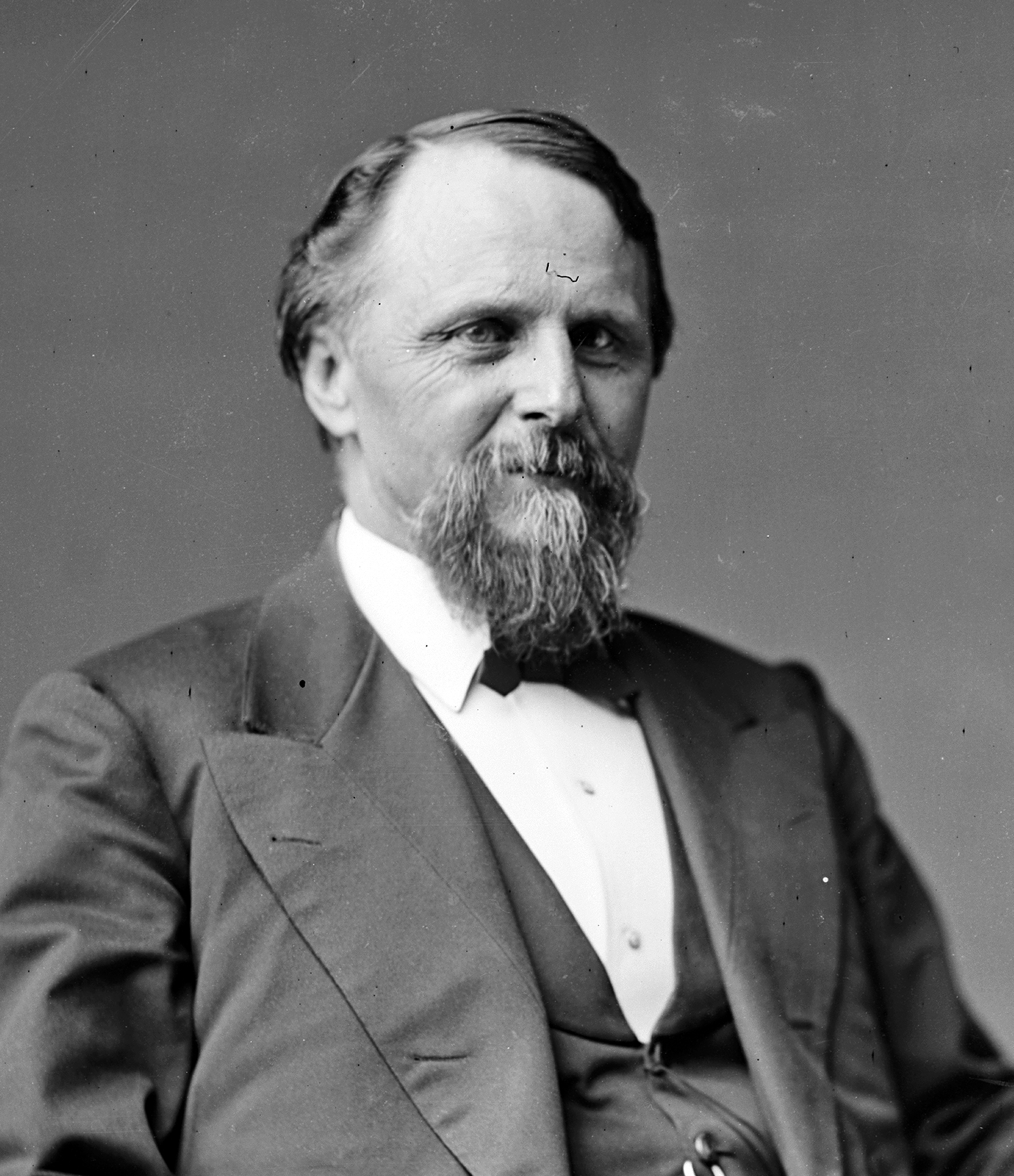
Historical · U.S. House · Illinois · District 5
Horatio Burchard
Former U.S. Representative · Illinois District 5 · 1869–1879 · Republican
Horatio Burchard represented Illinois's District 5 in the United States House of Representatives (1869–1879) for the Republican party. The page below collects sourced biographical facts, term history, committee roles, and provenance for Burchard.
Bioguide ID: B001070
Key facts
- Full name
- Horatio Burchard
- State
- Illinois
- District
- District 5
- Party
- Republican
- House service
- 1869–1879
- First House term
- 1869
- Status
- Left office
- Current term ends
- —
- Born
- 1825
- Bioguide ID
- B001070
- Committee assignments
- —
- Dataset version
- 1.20260606
Biographical narrative
874 words · sourced from the Wikipedia REST extract
Horatio Burchard was a prominent American politician and lawyer who served as a U.S. Representative for Illinois's 5th congressional district from 1869 to 1879. A member of the Republican Party, he was known for his role on the Ways and Means Committee, where he contributed to significant discussions surrounding taxation. Beyond his congressional career, Burchard also served as the director of the United States Mint, where he played a pivotal role in the development of the Consumer Price Index (CPI). His life spanned from September 22, 1825, until May 14, 1908, during which he made notable contributions to both state and national governance.
Early life and career
Horatio Burchard was born on September 22, 1825, in Marshall, New York. He received his early education through a combination of public schooling and private preparatory institutions. Burchard pursued higher education at Hamilton College in Clinton, New York, where he graduated in 1850. While at Hamilton, he became a member of the Chi Psi fraternity, which is known for fostering brotherhood and leadership among its members.
Following his graduation, Burchard studied law and was admitted to the bar in 1854. He began his legal practice in Freeport, Illinois, where he established himself as a respected attorney. His legal career coincided with his growing interest in public service. Burchard's political journey began when he was elected to the Illinois House of Representatives, where he served from 1863 to 1866. This experience laid the groundwork for his future endeavors in national politics.
In 1861, Burchard married Jane Lawver, and the couple had one son. His family life was an essential aspect of his identity, and he balanced his professional responsibilities with his role as a husband and father.
House tenure
Burchard's congressional career commenced when he was elected as a Republican to the Forty-first Congress, filling a vacancy created by the resignation of Elihu B. Washburne. He officially took office on December 6, 1869, and was subsequently re-elected to the Forty-second Congress and three additional terms, serving until March 3, 1879. Throughout his tenure, Burchard was involved in various legislative activities and was recognized for his commitment to his constituents in Illinois.
During his time in the House of Representatives, Burchard was appointed to the influential Ways and Means Committee, which is responsible for matters related to taxation and revenue generation. His leadership on the Subcommittee on Internal Revenue was particularly noteworthy, as he oversaw discussions regarding the first proposals for a peacetime income tax. Although these proposals did not ultimately result in successful legislation during his chairmanship, they marked a significant moment in the evolving conversation about taxation in the United States.
Burchard's legislative efforts were characterized by his focus on fiscal responsibility and the implications of taxation on the economy. His work on the Ways and Means Committee positioned him as a key figure in shaping economic policy during a transformative period in American history. Despite his contributions, Burchard faced challenges in securing renomination in 1878, which marked the end of his congressional career.
Legislative focus and committees
Throughout his time in the U.S. House of Representatives, Burchard's legislative focus was primarily centered on fiscal policy, particularly in relation to taxation and revenue. His role on the Ways and Means Committee allowed him to engage deeply with issues that were critical to the financial stability of the nation. As Chairman of the Subcommittee on Internal Revenue, he was at the forefront of discussions that sought to address the complexities of tax legislation during a time of economic change.
Burchard's efforts to introduce a peacetime income tax were significant, as they reflected the broader economic challenges faced by the country in the post-Civil War era. While the proposed legislation did not pass, the debates and discussions that took place under his leadership contributed to the ongoing dialogue about taxation in the United States. His work in this area laid the groundwork for future tax policy discussions and reforms.
After concluding his congressional service, Burchard transitioned to a prominent role as the director of the United States Mint from 1879 to 1885. In this capacity, he was instrumental in the creation of the Consumer Price Index (CPI), a tool that has become essential for measuring inflation and economic performance. His contributions to the CPI have had lasting impacts on economic analysis and policy-making.
In addition to his work at the U.S. Mint, Burchard remained active in public service. He participated in a commission to revise state revenue laws in Illinois during 1885 and 1886, demonstrating his ongoing commitment to improving fiscal policy at the state level. Furthermore, he was involved in the World's Columbian Exposition in Chicago in 1893, where he oversaw the jury of awards for the mining department, showcasing his engagement with both economic and cultural developments.
Horatio Burchard's life and career reflect a dedication to public service and a commitment to addressing the economic challenges of his time. His contributions as a U.S. Representative and later as the director of the U.S. Mint have left a lasting legacy in the fields of taxation and economic measurement. He passed away on May 14, 1908, in Freeport, Illinois, and was laid to rest in Oakland Cemetery, leaving behind a significant historical footprint in American governance.
Notable legislation
Sponsored and co-sponsored legislation for Horatio Burchard is pending operator curation. The biographical narrative above carries the same provenance trail until per-bill rows are written.
Sources
- [1]https://en.wikipedia.org/wiki/Horatio_C._BurchardWikipedia · retrieved 2026-06-06
Notable quotes
Sourced quotes for Horatio Burchard are pending operator curation. Narrative-scope provenance remains attached below.
Sources
- [1]https://en.wikipedia.org/wiki/Horatio_C._BurchardWikipedia · retrieved 2026-06-06
Key positions
Curated policy positions for Horatio Burchard are pending operator review. The biographical narrative above carries the same provenance trail until per-topic positions are written.
Sources
- [1]https://en.wikipedia.org/wiki/Horatio_C._BurchardWikipedia · retrieved 2026-06-06
Terms served
- 1869–1871U.S. House · Term 1 · Republican
- 1871–1873U.S. House · Term 2 · Republican
- 1873–1875U.S. House · Term 3 · Republican
- 1875–1877U.S. House · Term 4 · Republican
- 1877–1879U.S. House · Term 5 · Republican
Sources & provenance
Every attributable claim above carries a per-section [N] marker that resolves to the corresponding URL below. Each entry records the upstream provider, the canonical URL, and the timestamp at which the source was retrieved by the ingest pipeline.
Key facts
- https://bioguide.congress.gov/search/bio/B001070bioguide · retrieved 2026-06-06
- https://www.govtrack.us/congress/members/402016govtrack · retrieved 2026-06-06
Biographical narrative
- https://en.wikipedia.org/wiki/Horatio_C._Burchardwikipedia · retrieved 2026-06-06
Find your representative
Every U.S. state elects representatives by district. Browse Illinois’s delegation, the full former-representative roster, or explore the role and term length.
Related on The Candidate
- Preceded by Owen LovejoyEarlier holder of the Illinois District 5 House seat · Republican.Open
- Succeeded by Robert HawkLater holder of the Illinois District 5 House seat · Republican.Open
- Abner TaylorFormer U.S. Representative · Illinois District 1 · RepublicanOpen
- Adam SnyderFormer U.S. Representative · Illinois District 1 · DemocraticOpen
- Arthur MitchellFormer U.S. Representative · Illinois District 1 · DemocraticOpen
- Bennett StewartFormer U.S. Representative · Illinois District 1 · DemocraticOpen