
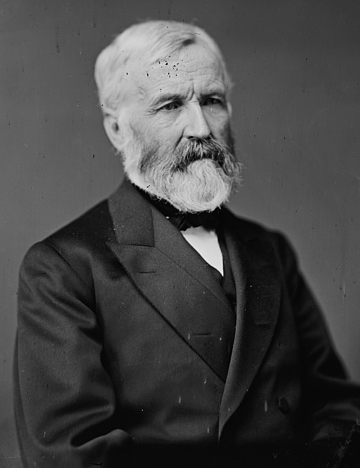
Historical · U.S. House · Illinois · District 7
Alexander Campbell
Former U.S. Representative · Illinois District 7 · 1875–1877 · Independent
Alexander Campbell represented Illinois's District 7 in the United States House of Representatives (1875–1877) for the Independent party. The page below collects sourced biographical facts, term history, committee roles, and provenance for Campbell.
Bioguide ID: C000075
Key facts
- Full name
- Alexander Campbell
- State
- Illinois
- District
- District 7
- Party
- Independent
- House service
- 1875–1877
- First House term
- 1875
- Status
- Left office
- Current term ends
- —
- Born
- 1814
- Bioguide ID
- C000075
- Committee assignments
- —
- Dataset version
- 1.20260606
Biographical narrative
859 words · sourced from the Wikipedia REST extract
Alexander Campbell was a prominent businessman, politician, and author from Illinois, who served as a U.S. Representative for the state's 7th congressional district. Elected as an independent, Campbell's political career was marked by his involvement in the Greenback movement, which advocated for the use of fiat money and aimed to reform the financial system in favor of labor. His tenure in the House of Representatives lasted from 1875 to 1877, during which he sought to influence economic policy through his writings and political activities.
Early life and career
Born on October 4, 1814, near Concord in Franklin County, Pennsylvania, Alexander Campbell grew up on a farm. He received his education in public schools, which laid the foundation for his future endeavors. After completing his schooling, Campbell began his career as a clerk in an iron works, where he quickly demonstrated his capabilities and was promoted to the position of superintendent. His work in this industry allowed him to amass considerable wealth, particularly through managing mines and steel mills across various states, including Pennsylvania, Kentucky, and Missouri.
In 1850, Campbell relocated to LaSalle, Illinois, where he shifted his focus to the local coal fields. His move to Illinois marked the beginning of his active engagement in local politics. As a member of the Whig Party, Campbell was elected as the mayor of LaSalle, serving two terms in the early 1850s. His political career continued to develop when he was elected to the Illinois House of Representatives as a Republican, serving from 1858 to 1859. Additionally, he participated as a delegate in the 1862 Illinois Constitutional Convention, further solidifying his role in state governance.
Campbell's political philosophy began to take shape during this period, influenced by the economic theories of Edward Kellogg, a pre-Civil War economist. In 1864, he published a significant work titled "The True American System of Finance," which expanded on Kellogg's advocacy for fiat money. Campbell's approach diverged from Kellogg's by promoting a currency and bond system instead of re-establishing a national bank. His writings positioned him as a leading figure in the Greenback movement, which sought to replace bank currency with United States Notes, aiming to create a more equitable financial system that favored labor over capital.
House tenure
In 1874, Campbell ran for the U.S. House of Representatives and won election as an independent candidate, unseating the Republican incumbent Franklin Corwin. He took office in the Forty-fourth Congress, representing Illinois's 7th congressional district from 1875 to 1877. During his time in Congress, Campbell continued to advocate for the principles he had espoused in his writings, focusing on monetary reform and the promotion of labor rights.
Despite his efforts, Campbell faced challenges in securing a second term. He sought re-election in 1876 but was defeated by Republican candidate Philip C. Hayes. His tenure in the House was marked by his commitment to the Greenback movement, and he garnered attention at the 1876 Greenback National Convention, where he received several votes for the presidential nomination. However, the nomination ultimately went to Peter Cooper.
Campbell's single term in the House of Representatives was significant in that it reflected the growing interest in monetary reform during the post-Civil War era. His election as an independent candidate indicated a shift in political dynamics, as he was able to attract support from constituents who were dissatisfied with the traditional party system.
Legislative focus and committees
During his time in Congress, Campbell's legislative focus was primarily centered on economic issues, particularly those related to finance and labor. His advocacy for the Greenback movement was a central theme of his political career, as he sought to challenge the dominance of bank currency and promote the use of fiat money. Campbell's writings, including "The True Greenback," further articulated his vision for a financial system that prioritized labor and aimed to create a more equitable economic landscape.
Although specific details about his committee assignments during his congressional tenure are not documented, it is evident that Campbell's interests aligned closely with issues of finance and labor rights. His background as a businessman and his experiences in local and state politics informed his approach to legislation, as he sought to address the concerns of working-class citizens and advocate for reforms that would benefit them.
After his defeat in the 1876 election, Campbell did not return to public office. However, he remained active in political discourse, issuing pamphlets such as his 1878 "Address to the voters of the seventh congressional district of Illinois," which reflected his ongoing commitment to the principles he championed during his time in Congress. He also sought the presidential nomination at the 1880 Greenback National Convention, although he was not selected, as the convention nominated James B. Weaver instead.
Alexander Campbell passed away on August 8, 1898, in LaSalle, Illinois. He was interred at Oakwood Cemetery, leaving behind a legacy as a businessman and political figure who contributed to the discourse on monetary reform and labor rights during a transformative period in American history. His work and advocacy for the Greenback movement continue to be recognized as part of the broader narrative of economic thought and political activism in the United States.
Notable legislation
Sponsored and co-sponsored legislation for Alexander Campbell is pending operator curation. The biographical narrative above carries the same provenance trail until per-bill rows are written.
Sources
- [1]https://en.wikipedia.org/wiki/Alexander_Campbell_(Illinois_politician)Wikipedia · retrieved 2026-06-06
Notable quotes
Sourced quotes for Alexander Campbell are pending operator curation. Narrative-scope provenance remains attached below.
Sources
- [1]https://en.wikipedia.org/wiki/Alexander_Campbell_(Illinois_politician)Wikipedia · retrieved 2026-06-06
Key positions
Curated policy positions for Alexander Campbell are pending operator review. The biographical narrative above carries the same provenance trail until per-topic positions are written.
Sources
- [1]https://en.wikipedia.org/wiki/Alexander_Campbell_(Illinois_politician)Wikipedia · retrieved 2026-06-06
Terms served
- 1875–1877U.S. House · Term 1 · Independent
Sources & provenance
Every attributable claim above carries a per-section [N] marker that resolves to the corresponding URL below. Each entry records the upstream provider, the canonical URL, and the timestamp at which the source was retrieved by the ingest pipeline.
Key facts
- https://bioguide.congress.gov/search/bio/C000075bioguide · retrieved 2026-06-06
- https://www.govtrack.us/congress/members/402233govtrack · retrieved 2026-06-06
Biographical narrative
- https://en.wikipedia.org/wiki/Alexander_Campbell_(Illinois_politician)wikipedia · retrieved 2026-06-06
Find your representative
Every U.S. state elects representatives by district. Browse Illinois’s delegation, the full former-representative roster, or explore the role and term length.
Related on The Candidate
- Preceded by Franklin CorwinEarlier holder of the Illinois District 7 House seat · Republican.Open
- Succeeded by Philip HayesLater holder of the Illinois District 7 House seat · Republican.Open
- Abner TaylorFormer U.S. Representative · Illinois District 1 · RepublicanOpen
- Adam SnyderFormer U.S. Representative · Illinois District 1 · DemocraticOpen
- Arthur MitchellFormer U.S. Representative · Illinois District 1 · DemocraticOpen
- Bennett StewartFormer U.S. Representative · Illinois District 1 · DemocraticOpen