
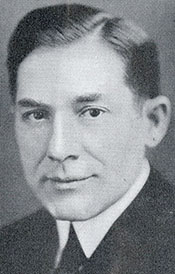
Historical · U.S. House · Illinois · District 8
Leo Kocialkowski
Former U.S. Representative · Illinois District 8 · 1933–1943 · Democratic
Leo Kocialkowski represented Illinois's District 8 in the United States House of Representatives (1933–1943) for the Democratic party. The page below collects sourced biographical facts, term history, committee roles, and provenance for Kocialkowski.
Bioguide ID: K000303
Key facts
- Full name
- Leo Kocialkowski
- State
- Illinois
- District
- District 8
- Party
- Democratic
- House service
- 1933–1943
- First House term
- 1933
- Status
- Left office
- Current term ends
- —
- Born
- 1882
- Bioguide ID
- K000303
- Committee assignments
- —
- Dataset version
- 1.20260605
Biographical narrative
996 words · sourced from the Wikipedia REST extract
Leo Kocialkowski was an American politician who served as a Democratic U.S. Representative for Illinois's 8th congressional district from 1933 until 1943. His political career spanned five terms in the House of Representatives, during which he was involved in various legislative efforts and held significant positions within congressional committees. Kocialkowski's background and early career were marked by personal challenges and a commitment to public service, reflecting the experiences of many Americans during the early 20th century.
Early life and career
Leo Paul Kocialkowski was born on August 16, 1882, in Chicago, Illinois, to parents Michael and Dorothy Kocialkowski, who were of Polish descent. Tragically, Kocialkowski was orphaned at a young age, which profoundly impacted his upbringing and shaped his future endeavors. Despite this early adversity, he pursued education through private schooling, where he received a foundational education that would serve him throughout his life. In addition to his primary education, Kocialkowski furthered his skills by enrolling in a business course, equipping him with knowledge that would later be beneficial in his various professional roles.
Following his education, Kocialkowski embarked on a career in the business sector, taking on various roles in different business houses in Chicago. His work experience included positions that involved financial oversight and management, which would later inform his approach to public service and governance. From 1916 to 1932, he engaged in tax appraisal and delinquent tax supervision in Cook County, Illinois. This role not only provided him with insight into the workings of local government and fiscal responsibility but also allowed him to develop a reputation as a knowledgeable figure in matters of taxation and public finance.
Kocialkowski's political involvement began to take shape in the late 1920s when he served as a delegate to the Democratic National Convention in 1928. This experience marked his entry into the political arena, where he began to establish connections and gain recognition within the Democratic Party. His work at the convention demonstrated his commitment to the party's principles and his desire to contribute to the political landscape of his community and the nation.
House tenure
Kocialkowski's congressional career began when he was elected to the U.S. House of Representatives as a Democrat, representing Illinois's 8th congressional district. He was first elected to the Seventy-third Congress, which commenced on March 4, 1933. His election occurred during a tumultuous period in American history, as the nation was grappling with the effects of the Great Depression. Kocialkowski's tenure in Congress spanned five terms, concluding on January 3, 1943.
Throughout his time in the House, Kocialkowski was involved in a range of legislative activities and initiatives. He served on several committees, which allowed him to influence policy and contribute to discussions on various issues affecting his constituents and the nation. Notably, he held the position of chairman of the Committee on Insular Affairs during the Seventy-fourth through Seventy-seventh Congresses. This role placed him at the forefront of discussions regarding U.S. territories and their governance, a topic of significant importance during the early 20th century as the United States expanded its influence overseas.
Kocialkowski's legislative focus included issues pertinent to his district and the broader American populace. His work in Congress coincided with significant national events, including the New Deal programs initiated by President Franklin D. Roosevelt, which aimed to address the economic challenges of the time. While specific details of his legislative achievements are not extensively documented, his role as a committee chairman suggests that he was actively engaged in shaping policies related to U.S. territories, which included considerations of citizenship, governance, and economic development.
Despite his contributions to Congress, Kocialkowski faced challenges in his political career. In 1942, he sought renomination but was unsuccessful in his bid to continue serving in the House. This defeat marked the end of his congressional tenure, although it did not signify the end of his public service.
Legislative focus and committees
During his five terms in the U.S. House of Representatives, Kocialkowski's legislative focus encompassed a variety of issues, particularly those related to the governance of U.S. territories. As chairman of the Committee on Insular Affairs, he played a crucial role in overseeing matters related to the territories acquired by the United States, including Puerto Rico and Guam. This committee was responsible for addressing the unique challenges faced by these regions, including issues of self-governance, economic development, and civil rights.
Kocialkowski's leadership within the committee allowed him to advocate for policies that aimed to improve the conditions of residents in these territories. His work contributed to the broader discussions about American imperialism and the responsibilities of the United States toward its territories during a time of significant global change. The committee's work often intersected with issues of national security, particularly during World War II, as the strategic importance of U.S. territories became increasingly apparent.
In addition to his role on the Committee on Insular Affairs, Kocialkowski's participation in other legislative activities reflected his commitment to addressing the needs of his constituents. His background in tax appraisal and public finance likely informed his perspectives on fiscal policy and economic recovery efforts during the Great Depression. While specific legislative initiatives he championed are not detailed, his long tenure in Congress suggests that he was involved in various discussions and decisions that shaped the legislative landscape of the time.
After leaving Congress, Kocialkowski continued to serve the public in a different capacity. He was appointed as a member of the Civil Service Commission of Cook County, Illinois, where he served from 1945 to 1949. This role allowed him to remain engaged in public service and contribute to the governance of local civil service matters.
Leo Kocialkowski passed away on September 27, 1958, in Chicago, Illinois. His contributions to American politics, particularly during a critical period in the nation's history, reflect the complexities of governance and the challenges faced by public servants. He was interred in St. Adalbert Cemetery, leaving behind a legacy of public service that spanned both local and national levels.
Notable legislation
Sponsored and co-sponsored legislation for Leo Kocialkowski is pending operator curation. The biographical narrative above carries the same provenance trail until per-bill rows are written.
Sources
- [1]https://en.wikipedia.org/wiki/Leo_KocialkowskiWikipedia · retrieved 2026-06-05
Notable quotes
Sourced quotes for Leo Kocialkowski are pending operator curation. Narrative-scope provenance remains attached below.
Sources
- [1]https://en.wikipedia.org/wiki/Leo_KocialkowskiWikipedia · retrieved 2026-06-05
Key positions
Curated policy positions for Leo Kocialkowski are pending operator review. The biographical narrative above carries the same provenance trail until per-topic positions are written.
Sources
- [1]https://en.wikipedia.org/wiki/Leo_KocialkowskiWikipedia · retrieved 2026-06-05
Terms served
- 1933–1935U.S. House · Term 1 · Democratic
- 1935–1937U.S. House · Term 2 · Democratic
- 1937–1939U.S. House · Term 3 · Democratic
- 1939–1941U.S. House · Term 4 · Democratic
- 1941–1943U.S. House · Term 5 · Democratic
Sources & provenance
Every attributable claim above carries a per-section [N] marker that resolves to the corresponding URL below. Each entry records the upstream provider, the canonical URL, and the timestamp at which the source was retrieved by the ingest pipeline.
Key facts
- https://bioguide.congress.gov/search/bio/K000303bioguide · retrieved 2026-06-05
- https://www.govtrack.us/congress/members/406459govtrack · retrieved 2026-06-05
Biographical narrative
- https://en.wikipedia.org/wiki/Leo_Kocialkowskiwikipedia · retrieved 2026-06-05
Find your representative
Every U.S. state elects representatives by district. Browse Illinois’s delegation, the full former-representative roster, or explore the role and term length.
Related on The Candidate
- Preceded by Peter GranataEarlier holder of the Illinois District 8 House seat · Republican.Open
- Succeeded by Thomas GordonLater holder of the Illinois District 8 House seat · Democratic.Open
- Abner TaylorFormer U.S. Representative · Illinois District 1 · RepublicanOpen
- Adam SnyderFormer U.S. Representative · Illinois District 1 · DemocraticOpen
- Arthur MitchellFormer U.S. Representative · Illinois District 1 · DemocraticOpen
- Bennett StewartFormer U.S. Representative · Illinois District 1 · DemocraticOpen