
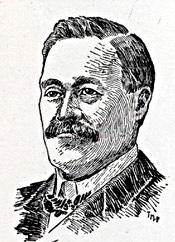
Historical · U.S. House · Illinois · District 8
William Mahoney
Former U.S. Representative · Illinois District 8 · 1901–1905 · Democratic
William Mahoney represented Illinois's District 8 in the United States House of Representatives (1901–1905) for the Democratic party. The page below collects sourced biographical facts, term history, committee roles, and provenance for Mahoney.
Bioguide ID: M000069
Key facts
- Full name
- William Mahoney
- State
- Illinois
- District
- District 8
- Party
- Democratic
- House service
- 1901–1905
- First House term
- 1901
- Status
- Left office
- Current term ends
- —
- Born
- 1856
- Bioguide ID
- M000069
- Committee assignments
- —
- Dataset version
- 1.20260606
Biographical narrative
852 words · sourced from the Wikipedia REST extract
William Mahoney was a U.S. Representative from Illinois, serving as a member of the Democratic Party. His tenure in the House of Representatives spanned from 1901 until his death in 1904. Mahoney's political career was marked by his involvement in local governance prior to his congressional service, and he represented Illinois's 8th congressional district during a time of significant change in American politics and society.
Early life and career
William Mahoney was born on February 22, 1856, in Chicago, Illinois. His formative years were spent in the city, where he received his education in the public school system. This educational background provided him with the foundational skills that would later support his career in business and politics. After completing his schooling, Mahoney entered the mercantile sector in 1876, engaging in various commercial activities that likely enhanced his understanding of the economic landscape and the needs of his community.
Mahoney's early career in commerce set the stage for his later political aspirations. His experience in the mercantile field would have given him insight into the concerns of local businesses and the economic challenges faced by residents of Chicago. This understanding proved beneficial as he transitioned into public service. His political career began to take shape when he was elected as an alderman on the Chicago City Council. He represented the 9th ward from 1884 to 1887 and later served the 18th ward from 1890 to 1896. During his time as an alderman, Mahoney would have been involved in addressing local issues, contributing to the governance of Chicago, and gaining valuable experience in legislative processes.
His tenure on the city council allowed him to build a network of political connections and develop a reputation as a dedicated public servant. These experiences likely influenced his decision to pursue a higher office, culminating in his election to the U.S. House of Representatives.
House tenure
William Mahoney was elected to the U.S. House of Representatives as a member of the Democratic Party, beginning his first term on March 4, 1901. He served in the 57th and 58th Congresses, representing Illinois's 8th congressional district. His election to Congress came during a period marked by significant political and social changes in the United States, including the Progressive Era, which sought to address issues such as corruption, social justice, and economic reform.
During his time in Congress, Mahoney participated in the legislative process and contributed to discussions on various national issues. His service in the House lasted until his death on December 27, 1904. Mahoney's time in office was cut short, and he was unable to complete his second term. His passing marked the end of a relatively brief congressional career, but it was one that was characterized by his commitment to public service and the representation of his constituents.
Following his death, Mahoney was interred in Calvary Cemetery located in Evanston, Illinois. His burial site serves as a reminder of his contributions to both local and national governance.
Legislative focus and committees
While specific details regarding the legislation Mahoney supported or the committees on which he served are not extensively documented, it can be inferred that his background as a businessman and local politician influenced his legislative priorities. As a representative from a major urban center like Chicago, Mahoney likely focused on issues pertinent to urban development, economic growth, and the welfare of his constituents.
During the early 1900s, many congressional representatives were engaged in discussions surrounding labor rights, economic regulation, and social reform. Given the context of the Progressive Era, it is reasonable to assume that Mahoney may have been involved in legislative efforts aimed at addressing the needs of working-class citizens and advocating for policies that promoted social equity.
His experience as an alderman would have equipped him with insights into the challenges faced by local governments, which may have informed his approach to federal legislation. Mahoney's dual experience in both business and local governance likely positioned him to understand the complexities of policy-making and the importance of balancing the interests of various stakeholders.
Although specific legislative achievements are not detailed in the available records, Mahoney's role as a U.S. Representative during a transformative period in American history suggests that he was part of broader discussions about the direction of the nation. His participation in the House would have involved collaboration with colleagues on both sides of the aisle, navigating the political landscape of the time.
In summary, William Mahoney's life and career reflect the journey of a local businessman who transitioned into a public servant at a critical juncture in American history. His early experiences in education and commerce, coupled with his service on the Chicago City Council, laid the groundwork for his election to the U.S. House of Representatives. Although his congressional tenure was relatively short, Mahoney's contributions to the legislative process and his representation of Illinois's 8th congressional district during a time of significant change remain a part of his legacy. His passing in 1904 marked the end of his public service, but his impact on the local community and his role in the national legislative framework continue to be recognized.
Notable legislation
Sponsored and co-sponsored legislation for William Mahoney is pending operator curation. The biographical narrative above carries the same provenance trail until per-bill rows are written.
Sources
- [1]https://en.wikipedia.org/wiki/William_F._MahoneyWikipedia · retrieved 2026-06-06
Notable quotes
Sourced quotes for William Mahoney are pending operator curation. Narrative-scope provenance remains attached below.
Sources
- [1]https://en.wikipedia.org/wiki/William_F._MahoneyWikipedia · retrieved 2026-06-06
Key positions
Curated policy positions for William Mahoney are pending operator review. The biographical narrative above carries the same provenance trail until per-topic positions are written.
Sources
- [1]https://en.wikipedia.org/wiki/William_F._MahoneyWikipedia · retrieved 2026-06-06
Terms served
- 1901–1903U.S. House · Term 1 · Democratic
- 1903–1905U.S. House · Term 2 · Democratic
Sources & provenance
Every attributable claim above carries a per-section [N] marker that resolves to the corresponding URL below. Each entry records the upstream provider, the canonical URL, and the timestamp at which the source was retrieved by the ingest pipeline.
Key facts
- https://bioguide.congress.gov/search/bio/M000069bioguide · retrieved 2026-06-06
- https://www.govtrack.us/congress/members/407097govtrack · retrieved 2026-06-06
Biographical narrative
- https://en.wikipedia.org/wiki/William_F._Mahoneywikipedia · retrieved 2026-06-06
Find your representative
Every U.S. state elects representatives by district. Browse Illinois’s delegation, the full former-representative roster, or explore the role and term length.
Related on The Candidate
- Preceded by Robert ChildsEarlier holder of the Illinois District 8 House seat · Republican.Open
- Succeeded by Charles McGavinLater holder of the Illinois District 8 House seat · Republican.Open
- Abner TaylorFormer U.S. Representative · Illinois District 1 · RepublicanOpen
- Adam SnyderFormer U.S. Representative · Illinois District 1 · DemocraticOpen
- Arthur MitchellFormer U.S. Representative · Illinois District 1 · DemocraticOpen
- Bennett StewartFormer U.S. Representative · Illinois District 1 · DemocraticOpen