
Historical · U.S. House · Illinois · District 9
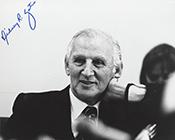
Sidney Yates
Former U.S. Representative · Illinois District 9 · 1949–1999 · Democratic
Sidney Yates represented Illinois's District 9 in the United States House of Representatives (1949–1999) for the Democratic party. The page below collects sourced biographical facts, term history, committee roles, and provenance for Yates.
Bioguide ID: Y000013
Key facts
- Full name
- Sidney Yates
- State
- Illinois
- District
- District 9
- Party
- Democratic
- House service
- 1949–1999
- First House term
- 1949
- Status
- Left office
- Current term ends
- —
- Born
- 1909
- Bioguide ID
- Y000013
- Committee assignments
- —
- Dataset version
- 1.20260605
Biographical narrative
1,001 words · sourced from the Wikipedia REST extract
Sidney R. Yates was a prominent American attorney and politician who served as a U.S. Representative for Illinois's 9th congressional district from 1949 to 1963 and again from 1965 until 1999. A member of the Democratic Party, Yates is noted for his extensive tenure in Congress, spanning 48 years, making him one of the longest-serving members in the history of the U.S. House of Representatives. Throughout his career, he was known for his advocacy of liberal causes, particularly in areas such as federal funding for the arts, environmental conservation, and support for Israel.
Early life and career
Sidney Richard Yates was born on August 27, 1909, in Chicago, Illinois, to Lithuanian Jewish immigrants Louis and Ida Yates. He was the youngest of six children in his family. Growing up in Chicago, Yates was exposed to a diverse urban environment that would later inform his political views and career. He attended Lake View High School, graduating in 1928, and subsequently enrolled at the University of Chicago, where he earned a Bachelor of Philosophy degree in 1931. He continued his education at the University of Chicago Law School, obtaining his Juris Doctor (J.D.) degree in 1933.
While in college, Yates was an active member of the Pi Lambda Phi fraternity and distinguished himself as a talented basketball player, receiving All Big Ten honors. In the mid-1930s, he played semiprofessional basketball while also beginning his legal career. His early professional experience included serving as an attorney for the Illinois state bank receiver from 1935 to 1937, followed by a role as an assistant state attorney general specializing in traction railroads for the Illinois Commerce Commission from 1937 to 1940.
During World War II, Yates served in the United States Navy from 1944 to 1946, where he was assigned as an attorney for the Bureau of Ships in Washington, D.C. This military service not only contributed to his legal experience but also provided him with a broader perspective on national issues, which would later influence his legislative priorities.
House tenure
Yates entered Congress in 1949 after winning election to represent Illinois's 9th congressional district. His initial term lasted until 1963, during which he became known for his advocacy on various issues. After an unsuccessful bid for the United States Senate in 1962 against Republican incumbent Everett Dirksen, Yates returned to the House in 1965 following the election that year. He continued to serve until January 3, 1999, when he chose not to seek reelection.
Throughout his congressional career, Yates represented a district that was primarily anchored in the Chicago lakefront area. Over the years, the boundaries of his district changed, particularly as Chicago's population declined in the 1970s, leading to the inclusion of northern suburbs such as Evanston, Des Plaines, Glenview, Rosemont, and Skokie.
Yates was known for his commitment to various social issues, including his early opposition to age discrimination. In 1951, he argued against mandatory retirement policies, asserting that they deprived older individuals of their rights to lead productive lives. His advocacy for civil rights extended to other areas, and he was involved in legislative efforts aimed at addressing societal issues.
In the late 1950s, Yates responded to rising concerns about youth violence by advocating for the ban of automatic-opening knives, commonly referred to as switchblade knives. He believed that such weapons contributed to a culture of violence among youth. The Switchblade Knife Act of 1958, which he supported, aimed to restrict the importation and sale of these knives, although subsequent research indicated that youth gang violence continued to rise, with firearms becoming the weapon of choice.
Yates's political career was marked by his ability to maintain relationships with both liberal reformers and traditional Democratic machine politicians in Chicago. He served on the House Appropriations Committee throughout his time in Congress, where he played a significant role in shaping federal funding priorities. He chaired the Interior Subcommittee from 1975 to 1995, during which he championed environmental programs and supported the National Endowment for the Arts.
In addition to his domestic policy work, Yates was a strong advocate for U.S. support of Israel and served on the Foreign Operations Subcommittee. His commitment to international issues reflected his broader understanding of the interconnectedness of domestic and foreign policy.
Legislative focus and committees
Yates's legislative focus was characterized by a commitment to liberal causes and a dedication to funding for the arts, environmental conservation, and social justice. His long-standing membership on the House Appropriations Committee allowed him to influence budgetary decisions and advocate for federal support in areas he deemed essential for the public good.
As chair of the Interior Subcommittee, Yates was instrumental in promoting initiatives related to national parks and historical conservation. His efforts contributed to the preservation of natural and cultural resources, reflecting his belief in the importance of protecting the environment for future generations.
Yates's advocacy extended to the arts, where he supported federal funding initiatives that aimed to enhance cultural programs across the country. His work in this area demonstrated his understanding of the arts as a vital component of American society, contributing to the nation's cultural identity and enriching the lives of its citizens.
Throughout his career, Yates maintained a reputation as a pragmatic legislator who could navigate the complexities of Congress while remaining true to his principles. His ability to work across party lines and build coalitions was evident in his legislative achievements, which included a range of social and environmental policies.
At the conclusion of his service in Congress, Yates was recognized as one of the oldest members to have served, being 89 years old at the time of his retirement. His extensive career left a lasting impact on the legislative landscape, and he is remembered for his contributions to both his constituents and the broader national discourse.
Sidney R. Yates passed away on October 5, 2000, in Washington, D.C. He was laid to rest at Memorial Park Cemetery in Skokie, Illinois, leaving behind a legacy of public service that spanned nearly half a century.
Notable legislation
Sponsored and co-sponsored legislation for Sidney Yates is pending operator curation. The biographical narrative above carries the same provenance trail until per-bill rows are written.
Sources
- [1]https://en.wikipedia.org/wiki/Sidney_R._YatesWikipedia · retrieved 2026-06-05
Notable quotes
Sourced quotes for Sidney Yates are pending operator curation. Narrative-scope provenance remains attached below.
Sources
- [1]https://en.wikipedia.org/wiki/Sidney_R._YatesWikipedia · retrieved 2026-06-05
Key positions
Curated policy positions for Sidney Yates are pending operator review. The biographical narrative above carries the same provenance trail until per-topic positions are written.
Sources
- [1]https://en.wikipedia.org/wiki/Sidney_R._YatesWikipedia · retrieved 2026-06-05
Terms served
- 1949–1951U.S. House · Term 1 · Democratic
- 1951–1953U.S. House · Term 2 · Democratic
- 1953–1955U.S. House · Term 3 · Democratic
- 1955–1957U.S. House · Term 4 · Democratic
- 1957–1959U.S. House · Term 5 · Democratic
- 1959–1961U.S. House · Term 6 · Democratic
- 1961–1963U.S. House · Term 7 · Democratic
- 1965–1967U.S. House · Term 8 · Democratic
- 1967–1969U.S. House · Term 9 · Democratic
- 1969–1971U.S. House · Term 10 · Democratic
- 1971–1973U.S. House · Term 11 · Democratic
- 1973–1975U.S. House · Term 12 · Democratic
- 1975–1977U.S. House · Term 13 · Democratic
- 1977–1979U.S. House · Term 14 · Democratic
- 1979–1981U.S. House · Term 15 · Democratic
- 1981–1983U.S. House · Term 16 · Democratic
- 1983–1985U.S. House · Term 17 · Democratic
- 1985–1987U.S. House · Term 18 · Democratic
- 1987–1989U.S. House · Term 19 · Democratic
- 1989–1991U.S. House · Term 20 · Democratic
- 1991–1993U.S. House · Term 21 · Democratic
- 1993–1995U.S. House · Term 22 · Democratic
- 1995–1997U.S. House · Term 23 · Democratic
- 1997–1999U.S. House · Term 24 · Democratic
Sources & provenance
Every attributable claim above carries a per-section [N] marker that resolves to the corresponding URL below. Each entry records the upstream provider, the canonical URL, and the timestamp at which the source was retrieved by the ingest pipeline.
Key facts
- https://bioguide.congress.gov/search/bio/Y000013bioguide · retrieved 2026-06-05
- https://www.govtrack.us/congress/members/411947govtrack · retrieved 2026-06-05
Biographical narrative
- https://en.wikipedia.org/wiki/Sidney_R._Yateswikipedia · retrieved 2026-06-05
Find your representative
Every U.S. state elects representatives by district. Browse Illinois’s delegation, the full former-representative roster, or explore the role and term length.
Related on The Candidate
- Preceded by Robert TwymanEarlier holder of the Illinois District 9 House seat · Republican.Open
- Abner TaylorFormer U.S. Representative · Illinois District 1 · RepublicanOpen
- Adam SnyderFormer U.S. Representative · Illinois District 1 · DemocraticOpen
- Arthur MitchellFormer U.S. Representative · Illinois District 1 · DemocraticOpen
- Bennett StewartFormer U.S. Representative · Illinois District 1 · DemocraticOpen
- Democratic PartyFederal candidates and office holders on the Democratic line.Open