
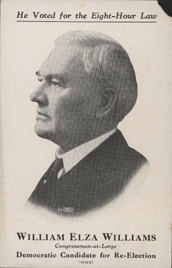
Historical · U.S. House · Illinois · At-Large
William Williams
Former U.S. Representative · Illinois At-Large · 1899–1917 · Democratic
William Williams represented Illinois's At-Large in the United States House of Representatives (1899–1917) for the Democratic party. The page below collects sourced biographical facts, term history, committee roles, and provenance for Williams.
Bioguide ID: W000548
Key facts
- Full name
- William Williams
- State
- Illinois
- District
- At-Large
- Party
- Democratic
- House service
- 1899–1917
- First House term
- 1899
- Status
- Left office
- Current term ends
- —
- Born
- 1857
- Bioguide ID
- W000548
- Committee assignments
- —
- Dataset version
- 1.20260606
Biographical narrative
869 words · sourced from the Wikipedia REST extract
William Elza Williams was a U.S. Representative from Illinois who served in the House of Representatives during the late 19th and early 20th centuries. A member of the Democratic Party, he represented the at-large congressional district of Illinois. His political career spanned three terms in Congress, beginning in 1899 and concluding in 1917. Williams was also a practicing attorney and held various local government positions prior to his congressional service. His life and career reflect the political landscape of his time, as well as the legal and civic responsibilities that shaped his contributions to his community and the nation.
Early life and career
William Elza Williams was born on May 5, 1857, near Detroit, Illinois, in Pike County. His early education took place in public schools, where he laid the foundation for his future academic and professional pursuits. Following his primary education, Williams attended Illinois College in Jacksonville, Illinois, where he furthered his studies and developed an interest in law.
After completing his education, Williams was admitted to the bar in 1880, marking the beginning of his legal career. He initially practiced law in both Detroit and Pittsfield, Illinois, where he became well-known within the legal community. His legal expertise and commitment to public service led him to take on significant roles in local government. He served as the State's Attorney for Pike County from 1886 to 1892, a position that allowed him to gain valuable experience in the judicial system and to advocate for the interests of his constituents.
In addition to his role as State's Attorney, Williams was active in local governance. He served on the board of aldermen in Pittsfield, contributing to the legislative process at the municipal level. His involvement in local education is also noteworthy; he was a member of the board of education, where he likely influenced educational policies and initiatives within the community. These positions provided him with a comprehensive understanding of both the legal and political frameworks that govern local and state affairs.
In 1903, Williams transitioned to a new role as a trial lawyer for the City Railway Company of Chicago. This position further expanded his legal experience and allowed him to engage with issues related to urban infrastructure and public transportation, which were increasingly important in the growing city of Chicago.
House tenure
Williams's political career took a significant turn when he was elected to the U.S. House of Representatives as a Democrat. He first took office on March 4, 1899, representing the Fifty-sixth Congress. His election marked the beginning of a notable congressional career that would span three terms. During his first term, Williams focused on various legislative issues pertinent to his constituents and the broader national context.
After completing his first term in Congress, Williams returned to his legal practice in Pittsfield. However, he remained active in politics and was elected to the Sixty-third and Sixty-fourth Congresses, serving from March 4, 1913, to March 3, 1917. His re-election to these terms indicated a continued support from his constituents, as he navigated the political landscape of the time, which included significant national events such as World War I and the Progressive Era reforms.
Despite his previous electoral successes, Williams faced challenges in his later political career. He was an unsuccessful candidate for re-election in 1916 to the Sixty-fifth Congress and also failed to secure a seat in the Sixty-sixth Congress in 1918. These defeats marked the end of his congressional tenure, but they did not diminish his commitment to public service.
Legislative focus and committees
During his time in Congress, Williams was involved in various legislative issues that reflected the concerns of his constituents and the national agenda. While specific details about the bills he sponsored or supported are not provided, it is common for representatives of his era to engage with issues such as infrastructure development, labor rights, and social reforms. Given his background as a trial lawyer and his experience in local government, it is likely that Williams brought a legal perspective to his legislative work, advocating for policies that aligned with his constituents' needs.
Williams's participation in congressional committees would have further shaped his legislative focus. Committees play a crucial role in the legislative process, allowing members to specialize in specific areas of policy and to influence the development of laws. Although the specific committees on which Williams served are not detailed, his legal background and experience in local governance would have made him a valuable member of committees dealing with legal, educational, or transportation issues.
After his congressional service, Williams returned to the practice of law in Pittsfield, where he continued to contribute to his community until his death on September 13, 1921. His interment took place at Pittsfield West Cemetery, marking the end of a life dedicated to public service and the legal profession.
In summary, William Elza Williams's career as a U.S. Representative and a local attorney reflects a commitment to civic engagement and the legal system. His experiences in education, local government, and law provided him with a unique perspective that influenced his work in Congress. Through his various roles, Williams contributed to the political landscape of Illinois and the nation during a transformative period in American history.
Notable legislation
Sponsored and co-sponsored legislation for William Williams is pending operator curation. The biographical narrative above carries the same provenance trail until per-bill rows are written.
Sources
- [1]https://en.wikipedia.org/wiki/William_E._WilliamsWikipedia · retrieved 2026-06-06
Notable quotes
Sourced quotes for William Williams are pending operator curation. Narrative-scope provenance remains attached below.
Sources
- [1]https://en.wikipedia.org/wiki/William_E._WilliamsWikipedia · retrieved 2026-06-06
Key positions
Curated policy positions for William Williams are pending operator review. The biographical narrative above carries the same provenance trail until per-topic positions are written.
Sources
- [1]https://en.wikipedia.org/wiki/William_E._WilliamsWikipedia · retrieved 2026-06-06
Terms served
- 1899–1901U.S. House · Term 1 · Democratic
- 1913–1915U.S. House · Term 2 · Democratic
- 1915–1917U.S. House · Term 3 · Democratic
Sources & provenance
Every attributable claim above carries a per-section [N] marker that resolves to the corresponding URL below. Each entry records the upstream provider, the canonical URL, and the timestamp at which the source was retrieved by the ingest pipeline.
Key facts
- https://bioguide.congress.gov/search/bio/W000548bioguide · retrieved 2026-06-06
- https://www.govtrack.us/congress/members/411704govtrack · retrieved 2026-06-06
Biographical narrative
- https://en.wikipedia.org/wiki/William_E._Williamswikipedia · retrieved 2026-06-06
Find your representative
Every U.S. state elects representatives by district. Browse Illinois’s delegation, the full former-representative roster, or explore the role and term length.
Related on The Candidate
- Preceded by Philip PostEarlier holder of the Illinois At-Large House seat · Republican.Open
- Succeeded by Richard YatesLater holder of the Illinois At-Large House seat · Republican.Open
- Abner TaylorFormer U.S. Representative · Illinois District 1 · RepublicanOpen
- Adam SnyderFormer U.S. Representative · Illinois District 1 · DemocraticOpen
- Arthur MitchellFormer U.S. Representative · Illinois District 1 · DemocraticOpen
- Bennett StewartFormer U.S. Representative · Illinois District 1 · DemocraticOpen