
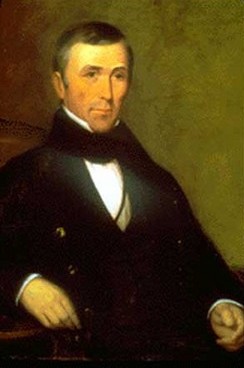
Historical · U.S. House · Indiana · District 1
Ratliff Boon
Former U.S. Representative · Indiana District 1 · 1825–1839 · Democratic
Ratliff Boon represented Indiana's District 1 in the United States House of Representatives (1825–1839) for the Democratic party. The page below collects sourced biographical facts, term history, committee roles, and provenance for Boon.
Bioguide ID: B000628
Key facts
- Full name
- Ratliff Boon
- State
- Indiana
- District
- District 1
- Party
- Democratic
- House service
- 1825–1839
- First House term
- 1825
- Status
- Left office
- Current term ends
- —
- Born
- 1781
- Bioguide ID
- B000628
- Committee assignments
- —
- Dataset version
- 1.20260606
Biographical narrative
985 words · sourced from the Wikipedia REST extract
Ratliff Boon was an American politician who served as a U.S. Representative for Indiana's 1st congressional district and briefly held the office of the second Governor of Indiana. A member of the Democratic Party, Boon was a significant figure in the early political landscape of Indiana, contributing to the establishment of the state's Democratic Party and supporting the policies of President Andrew Jackson during his tenure in Congress. His political career spanned multiple decades, during which he served six terms in the U.S. House of Representatives and held various positions in state government.
Early life and career
Ratliff Boon was born on January 18, 1781, in Franklin County, North Carolina, to parents Jesse and Kessiah Boon. His early life was marked by a move to Warren County, Kentucky, where he received his education in public schools and later apprenticed as a gunsmith in Danville. In 1801, he married Delilah Anderson, with whom he had seven children. In 1809, Boon relocated to what is now known as Boon Township in Warrick County, Indiana. The county seat, Boonville, was named in his honor, reflecting his influence in the region.
With the onset of the War of 1812, Boon joined the Indiana Territorial militia, where he achieved the rank of colonel. His military service during this period contributed to his growing prominence in the local community. Following the war, Boon transitioned into public service, beginning with an appointment as County Treasurer of Warrick County by Governor Thomas Posey in 1813. His political career advanced when he was elected to the first state legislature of Indiana in 1816, where he served two one-year terms. During this time, he successfully advocated for the division of Warrick County into three separate counties, showcasing his legislative capabilities.
In December 1818, Boon was elected to the state senate but resigned shortly thereafter to become the second Lieutenant Governor of Indiana in December 1819. His election followed the resignation of Christopher Harrison, the previous lieutenant governor, amid a scandal. Boon won the general election decisively, reflecting his growing political influence. In 1820, he capitalized on new legislation aimed at controlling the wolf population, earning a significant sum by hunting wolves, although the law was soon repealed due to its financial burden on the state.
House tenure
Boon's political career continued to evolve when he was re-elected as lieutenant governor in 1822 on a ticket with William Hendricks. Following the resignation of Governor Jonathan Jennings, Boon briefly served as the second governor of Indiana from September 12, 1822, until Hendricks's inauguration on December 5, 1822. During his short tenure as governor, he conducted a census of the area acquired through the Treaty of St. Mary's and made recommendations for the creation of new counties, which were later adopted by the General Assembly.
After returning to the lieutenant governor's office, Boon resigned on January 30, 1824, to pursue a seat in the United States House of Representatives. He was elected as a Jacksonian and served his first term in Congress from March 4, 1825, to March 3, 1827. However, he faced defeat in his re-election bid in 1826 against Thomas H. Blake, who campaigned on an internal improvement platform that conflicted with Boon's party's stance.
Despite this setback, Boon played a pivotal role in establishing the Democratic Party in Indiana during his time out of office. He returned to Congress in 1828, serving another term from March 4, 1829, to March 3, 1839. Throughout his congressional career, Boon was involved in various legislative activities and held the position of chairman of the Committee on Public Lands from 1835 until the end of his tenure in 1839. His influence in the House was marked by his support for the policies of President Andrew Jackson and his efforts to shape land policy during a period of significant growth and development in the United States.
Boon's congressional career came to an end when he was defeated in his re-election bid in 1839 by Oliver H. Smith. Following his defeat, Boon relocated to Louisiana, Missouri, where he continued to be active in politics. He became a vocal opponent of Thomas H. Benton and the pro-slavery faction within the state government. In 1844, Boon attempted to run for Congress again, aiming to challenge the pro-slavery candidate, but his health deteriorated, and he withdrew from the race. He passed away on November 20, 1844, shortly after learning of his party's electoral victory.
Legislative focus and committees
During his time in the U.S. House of Representatives, Ratliff Boon was particularly focused on issues related to public lands, reflecting the interests of his constituents and the broader national context of land distribution and management. As chairman of the Committee on Public Lands, he played a critical role in shaping policies that affected land use and ownership during a time when westward expansion was a significant aspect of American life. His leadership in this committee allowed him to influence legislation that would have lasting impacts on land policy in the United States.
Boon's alignment with the Democratic Party and his support for President Andrew Jackson's policies were also notable aspects of his legislative focus. He was part of a political movement that sought to promote the interests of the common man and reduce the influence of established elites in government. His efforts to establish the Democratic Party in Indiana were instrumental in creating a more organized political landscape in the state, moving away from the previously dominant Democratic-Republican affiliations.
Throughout his six terms in Congress, Boon navigated the complexities of early American politics, balancing local interests with national concerns. His legislative work and committee leadership contributed to the development of policies that addressed the needs of a growing nation, particularly in relation to land management and distribution. His political legacy is reflected in both his contributions to state governance and his role in the early formation of the Democratic Party in Indiana.
Notable legislation
Sponsored and co-sponsored legislation for Ratliff Boon is pending operator curation. The biographical narrative above carries the same provenance trail until per-bill rows are written.
Sources
- [1]https://en.wikipedia.org/wiki/Ratliff_BoonWikipedia · retrieved 2026-06-06
Notable quotes
Sourced quotes for Ratliff Boon are pending operator curation. Narrative-scope provenance remains attached below.
Sources
- [1]https://en.wikipedia.org/wiki/Ratliff_BoonWikipedia · retrieved 2026-06-06
Key positions
Curated policy positions for Ratliff Boon are pending operator review. The biographical narrative above carries the same provenance trail until per-topic positions are written.
Sources
- [1]https://en.wikipedia.org/wiki/Ratliff_BoonWikipedia · retrieved 2026-06-06
Terms served
- 1825–1827U.S. House · Term 1 · Jackson
- 1829–1831U.S. House · Term 2 · Jackson
- 1831–1833U.S. House · Term 3 · Jackson
- 1833–1835U.S. House · Term 4 · Jackson
- 1835–1837U.S. House · Term 5 · Jackson
- 1837–1839U.S. House · Term 6 · Democratic
Sources & provenance
Every attributable claim above carries a per-section [N] marker that resolves to the corresponding URL below. Each entry records the upstream provider, the canonical URL, and the timestamp at which the source was retrieved by the ingest pipeline.
Key facts
- https://bioguide.congress.gov/search/bio/B000628bioguide · retrieved 2026-06-06
- https://www.govtrack.us/congress/members/401593govtrack · retrieved 2026-06-06
Biographical narrative
- https://en.wikipedia.org/wiki/Ratliff_Boonwikipedia · retrieved 2026-06-06
Find your representative
Every U.S. state elects representatives by district. Browse Indiana’s delegation, the full former-representative roster, or explore the role and term length.
Related on The Candidate
- Preceded by Jacob CallEarlier holder of the Indiana District 1 House seat · Jackson Republican.Open
- Succeeded by George ProffitLater holder of the Indiana District 1 House seat · Whig.Open
- Adam Benjamin Jr.Former U.S. Representative · Indiana District 1 · DemocraticOpen
- Alvin HoveyFormer U.S. Representative · Indiana District 1 · RepublicanOpen
- Arthur TaylorFormer U.S. Representative · Indiana District 1 · DemocraticOpen
- Benoni FullerFormer U.S. Representative · Indiana District 1 · DemocraticOpen