
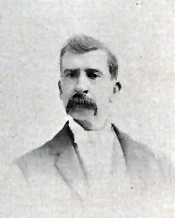
Historical · U.S. House · Indiana · District 10
Jethro Hatch
Former U.S. Representative · Indiana District 10 · 1895–1897 · Republican
Jethro Hatch represented Indiana's District 10 in the United States House of Representatives (1895–1897) for the Republican party. The page below collects sourced biographical facts, term history, committee roles, and provenance for Hatch.
Bioguide ID: H000337
Key facts
- Full name
- Jethro Hatch
- State
- Indiana
- District
- District 10
- Party
- Republican
- House service
- 1895–1897
- First House term
- 1895
- Status
- Left office
- Current term ends
- —
- Born
- 1837
- Bioguide ID
- H000337
- Committee assignments
- —
- Dataset version
- 1.20260606
Biographical narrative
916 words · sourced from the Wikipedia REST extract
Jethro Hatch was an American physician and politician who served as a U.S. Representative for Indiana's 10th congressional district from 1895 to 1897. A member of the Republican Party, Hatch's political career was preceded by a significant medical practice and military service during the American Civil War. His contributions to both medicine and politics reflect a life dedicated to public service.
Early life and career
Jethro Hatch was born on June 18, 1837, in Pitcher, New York. He was the son of Jethro Hatch Sr. and Minerva Pierce, the latter being a descendant of notable figures in early American history. His maternal grandfather, Gordon Pierce, and grandmother, Thirza Smalley, were part of a lineage that included Timothy Hatch, a pioneer and proprietor of Sherburne, New York. Timothy Hatch's wife, Ruth Welles, was related to prominent historical figures, including Gov. Thomas Welles, who served as the Fourth Colonial Governor of Connecticut.
In 1847, Hatch's family moved to Sugar Grove, Illinois, where they became pioneers in Kane County. Growing up in a family with a rich historical background, Hatch was educated in local common schools and later graduated from Batavia Institute in Batavia, Illinois. His academic pursuits led him to Rush Medical College in Chicago, where he completed his medical degree in February 1860. Shortly after graduating, he began his medical practice in Kentland, Indiana, in July 1860, becoming the first physician to establish a practice in the area.
Hatch's medical career was interrupted by the Civil War. In 1862, he was commissioned as an Assistant Surgeon with the 36th Illinois Volunteer Infantry Regiment. His service was marked by a promotion to Surgeon, and he continued to serve until the conclusion of the war, being mustered out on October 8, 1865. Following the war, he returned to Kentland, where he resumed his medical practice and took on various roles in public health and medical administration. He served as a local health officer and held positions such as secretary and later president of the pension examining board from 1865 to 1907. Additionally, he was involved with the board of the hospital for the insane in Logansport, Indiana, and provided medical services for the Logansport division of the Pennsylvania Railroad and the Chicago and Cairo division of the New York Central Railroad until 1907.
In his personal life, Hatch married Sarah Melissa Shaeffer on May 26, 1881, in Kentland, Indiana. Sarah was the daughter of Gilbert and Margaret Shaeffer from Lancaster, Ohio. Together, they had two children: Darwin Shaeffer Hatch, who became a graduate of Purdue University and later served as the Editor in Chief of Motor Age Magazine, and Hazel Margaret Hatch, who graduated from Ferry Hall School and Indiana University. Hazel married Claude Seymore Steele, who served as a Senator in the Indiana Senate.
House tenure
Hatch's political career began at the state level when he served as a member of the Indiana House of Representatives from 1872 to 1873. His experience in state politics laid the groundwork for his subsequent election to the U.S. House of Representatives. In 1894, Hatch was elected as a Republican to the Fifty-fourth Congress, representing Indiana's 10th congressional district. His congressional term lasted from March 4, 1895, until March 3, 1897. During his time in Congress, Hatch participated in the legislative process and contributed to discussions pertinent to his constituents and the nation.
Despite his involvement in national politics, Hatch did not seek renomination in 1896, choosing instead to return to his medical practice in Kentland after completing his term. His decision to step away from the political arena after a single term reflects a common trend among politicians who balance public service with other professional commitments.
Legislative focus and committees
During his time in the House of Representatives, Jethro Hatch's legislative focus and committee assignments are not extensively documented in the available records. However, as a physician and a public health advocate, it can be inferred that his background in medicine likely influenced his perspectives on health-related issues and policies during his congressional tenure. His experience as a local health officer and his long-standing involvement in medical administration may have provided him with insights into the healthcare needs of his constituents.
Hatch's role in the Indiana House of Representatives prior to his congressional service suggests that he was familiar with legislative processes and the importance of addressing local concerns at the state and federal levels. His medical background would have equipped him to engage in discussions about health policy, veterans' affairs, and other issues relevant to his constituents, particularly those related to public health and welfare.
After leaving Congress, Hatch returned to Kentland, where he continued to practice medicine until his later years. His commitment to public service extended beyond his political career, as he remained active in his community and contributed to various local initiatives.
In 1907, Hatch relocated to Victoria, Texas, where he transitioned into the real estate business. This move marked a significant change in his professional life, as he shifted from medicine and politics to a new field. He lived in Victoria until his death on August 3, 1912, at the age of 75.
Jethro Hatch's life and career reflect a dedication to service in both medicine and politics. His contributions as a physician and a legislator illustrate the interconnectedness of healthcare and public policy in the late 19th century. Through his work, Hatch left a legacy that underscores the importance of civic engagement and the role of healthcare professionals in shaping public policy.
Notable legislation
Sponsored and co-sponsored legislation for Jethro Hatch is pending operator curation. The biographical narrative above carries the same provenance trail until per-bill rows are written.
Sources
- [1]https://en.wikipedia.org/wiki/Jethro_A._HatchWikipedia · retrieved 2026-06-06
Notable quotes
Sourced quotes for Jethro Hatch are pending operator curation. Narrative-scope provenance remains attached below.
Sources
- [1]https://en.wikipedia.org/wiki/Jethro_A._HatchWikipedia · retrieved 2026-06-06
Key positions
Curated policy positions for Jethro Hatch are pending operator review. The biographical narrative above carries the same provenance trail until per-topic positions are written.
Sources
- [1]https://en.wikipedia.org/wiki/Jethro_A._HatchWikipedia · retrieved 2026-06-06
Terms served
- 1895–1897U.S. House · Term 1 · Republican
Sources & provenance
Every attributable claim above carries a per-section [N] marker that resolves to the corresponding URL below. Each entry records the upstream provider, the canonical URL, and the timestamp at which the source was retrieved by the ingest pipeline.
Key facts
- https://bioguide.congress.gov/search/bio/H000337bioguide · retrieved 2026-06-06
- https://www.govtrack.us/congress/members/405207govtrack · retrieved 2026-06-06
Biographical narrative
- https://en.wikipedia.org/wiki/Jethro_A._Hatchwikipedia · retrieved 2026-06-06
Find your representative
Every U.S. state elects representatives by district. Browse Indiana’s delegation, the full former-representative roster, or explore the role and term length.
Related on The Candidate
- Preceded by Thomas HammondEarlier holder of the Indiana District 10 House seat · Democratic.Open
- Succeeded by Edgar CrumpackerLater holder of the Indiana District 10 House seat · Republican.Open
- Adam Benjamin Jr.Former U.S. Representative · Indiana District 1 · DemocraticOpen
- Alvin HoveyFormer U.S. Representative · Indiana District 1 · RepublicanOpen
- Arthur TaylorFormer U.S. Representative · Indiana District 1 · DemocraticOpen
- Benoni FullerFormer U.S. Representative · Indiana District 1 · DemocraticOpen