
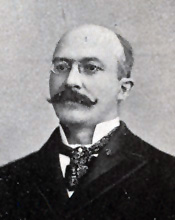
Historical · U.S. House · Indiana · District 2
Alexander Hardy
Former U.S. Representative · Indiana District 2 · 1895–1897 · Republican
Alexander Hardy represented Indiana's District 2 in the United States House of Representatives (1895–1897) for the Republican party. The page below collects sourced biographical facts, term history, committee roles, and provenance for Hardy.
Bioguide ID: H000194
Key facts
- Full name
- Alexander Hardy
- State
- Indiana
- District
- District 2
- Party
- Republican
- House service
- 1895–1897
- First House term
- 1895
- Status
- Left office
- Current term ends
- —
- Born
- 1847
- Bioguide ID
- H000194
- Committee assignments
- —
- Dataset version
- 1.20260606-1
Biographical narrative
825 words · sourced from the Wikipedia REST extract
Alexander Hardy was an American lawyer and politician who served as a U.S. Representative for Indiana's 2nd congressional district from 1895 to 1897. A member of the Republican Party, Hardy's political career was marked by his involvement in both journalism and law, reflecting a diverse professional background that spanned multiple states and regions. His tenure in Congress was brief, as he served only one term, after which he returned to his legal practice and engaged in various ventures, including mining.
Early life and career
Born on December 16, 1847, in Simcoe, Norfolk County, Ontario, Canada, Alexander Hardy grew up in a region that would later become known for its agricultural and industrial development. His early education included a college course that laid the groundwork for his future endeavors. In 1864, at the age of 16, Hardy moved to the United States, seeking new opportunities. He enrolled in Eastman College in Poughkeepsie, New York, where he pursued a commercial course, equipping himself with skills that would later serve him in various professional roles.
After completing his studies, Hardy relocated to New Orleans in 1869. There, he began his career in journalism, working in the newspaper industry until 1873. This experience in the media sector provided him with valuable insights into public opinion and communication, which would later influence his political career. In 1873, Hardy moved to Natchez, Mississippi, where he continued his work in journalism by running a Republican newspaper until 1877. His involvement in the newspaper industry not only showcased his commitment to the Republican Party but also allowed him to engage with the political issues of the time.
In recognition of his capabilities, Hardy was appointed as the collector of the port of Natchez by President Ulysses S. Grant. This position further solidified his connections within the Republican Party and provided him with experience in government operations. In 1884, Hardy relocated to Washington, Indiana, where he took significant steps toward establishing a legal career. He was admitted to the bar in the same year and began practicing law in Terre Haute, Indiana. His legal career would become a significant aspect of his life, as he balanced his professional obligations with his growing interest in politics.
House tenure
Hardy's political career reached a notable milestone when he was elected as a Republican to the Fifty-fourth Congress, serving from March 4, 1895, to March 3, 1897. His election to the House of Representatives came during a period of significant political change in the United States, characterized by economic challenges and shifting party dynamics. As a member of Congress, Hardy represented Indiana's 2nd congressional district, a region that encompassed a diverse population and a variety of economic interests.
During his time in Congress, Hardy participated in the legislative process, contributing to discussions and decisions that would impact his constituents and the nation. However, his tenure was relatively short-lived, as he was unsuccessful in his bid for reelection in 1896, when he sought a seat in the Fifty-fifth Congress. This defeat marked the end of his formal legislative career, but it did not signify the conclusion of his professional pursuits.
Legislative focus and committees
While specific details regarding Hardy's legislative focus and committee assignments during his time in Congress are not extensively documented, it can be inferred that his background in law and journalism likely influenced his approach to governance and policy-making. As a member of the Republican Party, he would have aligned with the party's platform, which during the 1890s included issues such as economic reform, infrastructure development, and support for business interests.
After concluding his term in the House of Representatives, Hardy returned to his legal practice in Washington, Indiana. His experience in Congress may have enriched his legal career, providing him with a deeper understanding of the legislative process and the intricacies of government. In 1904, he moved to Los Angeles, California, where he continued to practice law, adapting to the changing legal landscape of the West Coast.
Hardy's career took him through several states, reflecting a willingness to explore new opportunities and environments. After his time in California, he moved to Searchlight, Nevada, and subsequently to Salt Lake City, Utah. Ultimately, he settled in Tonopah, Nevada, in 1914, where he continued his legal practice and became involved in mining ventures. This interest in mining is indicative of the economic opportunities that characterized the region during the early 20th century, particularly in Nevada, which was known for its mineral wealth.
Alexander Hardy passed away on August 31, 1927, in Tonopah, Nevada. His contributions to law and politics, though limited in duration, reflect a life dedicated to public service and professional achievement. He was interred in Tonopah Cemetery, leaving behind a legacy that encompasses his varied career as a lawyer, journalist, and politician. Hardy's journey from Canada to the United States and his subsequent involvement in multiple states exemplify the dynamic nature of American life during a period of significant change and development.
Notable legislation
Sponsored and co-sponsored legislation for Alexander Hardy is pending operator curation. The biographical narrative above carries the same provenance trail until per-bill rows are written.
Sources
- [1]https://en.wikipedia.org/wiki/Alexander_M._HardyWikipedia · retrieved 2026-06-06
Notable quotes
Sourced quotes for Alexander Hardy are pending operator curation. Narrative-scope provenance remains attached below.
Sources
- [1]https://en.wikipedia.org/wiki/Alexander_M._HardyWikipedia · retrieved 2026-06-06
Key positions
Curated policy positions for Alexander Hardy are pending operator review. The biographical narrative above carries the same provenance trail until per-topic positions are written.
Sources
- [1]https://en.wikipedia.org/wiki/Alexander_M._HardyWikipedia · retrieved 2026-06-06
Terms served
- 1895–1897U.S. House · Term 1 · Republican
Sources & provenance
Every attributable claim above carries a per-section [N] marker that resolves to the corresponding URL below. Each entry records the upstream provider, the canonical URL, and the timestamp at which the source was retrieved by the ingest pipeline.
Key facts
- https://bioguide.congress.gov/search/bio/H000194bioguide · retrieved 2026-06-06
- https://www.govtrack.us/congress/members/405075govtrack · retrieved 2026-06-06
Biographical narrative
- https://en.wikipedia.org/wiki/Alexander_M._Hardywikipedia · retrieved 2026-06-06
Find your representative
Every U.S. state elects representatives by district. Browse Indiana’s delegation, the full former-representative roster, or explore the role and term length.
Related on The Candidate
- Preceded by John BretzEarlier holder of the Indiana District 2 House seat · Democratic.Open
- Succeeded by Robert MiersLater holder of the Indiana District 2 House seat · Democratic.Open
- Adam Benjamin Jr.Former U.S. Representative · Indiana District 1 · DemocraticOpen
- Alvin HoveyFormer U.S. Representative · Indiana District 1 · RepublicanOpen
- Arthur TaylorFormer U.S. Representative · Indiana District 1 · DemocraticOpen
- Benoni FullerFormer U.S. Representative · Indiana District 1 · DemocraticOpen