
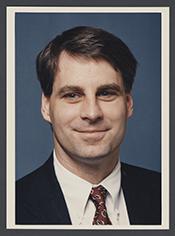
Historical · U.S. House · Indiana · District 3
Timothy Roemer
Former U.S. Representative · Indiana District 3 · 1991–2003 · Democratic
Timothy Roemer represented Indiana's District 3 in the United States House of Representatives (1991–2003) for the Democratic party. The page below collects sourced biographical facts, term history, committee roles, and provenance for Roemer.
Bioguide ID: R000385
Key facts
- Full name
- Timothy Roemer
- State
- Indiana
- District
- District 3
- Party
- Democratic
- House service
- 1991–2003
- First House term
- 1991
- Status
- Left office
- Current term ends
- —
- Born
- 1956
- Bioguide ID
- R000385
- Committee assignments
- —
- Dataset version
- 1.20260605
Biographical narrative
980 words · sourced from the Wikipedia REST extract
Tim Roemer is a former U.S. Representative from Indiana, having served in the House of Representatives from 1991 to 2003. A member of the Democratic Party, Roemer represented Indiana's 3rd congressional district during his tenure in Congress. Following his legislative career, he transitioned into diplomatic roles and leadership positions in various organizations focused on national security and education.
Early life and career
Tim Roemer was born on October 30, 1956, in South Bend, Indiana. He grew up in a family deeply involved in education; his grandfather was a philosophy professor at the University of Notre Dame, while his grandmother worked as an elementary school teacher. Roemer's parents also had ties to Notre Dame, with his father serving as the dean of students and his mother coordinating volunteer activities. Additionally, his uncle was an FBI agent known for his work against organized crime, which may have influenced Roemer's later interests in public service and national security.
Roemer completed his secondary education at Penn High School, graduating in 1975. To finance his college education, he held various jobs starting at the age of 14. He attended the University of California, San Diego, where he earned a Bachelor of Arts degree in 1979. Roemer continued his academic pursuits at the University of Notre Dame, obtaining both a Master of Arts and a Doctor of Philosophy degree. His doctoral dissertation, completed in 1985, focused on public personnel policy, specifically the Senior Executive Service.
Roemer's entry into politics began while he was still in college, as he worked on the staff of U.S. Representative John Brademas of Indiana from 1978 to 1979. After completing his doctorate, he served as a staff member for U.S. Senator Dennis DeConcini of Arizona from 1985 to 1989. This experience laid the groundwork for his future political career.
House tenure
In 1990, Roemer successfully ran for the U.S. House of Representatives, representing Indiana's 3rd congressional district, a seat previously held by his former boss, John Brademas. He was elected as a Democrat and served a total of six terms in Congress from 1991 until he chose not to seek reelection in 2002. During his time in the House, Roemer was a member of several important congressional committees, including the Permanent Select Committee on Intelligence, the Committee on Education and Workforce, and the Committee on Science, Space, and Technology.
Throughout his congressional career, Roemer was known for his active participation in various legislative initiatives. He supported trade agreements such as the General Agreement on Tariffs and Trade (GATT) and the African Growth and Opportunity Act, while opposing the North American Free Trade Agreement (NAFTA) due to concerns about its impact on American jobs. He also voted against the presidential fast-track trade promotion authority, advocating for stricter enforcement of existing trade agreements.
Education reform was a significant focus of Roemer's legislative efforts. He was the principal author of the Ed-Flex bill, which aimed to encourage states to adopt innovative approaches to education. Additionally, he sponsored the "Transition to Teaching" bill, which sought to address teacher shortages by facilitating the recruitment and training of professionals from other fields to become educators. Roemer played a key role in the reauthorization of the Higher Education Act of 1965, which included provisions to reduce student loan interest rates, increase Pell Grants, and expand funding for teacher training.
Roemer was also a strong advocate for national service programs, serving as a principal sponsor of the AmeriCorps initiative. He co-authored legislation to expand Head Start services, aimed at providing childcare for women transitioning from welfare to work. His commitment to education extended to special education, as he co-wrote legislation to reauthorize the Individuals with Disabilities Education Act and introduced amendments to support teacher certification for professionals entering the education field.
In his final term, Roemer was instrumental in the passage of the No Child Left Behind Act, advocating for full funding of the program to ensure its success. He was also a proponent of national security measures, being one of the first members of Congress to call for the establishment of a Cabinet-level department to oversee national security. Although he initially supported the creation of the Department of Homeland Security, he later opposed certain revisions proposed by the Bush administration, citing concerns about bureaucratic inefficiencies.
Legislative focus and committees
During his tenure in the House, Roemer's legislative focus encompassed a range of issues, with a particular emphasis on education and national security. His work on education reform included initiatives aimed at improving teacher recruitment, enhancing funding for educational programs, and promoting innovative teaching methods. Roemer's commitment to education was evident in his sponsorship of various bills designed to address teacher shortages and improve access to quality education for all students.
In addition to his education-related efforts, Roemer was actively involved in national security issues. He was an original sponsor of legislation aimed at creating the Department of Homeland Security and advocated for the establishment of a civilian reserve corps to enhance the United States Intelligence Community's capabilities. His involvement in national security extended to his role as a principal sponsor of bioterrorism legislation and his support for the creation of the 9/11 Commission, which investigated the terrorist attacks on the United States.
Roemer's moderate political stance allowed him to navigate complex issues, balancing liberal and conservative viewpoints. He was recognized for his bipartisan approach, particularly in foreign policy matters, while maintaining more conservative positions on social issues. His political career was marked by a willingness to engage with colleagues across the aisle to achieve legislative goals.
After leaving Congress, Roemer continued to contribute to national security discussions and education initiatives in various capacities, including serving as the United States Ambassador to India from 2009 to 2011 and holding leadership positions in think tanks and non-profit organizations. His post-electoral career reflects his ongoing commitment to public service and his expertise in national security and education policy.
Notable legislation
Sponsored and co-sponsored legislation for Timothy Roemer is pending operator curation. The biographical narrative above carries the same provenance trail until per-bill rows are written.
Sources
- [1]https://en.wikipedia.org/wiki/Tim_RoemerWikipedia · retrieved 2026-06-05
Notable quotes
Sourced quotes for Timothy Roemer are pending operator curation. Narrative-scope provenance remains attached below.
Sources
- [1]https://en.wikipedia.org/wiki/Tim_RoemerWikipedia · retrieved 2026-06-05
Key positions
Curated policy positions for Timothy Roemer are pending operator review. The biographical narrative above carries the same provenance trail until per-topic positions are written.
Sources
- [1]https://en.wikipedia.org/wiki/Tim_RoemerWikipedia · retrieved 2026-06-05
Terms served
- 1991–1993U.S. House · Term 1 · Democratic
- 1993–1995U.S. House · Term 2 · Democratic
- 1995–1997U.S. House · Term 3 · Democratic
- 1997–1999U.S. House · Term 4 · Democratic
- 1999–2001U.S. House · Term 5 · Democratic
- 2001–2003U.S. House · Term 6 · Democratic
Sources & provenance
Every attributable claim above carries a per-section [N] marker that resolves to the corresponding URL below. Each entry records the upstream provider, the canonical URL, and the timestamp at which the source was retrieved by the ingest pipeline.
Key facts
- https://bioguide.congress.gov/search/bio/R000385bioguide · retrieved 2026-06-05
- https://www.govtrack.us/congress/members/400520govtrack · retrieved 2026-06-05
Biographical narrative
- https://en.wikipedia.org/wiki/Tim_Roemerwikipedia · retrieved 2026-06-05
Find your representative
Every U.S. state elects representatives by district. Browse Indiana’s delegation, the full former-representative roster, or explore the role and term length.
Related on The Candidate
- Preceded by John HilerEarlier holder of the Indiana District 3 House seat · Republican.Open
- Adam Benjamin Jr.Former U.S. Representative · Indiana District 1 · DemocraticOpen
- Alvin HoveyFormer U.S. Representative · Indiana District 1 · RepublicanOpen
- Arthur TaylorFormer U.S. Representative · Indiana District 1 · DemocraticOpen
- Benoni FullerFormer U.S. Representative · Indiana District 1 · DemocraticOpen
- Democratic PartyFederal candidates and office holders on the Democratic line.Open