
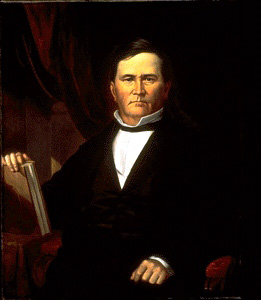
Historical · U.S. House · Indiana · District 6
David Wallace
Former U.S. Representative · Indiana District 6 · 1841–1843 · Whig
David Wallace represented Indiana's District 6 in the United States House of Representatives (1841–1843) for the Whig party. The page below collects sourced biographical facts, term history, committee roles, and provenance for Wallace.
Bioguide ID: W000076
Key facts
- Full name
- David Wallace
- State
- Indiana
- District
- District 6
- Party
- Whig
- House service
- 1841–1843
- First House term
- 1841
- Status
- Left office
- Current term ends
- —
- Born
- 1799
- Bioguide ID
- W000076
- Committee assignments
- —
- Dataset version
- 1.20260606
Biographical narrative
807 words · sourced from the Wikipedia REST extract
David Wallace was a prominent political figure in the early 19th century, serving as the U.S. Representative for Indiana's 6th congressional district and as the sixth governor of Indiana. A member of the Whig Party, he played a significant role in the state's political landscape during a tumultuous economic period marked by the Panic of 1837. Wallace's career spanned various public offices, including the Indiana House of Representatives and the Lieutenant Governorship, before he transitioned to Congress. His legislative and executive actions were influenced by the economic challenges of his time, particularly concerning state finances and internal improvements.
Early life and career
David Wallace was born on April 24, 1799, in Mifflin County, Pennsylvania, as the eldest of seven children in the family of Andrew and Eleanor Wallace. His father, Andrew, was a surveyor and tavern owner who developed a close friendship with William Henry Harrison during their service in the War of 1812. This connection would later benefit Wallace's political career. The family relocated to Ohio near Cincinnati during Wallace's childhood and subsequently moved to Brookville, Indiana, in 1817.
Wallace pursued higher education at Miami College before entering the United States Military Academy at West Point, where he graduated in 1821. Following his graduation, he served as a lieutenant of artillery and briefly taught mathematics at West Point before resigning his commission after a year. He later attained the rank of captain and colonel in the 7th Regiment of the Indiana Militia.
After leaving military service, Wallace returned to Brookville, where he began studying law under Judge Miles C. Eggleston. He was admitted to the bar in 1823 and soon entered into a law practice with Congressman John Test. In 1824, he married Esther French Test, with whom he had four children, including Lew Wallace, who would later gain fame as the author of "Ben-Hur: A Tale of the Christ" and serve as the Governor of New Mexico Territory. Following the death of his first wife in 1836, Wallace married Zerelda Gray Sanders, a prominent figure in the temperance movement, and they had six children together.
Wallace's political career began in earnest when he was elected to the Indiana House of Representatives in 1828, serving until 1831. He then became the sixth Lieutenant Governor of Indiana, elected alongside Governor Noah Noble. During his tenure as Lieutenant Governor, he advocated for the establishment of the Bank of Indiana and gained recognition for his oratory skills. His support for internal improvement projects positioned him favorably with the electorate, although these initiatives would later contribute to significant financial challenges for the state.
House tenure
David Wallace's congressional career began when he was elected to the U.S. House of Representatives, representing Indiana's 6th congressional district. His first term commenced in 1841, during a period marked by economic instability and political realignment. Wallace's tenure in the House was relatively brief, concluding on March 3, 1843. Although he served only one term, his experience in Congress was informed by his previous roles in state government and his understanding of the financial issues facing Indiana and the nation.
After his time in Congress, Wallace continued to be active in public service. He became the chairman of the Indiana Whig Party, where he played a role in shaping the party's direction and policies during a time of political change. His involvement in state politics did not end with his congressional service; he later transitioned to a judicial role, serving as a state judge until his death in 1859.
Legislative focus and committees
During his time in the U.S. House of Representatives, David Wallace's legislative focus was likely influenced by his background in state governance and his experiences with financial crises. While specific details about the bills he sponsored or the committees he served on are not documented, it can be inferred that his previous advocacy for internal improvements and financial management would have shaped his priorities in Congress.
Wallace's earlier political career was marked by his support for infrastructure projects aimed at enhancing Indiana's economic prospects. However, the financial difficulties that arose during his governorship due to the Panic of 1837 would have informed his understanding of the importance of fiscal responsibility and prudent governance. His experiences in the Indiana General Assembly and as Lieutenant Governor likely provided him with insights into the challenges faced by states during economic downturns, which could have influenced his legislative approach in the House.
In summary, David Wallace's career spanned various roles in public service, from local legislator to U.S. Representative and state judge. His tenure in the House of Representatives was a continuation of his commitment to public service, shaped by the economic realities of his time and his previous experiences in state government. Wallace's legacy is intertwined with the political and economic history of Indiana during a critical period in the state's development.
Notable legislation
Sponsored and co-sponsored legislation for David Wallace is pending operator curation. The biographical narrative above carries the same provenance trail until per-bill rows are written.
Sources
- [1]https://en.wikipedia.org/wiki/David_Wallace_(Indiana_politician)Wikipedia · retrieved 2026-06-06
Notable quotes
Sourced quotes for David Wallace are pending operator curation. Narrative-scope provenance remains attached below.
Sources
- [1]https://en.wikipedia.org/wiki/David_Wallace_(Indiana_politician)Wikipedia · retrieved 2026-06-06
Key positions
Curated policy positions for David Wallace are pending operator review. The biographical narrative above carries the same provenance trail until per-topic positions are written.
Sources
- [1]https://en.wikipedia.org/wiki/David_Wallace_(Indiana_politician)Wikipedia · retrieved 2026-06-06
Terms served
- 1841–1843U.S. House · Term 1 · Whig
Sources & provenance
Every attributable claim above carries a per-section [N] marker that resolves to the corresponding URL below. Each entry records the upstream provider, the canonical URL, and the timestamp at which the source was retrieved by the ingest pipeline.
Key facts
- https://bioguide.congress.gov/search/bio/W000076bioguide · retrieved 2026-06-06
- https://www.govtrack.us/congress/members/411255govtrack · retrieved 2026-06-06
Biographical narrative
- https://en.wikipedia.org/wiki/David_Wallace_(Indiana_politician)wikipedia · retrieved 2026-06-06
Find your representative
Every U.S. state elects representatives by district. Browse Indiana’s delegation, the full former-representative roster, or explore the role and term length.
Related on The Candidate
- Preceded by William HerodEarlier holder of the Indiana District 6 House seat · Whig.Open
- Succeeded by Willis GormanLater holder of the Indiana District 6 House seat · Democratic.Open
- Adam Benjamin Jr.Former U.S. Representative · Indiana District 1 · DemocraticOpen
- Alvin HoveyFormer U.S. Representative · Indiana District 1 · RepublicanOpen
- Arthur TaylorFormer U.S. Representative · Indiana District 1 · DemocraticOpen
- Benoni FullerFormer U.S. Representative · Indiana District 1 · DemocraticOpen