
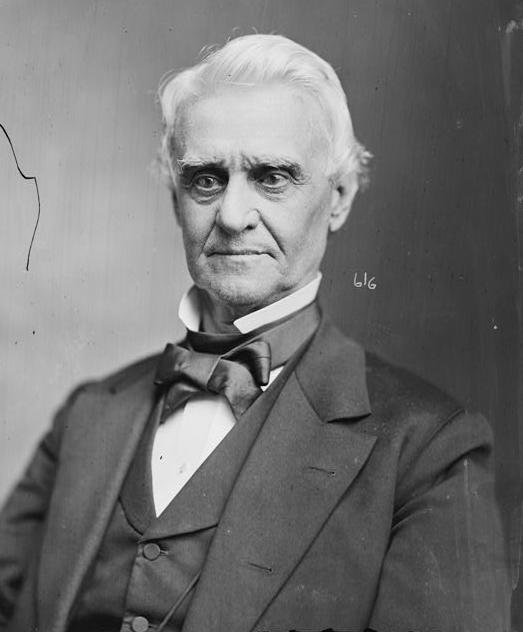
Historical · U.S. House · Indiana · District 7
Richard Thompson
Former U.S. Representative · Indiana District 7 · 1841–1849 · Whig
Richard Thompson represented Indiana's District 7 in the United States House of Representatives (1841–1849) for the Whig party. The page below collects sourced biographical facts, term history, committee roles, and provenance for Thompson.
Bioguide ID: T000214
Key facts
- Full name
- Richard Thompson
- State
- Indiana
- District
- District 7
- Party
- Whig
- House service
- 1841–1849
- First House term
- 1841
- Status
- Left office
- Current term ends
- —
- Born
- 1809
- Bioguide ID
- T000214
- Committee assignments
- —
- Dataset version
- 1.20260606
Biographical narrative
881 words · sourced from the Wikipedia REST extract
Richard Thompson was a U.S. Representative from Indiana who served two non-consecutive terms in the House of Representatives during the early to mid-19th century. A member of the Whig Party, Thompson's political career spanned several decades, during which he also held various positions in state and federal government, including Secretary of the Navy under President Rutherford B. Hayes. His contributions to American politics were marked by his involvement in significant political movements of his time, as well as his role in shaping the legislative landscape in Indiana.
Early life and career
Richard Wigginton Thompson was born on June 9, 1809, in Culpeper County, Virginia. In 1831, he relocated from Virginia to Louisville, Kentucky, before ultimately settling in Lawrence County, Indiana. This move marked the beginning of his long-term engagement with the state of Indiana, where he would establish his career and political base. In Lawrence County, Thompson took on various roles; he worked as a schoolteacher, operated a store, and pursued legal studies during the evenings. His dedication to education and self-improvement led to his admission to the bar in 1834, after which he began practicing law in Bedford, Indiana.
Thompson's early political career began in the Indiana General Assembly, where he served four terms from 1834 to 1838. His legislative experience included a brief tenure as President pro tempore of the Indiana Senate and a short period as acting Lieutenant Governor. These roles provided him with valuable insights into the workings of state governance and laid the groundwork for his future political endeavors.
House tenure
Thompson's entry into federal politics came during a period of significant national change. He was a staunch supporter of William Henry Harrison during the presidential election of 1840, which helped solidify his standing within the Whig Party. Following this, he was elected to the United States House of Representatives, where he served from 1841 to 1843 and again from 1847 to 1849. His time in Congress was characterized by the political turbulence of the era, as the nation grappled with issues such as slavery and immigration.
During his congressional tenure, Thompson was part of a shifting political landscape. The Whig Party, which had been a dominant force, began to decline in the 1850s, leading Thompson and some of his colleagues to realign with the American Party, commonly known as the Know Nothing Party. This shift was influenced by their concerns regarding increased immigration from Ireland and Germany, as well as the party's stance against slavery. Thompson's involvement in this political realignment reflected the broader societal tensions of the time.
In the 1860 presidential election, Thompson played a significant role in organizing the Constitutional Union Party in Indiana. Initially, the party supported John McLean but later rallied behind John Bell. Thompson's engagement in this third-party effort demonstrated his commitment to preventing a Democratic victory in the state. However, by August of that year, he shifted his support to Abraham Lincoln, prioritizing party unity and the broader goals of the Republican Party.
After the Civil War, Thompson continued to serve in various capacities within Indiana's political framework. He was appointed as a judge of the 18th Circuit Court from 1867 to 1869, further solidifying his legal and political credentials. His active participation in Republican politics included serving as the Platform Committee chairman at the 1868 Republican National Convention, where he contributed to shaping the party's platform. He also played a role in subsequent conventions, nominating candidates for various offices and demonstrating his ongoing influence within the party.
Legislative focus and committees
Throughout his time in Congress, Thompson's legislative focus aligned with the priorities of the Whig Party and later the Republican Party. His early support for Harrison and his involvement in the American Party highlighted his engagement with the pressing issues of his time, particularly those related to immigration and slavery. As a member of the House, he participated in discussions and debates that shaped the national dialogue on these critical topics.
Thompson's committee assignments and legislative initiatives during his congressional terms are less documented, but his active involvement in state politics and his leadership roles within the Republican Party suggest that he was engaged in significant legislative activities. His transition from the Whig Party to the American Party and eventually to the Republican Party illustrates his adaptability to the evolving political landscape of the 19th century.
After his congressional career, Thompson's appointment as Secretary of the Navy under President Hayes marked a significant transition in his public service. Although his tenure in this role was characterized by challenges and controversies, it underscored his continued influence in national politics. His subsequent resignation from the Cabinet to pursue opportunities with the Panama Canal Company further illustrated the complexities of political life during this period.
In summary, Richard Thompson's career spanned several important phases in American history, reflecting the dynamic nature of U.S. politics in the 19th century. His contributions to both state and federal government, along with his involvement in various political movements, positioned him as a notable figure in Indiana's political landscape. After retiring from public life, he lived in Indiana until his death on February 9, 1900. His legacy includes not only his political achievements but also the USS Thompson (DD-305), a destroyer named in his honor, recognizing his service to the nation.
Notable legislation
Sponsored and co-sponsored legislation for Richard Thompson is pending operator curation. The biographical narrative above carries the same provenance trail until per-bill rows are written.
Sources
- [1]https://en.wikipedia.org/wiki/Richard_W._ThompsonWikipedia · retrieved 2026-06-06
Notable quotes
Sourced quotes for Richard Thompson are pending operator curation. Narrative-scope provenance remains attached below.
Sources
- [1]https://en.wikipedia.org/wiki/Richard_W._ThompsonWikipedia · retrieved 2026-06-06
Key positions
Curated policy positions for Richard Thompson are pending operator review. The biographical narrative above carries the same provenance trail until per-topic positions are written.
Sources
- [1]https://en.wikipedia.org/wiki/Richard_W._ThompsonWikipedia · retrieved 2026-06-06
Terms served
- 1841–1843U.S. House · Term 1 · Whig
- 1847–1849U.S. House · Term 2 · Whig
Sources & provenance
Every attributable claim above carries a per-section [N] marker that resolves to the corresponding URL below. Each entry records the upstream provider, the canonical URL, and the timestamp at which the source was retrieved by the ingest pipeline.
Key facts
- https://bioguide.congress.gov/search/bio/T000214bioguide · retrieved 2026-06-06
- https://www.govtrack.us/congress/members/410793govtrack · retrieved 2026-06-06
Biographical narrative
- https://en.wikipedia.org/wiki/Richard_W._Thompsonwikipedia · retrieved 2026-06-06
Find your representative
Every U.S. state elects representatives by district. Browse Indiana’s delegation, the full former-representative roster, or explore the role and term length.
Related on The Candidate
- Preceded by Tilghman HowardEarlier holder of the Indiana District 7 House seat · Democratic.Open
- Succeeded by John DavisLater holder of the Indiana District 7 House seat · Anti-Lecompton Democrat.Open
- Adam Benjamin Jr.Former U.S. Representative · Indiana District 1 · DemocraticOpen
- Alvin HoveyFormer U.S. Representative · Indiana District 1 · RepublicanOpen
- Arthur TaylorFormer U.S. Representative · Indiana District 1 · DemocraticOpen
- Benoni FullerFormer U.S. Representative · Indiana District 1 · DemocraticOpen